
SaGeminieTech

Taiwan Semiconductor Manufacturing (TSM) – Company Overview, Business Model & Stock Analysis

Taiwan Semiconductor Manufacturing Company Limited (NYSE: TSM; Taiwan Stock Exchange: 2330), or TSMC, is a Hsinchu, Taiwan-based semiconductor company that describes its business model as a “dedicated semiconductor foundry”: it manufactures chips using its own processes for customers, based on the customers’ designs. This page profiles the listed company and its New York Stock Exchange American depositary shares (ADSs): it brings together TradingView market widgets, financial reference data taken from TSMC’s SEC filings, and a dated, clearly labelled third-party Shariah-screening snapshot for research purposes. TSMC reports in New Taiwan dollars (NT$) and its fiscal year is the calendar year; each ADS represents five common shares. Its common shares are listed on the Taiwan Stock Exchange, so this NYSE page covers the ADS listing of a foreign issuer. Widgets update dynamically; the tables and screening notes are static and carry their own reporting periods and dates. For sector context see SaGeminieTech’s Semiconductors hub, the AI and semiconductor sector analysis and the NYSE hub.

Taiwan Semiconductor Manufacturing Company (TSM) Symbol Information

TSMC’s American depositary shares trade on the New York Stock Exchange (NYSE) under the ticker symbol TSM, while its common shares trade on the Taiwan Stock Exchange under 2330; each ADS represents five common shares. The panel below summarizes the current symbol — price, exchange and identifying details — as a quick reference before reviewing deeper fundamentals and charts.


Market information shown here may update dynamically throughout the trading session and reflects the ADS, not the Taiwan-listed common shares. Verify any material figure through TSMC’s official filings and its investor relations site.

TSM Advanced Stock Chart

The interactive chart below displays TSM price and volume history across time intervals from intraday to multi-year views. Developments that TSMC’s own filings highlight include capital expenditures of NT$1,272 billion in 2025 with a 2026 expectation of US$52–56 billion, a Board approval on August 11, 2026 of capital appropriations of approximately US$29.4 billion, and the formation of a joint venture with Sony Semiconductor Solutions for image sensors. Customer concentration, technology transitions, tariffs and export controls, currency movements and capital spending can also influence sentiment, so price history is one input among several and should be read alongside fundamentals. See also SaGeminieTech’s Artificial Intelligence hub.


Chart patterns are not guarantees of future performance. Price movements may reflect quarterly results, customer demand, capital-spending plans, currency movements, trade and export policy or broader sentiment toward semiconductor stocks. ADS prices are quoted in U.S. dollars while results are reported in NT$.

Taiwan Semiconductor Manufacturing Company Financial Statements and Fundamentals

Key figures worth examining for TSMC include net revenue and its mix by platform and technology, gross and operating margin, capital expenditure, cash generation and customer concentration. In 2025 net revenue was NT$3,809 billion (US$121.4 billion at the company’s convenience translation), up 31.6% from NT$2,894 billion in 2024 (calculated); gross margin, calculated from reported figures, was 59.9% and operating margin 50.8%. Net cash generated by operating activities was NT$2,275 billion against NT$1,272 billion of acquisitions of property, plant and equipment, and cash dividends paid were NT$467 billion (20-F). High Performance Computing was 58% of 2025 net revenue, Smartphone 29%, and 3-, 5- and 7-nanometer processes together were about 74% of wafer revenue (calculated from rounded reported shares).

The most recent interim statements cover the six months ended June 30, 2026 and follow Taiwan-IFRSs. Second-quarter net revenue was NT$1,270 billion versus NT$934 billion a year earlier, up 36.0% (calculated), and income from operations was NT$767 billion; the Board approved a cash dividend of NT$7.0 per share for the second quarter, payable January 7, 2027, after NT$7.0 per share for the first quarter, payable October 8, 2026 (Forms 6-K). Cash and cash equivalents were NT$3,134 billion at June 30, 2026, and noncurrent bonds payable were NT$815 billion (tables below).

TSMC reported financial figures — NT$ millions, years ended December 31 (IFRS Accounting Standards as issued by the IASB)
Metric 2023 2024 2025
Net revenue (reported) 2,161,736 2,894,308 3,809,054
Cost of revenue (reported) 986,625 1,269,954 1,527,760
Gross profit (reported) 1,175,111 1,624,354 2,281,294
Research and development (reported) 182,370 204,182 246,427
General and administrative (reported) 60,873 83,745 82,304
Marketing (reported) 10,591 13,144 16,918
Income from operations (reported) 921,466 1,322,053 1,936,092
Net income (reported) 851,028 1,157,524 1,695,125
Net income attributable to shareholders of the parent (reported) 851,740 1,158,380 1,697,604
Diluted earnings per share, NT$ (reported) 32.85 44.67 65.47
Net cash generated by operating activities (reported) 1,241,967 1,826,177 2,274,976
Acquisitions of property, plant and equipment (reported) 949,817 956,006 1,272,410
Cash dividends paid (reported) 291,722 363,055 466,779
Gross margin (calculated: gross profit ÷ net revenue) 54.4% 56.1% 59.9%
Operating margin (calculated: income from operations ÷ net revenue) 42.6% 45.7% 50.8%
Free cash flow (calculated: operating cash flow − acquisitions of property, plant and equipment) 292,150 870,171 1,002,565

Source: TSMC Annual Report on Form 20-F for the year ended December 31, 2025 (SEC filing, filed 2026-04-16); 2023 and 2024 comparatives as presented in that filing. The company also presents US-dollar amounts for the convenience of readers (for example 2025 net revenue of US$121,423 million and net income attributable to shareholders of the parent of US$54,116 million); this page uses the New Taiwan dollar (NT$) amounts as reported. Rows marked “calculated” are derived by SaGeminieTech from the reported inputs shown and are not company-reported measures. Amounts are in millions of NT$ except per-share amounts.

TSMC interim results — NT$ millions, quarter and six months ended June 30 (Taiwan-IFRSs, unaudited, reviewed)
Line item Q2 2026 Q2 2025 Six months 2026 Six months 2025
Net revenue 1,270,380 933,792 2,404,484 1,773,046
Gross profit 860,311 547,369 1,611,606 1,040,764
Research and development 73,146 61,280 — —
Income from operations 766,603 463,424 1,425,569 870,504
Net income (including non-controlling interests) 706,781 397,493 1,279,582 758,226
Net revenue growth, year over year (calculated) 36.0% — 35.6% —
Gross margin (calculated) 67.7% 58.6% 67.0% 58.7%
Operating margin (calculated) 60.3% 49.6% 59.3% 49.1%

Source: consolidated financial statements for the six months ended June 30, 2026 and 2025, furnished under Form 6-K (SEC filing, filed 2026-08-14), which are prepared under Taiwan-IFRSs (IFRS as adopted in the Republic of China) and are shown in NT$ thousands in the filing, converted here to millions. The Board’s resolution of August 11, 2026 reports second-quarter net income attributable to shareholders of the parent of NT$706.56 billion and diluted earnings per share of NT$27.25 (Form 6-K). Basis differs from the annual table above, so small differences between the two sets of statements can occur.

TSMC selected balance-sheet measures — NT$ millions (Taiwan-IFRSs, unaudited at June 30, 2026)
Measure As of Jun 30, 2026 As of Dec 31, 2025
Cash and cash equivalents (reported) 3,134,218 2,767,856
Notes and accounts receivable, net (reported) 435,762 279,052
Inventories (reported) 385,525 288,109
Property, plant and equipment (reported) 4,302,880 3,691,841
Total assets (reported) 9,375,655 7,933,024
Bonds payable, noncurrent (reported) 815,037 856,228
Long-term bank loans, noncurrent (reported) 49,227 39,834
Long-term liabilities, current portion (reported) 167,410 136,926
Total liabilities (reported) 2,901,184 2,472,229
Total equity (reported) 6,474,471 5,460,795

Source: consolidated statements of financial position in the Form 6-K filed 2026-08-14 (filing). The December 31, 2025 column is as presented in that interim report, which follows Taiwan-IFRSs and differs slightly from the amounts in the 20-F (for example, total assets of NT$7,932,843 million there). Capital expenditure guidance is a company expectation, not a result: the 20-F says 2026 capital expenditures are expected to be between US$52 billion and US$56 billion and may be adjusted.


Financial panels should be read across multiple reporting periods rather than a single quarter, and checked against TSMC’s filings: the 2025 Form 20-F and the second-quarter 2026 Form 6-K. Amounts are in NT$; ADS prices are in U.S. dollars, so the two are not directly comparable without currency and ADS-ratio conversion.

Taiwan Semiconductor Manufacturing Company Company Profile and Business Model

TSMC says it manufactures semiconductors using its own processes for customers, based on customer designs, and that it offers a range of wafer-fabrication processes together with design services, mask making, advanced silicon stacking and packaging (TSMC 3DFabric), and testing. In its August 2026 Board release the company says it was founded in 1987, pioneered the pure-play foundry model, and in 2025 deployed 305 distinct process technologies and manufactured 12,682 products for 534 customers. Its corporate headquarters are in Hsinchu Science Park, Taiwan.

The 20-F says the company operates one 150mm fab, six 200mm fabs, nine 300mm fabs and seven advanced backend fabs: nine fabs are in Hsinchu Science Park, two in the Central Taiwan Science Park, seven in the Southern Taiwan Science Park, two in the United States, and one each in Shanghai, Nanjing and Japan. That is 18 of 23 facilities in Taiwan (calculated from the filing). In November 2024 its subsidiary TSMC Arizona entered agreements with the U.S. Department of Commerce for CHIPS Act incentives of up to US$6.6 billion in direct funding and up to US$5 billion of proposed loans.

C.C. Wei is Chairman and Chief Executive Officer (20-F); Y.P. Chyn and Y.J. Mii are Executive Vice Presidents and Co-Chief Operating Officers; and Wendell Huang is Senior Vice President and Chief Financial Officer (signatory of the Forms 6-K). Because TSMC is a foreign private issuer, it files an annual report on Form 20-F and furnishes interim information on Form 6-K rather than filing Forms 10-K and 10-Q. This section profiles the listed company; for how a chipmaking-equipment supplier to the industry is profiled, see SaGeminieTech’s ASML company profile.

TSMC net revenue by platform — NT$ millions, years ended December 31
Platform 2025 2024 2023 Share 2025 (reported) Share 2024 (reported) Share 2023 (reported)
High Performance Computing 2,192,931 1,476,891 934,769 58% 51% 43%
Smartphone 1,110,816 1,005,130 814,914 29% 35% 38%
Internet of Things 191,047 165,516 161,917 5% 6% 8%
Automotive 186,667 139,323 133,654 5% 5% 6%
Digital Consumer Electronics 47,997 47,961 47,000 1% 1% 2%
Others 79,596 59,487 69,482 2% 2% 3%
Total 3,809,054 2,894,308 2,161,736 100% 100% 100%

Source: 20-F, “Markets and Customers” (filing). Wafer fabrication accounted for approximately 86% of 2025 net revenue according to the filing; the rest was mainly packaging and testing services, mask making, design and royalty income.

TSMC wafer revenue by process technology — share of total wafer revenue
Process technology 2025 2024 2023
3-nanometer 24% 18% 6%
5-nanometer 36% 34% 33%
7-nanometer 14% 17% 19%
3-, 5- and 7-nanometer combined (calculated from the rounded shares) 74% 69% 58%

Source: 20-F (filing). The company’s table also lists older nodes (16-nanometer and above), which made up the balance. Percentages are as reported and rounded, so the combined row can differ by a point from the company’s unrounded figures.

TSMC net revenue by customer headquarters location — NT$ millions, years ended December 31
Region 2025 2024 2023 Share 2025 (reported)
North America 2,875,270 2,031,326 1,470,215 75%
Asia Pacific (excluding China and Japan) 329,269 284,308 174,947 9%
China 327,503 331,673 267,154 9%
Japan 150,428 144,240 132,072 4%
EMEA 126,584 102,761 117,348 3%
Total 3,809,054 2,894,308 2,161,736 100%

Source: 20-F (filing). TSMC categorizes net revenue mainly by the country where each customer is headquartered, which may differ from where products are shipped or ordered. The company reports that its ten largest customers accounted for approximately 70%, 76% and 78% of net revenue in 2023, 2024 and 2025, its largest customer for 25%, 22% and 19%, and its second largest customer for 11%, 12% and 17%.


TSMC’s revenue is concentrated in High Performance Computing (58% of 2025 net revenue), in advanced nodes (about 74% of wafer revenue at 3-, 5- and 7-nanometer, calculated), in customers headquartered in North America (75%), and in a small number of large customers (ten customers were about 78% of 2025 net revenue). For the wider industry context see SaGeminieTech’s Semiconductors hub.

Taiwan Semiconductor Manufacturing Company Technical Analysis

This widget summarizes technical indicators — moving averages, oscillators and overall signal counts — for TSM (the NYSE-listed ADS) across selected timeframes.


Technical signals change as new data arrives and should not be treated as a recommendation. Consider them together with fundamentals, currency effects between the NT$ and the U.S. dollar, customer concentration and the timing of quarterly results.

Taiwan Semiconductor Manufacturing Company Historical Stock-Price Overview

The overview below covers TSM price and percentage change across several date ranges, with volume and moving-average context. TSMC’s reported net revenue rose from NT$2,162 billion in 2023 to NT$3,809 billion in 2025 (table above), while operating margin, calculated from reported figures, rose from 42.6% to 50.8% over the same period. Price history is best interpreted alongside those developments, the ADS structure and currency effects, rather than in isolation.


Historical performance does not guarantee future results and reflects a specific past period only.

Taiwan Semiconductor Manufacturing Company Shariah Compliance Snapshot

The snapshot below reflects third-party Shariah screening for TSM based on AAOIFI-derived methodology, as reported by two providers, Zoya and Musaffa. Both public pages were read on 2026-09-21. Screening results change as market capitalization, debt, cash and non-permissible income change — treat this as a starting reference, not a permanent certification. Neither provider’s screen is an AAOIFI certification, and each applies its own thresholds.

Current StatusScreened as Shariah-compliant by Zoya (AAOIFI standard; last updated September 2026) and as HALAL with a B- rating by Musaffa (AAOIFI-based methodology; last updated August 4, 2026, 2026 Q2 report). The two sources agree as of 2026-09-21 — independent current verification required
Debt / Market CapManual verification required (not disclosed on Zoya’s public page; Musaffa’s detailed report is behind login). For reference, TSMC’s June 30, 2026 balance sheet reports noncurrent bonds payable of NT$815.0 billion and noncurrent long-term bank loans of NT$49.2 billion — re-verify the latest status before relying on it
Cash + Securities / Market CapManual verification required (not disclosed on Zoya’s public page; Musaffa’s detailed report is behind login)
Non-Permissible IncomeZoya reports revenue of NT$3,848,511 million and interest income of NT$94,335 million, 2.45% of the combined total, for the fiscal year ended December 31, 2025. These differ from the 20-F’s net revenue of NT$3,809,054 million and interest income of NT$105,739 million, so the basis of Zoya’s ratio cannot be verified from public data — manual verification required
Screening BasisAAOIFI Standard (per Zoya’s and Musaffa’s stated methodologies)
Last ReviewedZoya last updated September 2026 (cites the fiscal year ended December 31, 2025); Musaffa last updated August 4, 2026 (2026 Q2 report). The two providers may use different reporting periods. Both pages were read on 2026-09-21; figures were not independently re-verified on this page
Shariah compliance can change when market capitalization, debt, cash, interest-bearing assets or non-permissible income changes. This snapshot reflects two third-party providers (Zoya and Musaffa) and is not a permanent certification. Confirm the latest status through Zoya’s Shariah screening, Musaffa’s Shariah screening or a qualified Shariah adviser before making an investment decision. For general screening context see SaGeminieTech’s halal stocks guide.

Latest Taiwan Semiconductor Manufacturing Company News

The feed below may include dynamically updated market stories related to TSMC.


Distinguish between official TSMC announcements, SEC filings, earnings releases, analyst commentary and general media coverage. Verify material news through TSMC’s investor relations page and its SEC filings.

Key Investor Considerations for Taiwan Semiconductor Manufacturing Company

Potential Strengths

  • Net revenue of NT$3,809 billion in 2025, up 31.6% from 2024 (calculated), and NT$1,270 billion in the second quarter of 2026, up 36.0% year over year (calculated)
  • Gross margin of 59.9% and operating margin of 50.8% in 2025, up from 54.4% and 42.6% in 2023 (calculated from reported figures)
  • Net cash generated by operating activities of NT$2,275 billion in 2025 and cash and cash equivalents of NT$3,134 billion at June 30, 2026
  • High Performance Computing at 58% of 2025 net revenue and 3-, 5- and 7-nanometer processes at about 74% of wafer revenue (reported shares, summed)
  • A wide customer and product base according to the company: 534 customers, 305 process technologies and 12,682 products in 2025

Material Risks

  • Customer concentration: the ten largest customers were approximately 78% of 2025 net revenue, the largest 19% and the second largest 17%
  • Very high capital intensity: acquisitions of property, plant and equipment were NT$1,272 billion in 2025, 2026 capital expenditures are expected at US$52–56 billion, and the Board approved about US$29.4 billion of appropriations on August 11, 2026
  • Geopolitical, tariff and export-control exposure: the 20-F says political and trade tensions among major economies have resulted or may result in tariffs, export controls and other measures that have been particularly impactful to the semiconductor industry; 18 of its 23 facilities are in Taiwan (calculated)
  • Operational risk from natural and man-made disasters, utilities disruption and cyberattacks, which the 20-F lists among its risk factors
  • Currency exposure: substantially all sales are denominated in U.S. dollars while results are reported in NT$, and the 20-F says every 1% depreciation of the U.S. dollar against the NT$ would reduce operating margin by about 0.3 percentage point on 2025 results
  • Foreign-issuer and ADS considerations: results are in NT$ under IFRS, interim statements follow Taiwan-IFRSs, and ADS holders should read the dividend, tax and currency terms in the filings

Frequently Asked Questions

What does TSMC do?

TSMC manufactures semiconductors for customers based on their designs — a business model it calls a dedicated semiconductor foundry — and also offers design, mask-making, advanced packaging and testing services, according to its 2025 Form 20-F. Wafer fabrication was approximately 86% of 2025 net revenue.

On which exchanges is TSMC listed?

TSMC’s common shares trade on the Taiwan Stock Exchange under 2330, and its American depositary shares trade on the New York Stock Exchange under TSM; each ADS represents five common shares. The SEC’s ticker and exchange listing shows TSM on NYSE.

What currency and fiscal year does TSMC report in?

TSMC reports in New Taiwan dollars and its fiscal year is the calendar year. Its annual report follows IFRS Accounting Standards as issued by the IASB; interim statements furnished on Form 6-K follow Taiwan-IFRSs.

What are TSMC’s largest markets and platforms?

In 2025, High Performance Computing was 58% of net revenue and Smartphone 29%. By customer headquarters location, North America was 75%, Asia Pacific (excluding China and Japan) 9%, China 9%, Japan 4% and EMEA 3%.

Does TSMC pay dividends?

Yes. TSMC paid cash dividends of NT$467 billion in 2025, and its Board approved NT$7.0 per share for each of the first two quarters of 2026 (payable October 8, 2026 and January 7, 2027). Dividends are declared in NT$; ADS holders should check the current terms on TSMC’s investor relations page.

Is TSMC a U.S. company?

No. TSMC is headquartered in Hsinchu, Taiwan. It is a foreign private issuer, so it files annual reports on Form 20-F and furnishes interim information on Form 6-K with the SEC, and its ADSs are listed on the NYSE.

Is TSM stock currently Shariah compliant?

Zoya screens TSM as Shariah-compliant (last updated September 2026) and Musaffa classifies it as HALAL with a B- rating (last updated August 4, 2026), both under AAOIFI-based methodologies. Ratios are not public and Zoya’s stated figures differ from the 20-F, so check a current, named screening source before relying on any compliance status.

Conclusion

TSMC is a large dedicated foundry whose 2025 net revenue of NT$3,809 billion, gross margin of 59.9% and operating margin of 50.8% (calculated) reflect strong demand in High Performance Computing and advanced process nodes, and whose second-quarter 2026 revenue rose 36.0% year over year (calculated). That profile is balanced against customer concentration, very high and rising capital spending, exposure to tariffs, export controls and geopolitical tension with most of its facilities in Taiwan, currency effects between the NT$ and the U.S. dollar, and the complexities of a foreign issuer reporting in NT$ with ADSs quoted in dollars. The tools on this page — charts, financials, technical indicators and news — support ongoing research into TSMC, but they do not replace a review of its official filings or independent financial, legal, tax or Shariah advice.

This page is informational and is not investment advice, a recommendation to buy, sell or hold any security, or a prediction of future returns. See SaGeminieTech’s Disclaimer.
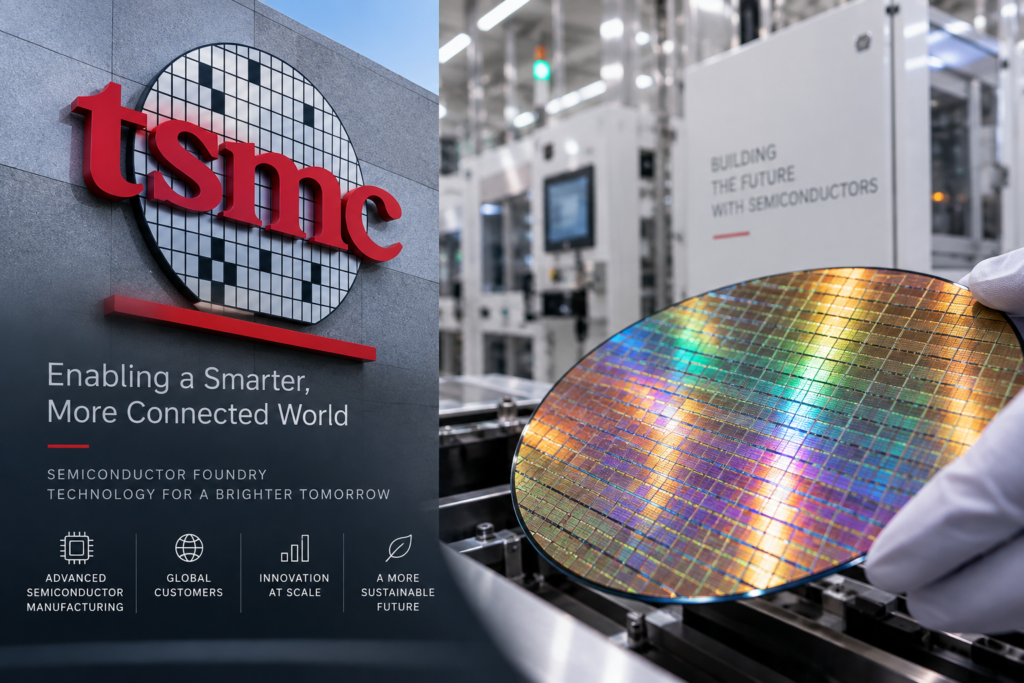
TSMC semiconductor foundry and advanced chip manufacturing technology

Scroll to Top