Best Halal Stocks 2026 begins with understanding what makes a stock genuinely Shariah-compliant. A stock only earns the “halal” label after passing a specific, repeatable financial test—not because it’s popular, not because a technology company is trending, and not because of anyone’s personal opinion. It has to clear rules on what the business actually does, how much debt it carries, and how much of its income comes from interest. Standards bodies like AAOIFI define exactly what that test looks like, and index providers like S&P Dow Jones Islamic Market Indices and MSCI’s Islamic Index Series apply it to thousands of listed companies every quarter.
That distinction matters more this year than ever, as more Muslim investors worldwide look to U.S. equities for growth, and more platforms throw the word “halal” around loosely without real screening behind it. This guide screens seven widely-held names against AAOIFI-style criteria, then goes further than a typical list: how to actually buy them, what zakat and purification obligations apply on top of compliance, how to check a stock’s status yourself before you rely on anyone’s list — including this one — and the mistakes that trip up new halal investors most often.
Key Takeaways
- A stock is Shariah-compliant when its business activity is permissible, its debt and interest-bearing assets each stay under roughly 30% of market cap, and impure income stays under 5% of revenue.
- Compliance is re-checked quarterly by index providers — a stock that passes today isn’t guaranteed to pass next quarter, so no list (including this one) should be treated as permanent.
- Zakat (an annual ~2.5% wealth tax) and purification (donating incidental impure income) are two separate obligations, and most halal-stock content online only covers one of them.
- U.S. halal stock lists skew heavily toward technology because low-debt, asset-light business models clear the debt-ratio screen more easily than capital-intensive sectors like banking, real estate, and utilities.
- Free screening apps (Zoya, Islamicly, Musaffa) let you check any individual ticker’s current compliance status in seconds — use one before buying, not just a list from any article.
Best Halal Stocks 2026: What Makes a Stock Halal?
Understanding the screening process behind Best Halal Stocks 2026 starts with two essential questions: what does the company actually do to earn money, and how is its balance sheet structured? The second question exists because of riba—the prohibition on interest in Islamic finance—which is why debt levels and interest income matter just as much as the business itself.
A stock is generally considered Shariah-compliant when it clears these AAOIFI-based criteria:
| Screening test | Threshold | Why it exists |
|---|---|---|
| Business activity | Core operations must be permissible | No alcohol, gambling, conventional interest-based banking, pork products, or adult entertainment as a primary revenue source |
| Debt ratio | Under ~30% of market capitalization | Excessive debt implies structural reliance on interest-based financing |
| Cash & interest-bearing securities | Under ~30% of market capitalization | Holding excessive interest-generating assets conflicts with the prohibition on riba |
| Impure income | Under 5% of total revenue | Even compliant companies can earn incidental interest; above 5%, the business itself is considered non-compliant |
One thing worth remembering before trusting any halal stock list, including this one: compliance isn’t permanent. Companies are re-screened quarterly by index providers, not once and forever — a stock that passes today could shift out of compliance next quarter if its debt load or interest income changes. That’s why every pick below is worth periodically re-checking, not just bookmarking.
Why U.S. Halal Stock Lists Skew Toward Tech
If you’ve noticed that halal stock lists — this one included — lean heavily toward technology names, that’s not a curation choice. It’s a structural side effect of how the screening math works. Asset-light software and chip-design businesses typically carry lower debt relative to their market capitalization than capital-intensive industries like banking, real estate, airlines, or utilities, which routinely finance operations with debt loads that fail the 30% threshold outright. Conventional banks are usually excluded on business-activity grounds alone, since interest-based lending is their core product. The result is a Shariah-compliant universe that’s real and substantial — the Dow Jones Islamic Market U.S. Index holds hundreds of constituents — but visibly concentrated in sectors that naturally run lean on debt, with technology and healthcare overrepresented relative to the broader market.
Best Halal Stocks 2026: The Screened List
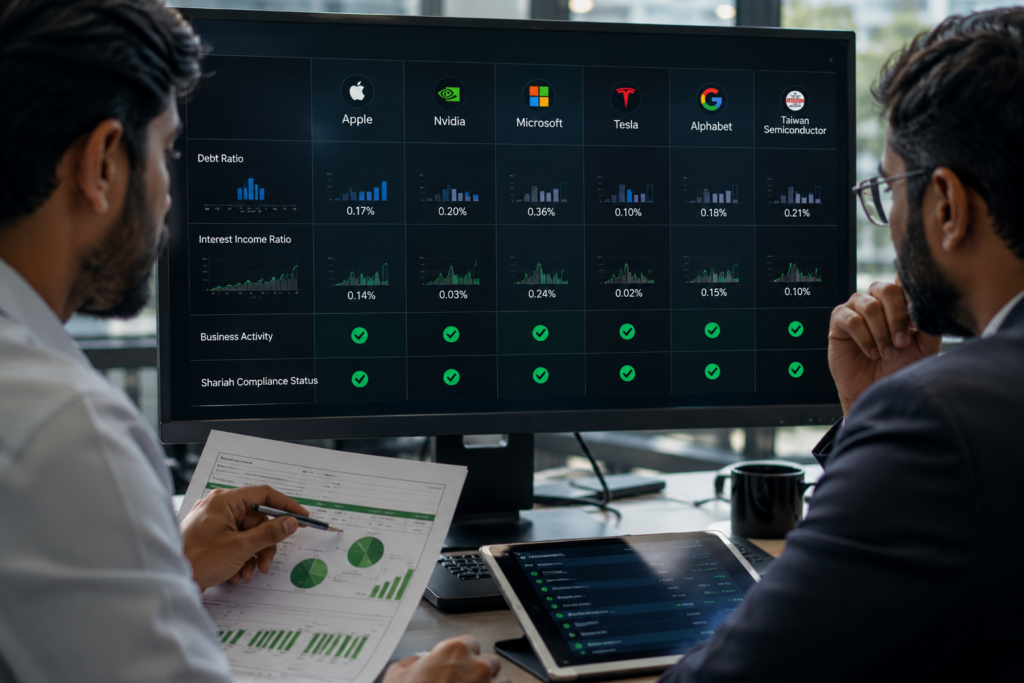
Here’s the core list — seven widely-held names that generally clear the AAOIFI screening criteria above, not a roundup of whatever’s popular in tech headlines. Verify each one’s current status with a screening tool before buying; quarterly re-screening means this table is a starting point, not a guarantee.
| Company | Ticker | Sector | Why It Generally Passes | Watch For |
|---|---|---|---|---|
| Apple | AAPL | Consumer Technology | Devices & services revenue, low debt relative to market cap | Rising cash reserves relative to market cap over time |
| Nvidia | NVDA | Semiconductors | Chip-design model with minimal debt relative to valuation | Valuation swings, not compliance risk |
| Microsoft | MSFT | Enterprise Software / Cloud | Low debt relative to enormous market cap; no interest-based core revenue | One of the more stable compliance profiles on this list |
| Broadcom | AVGO | Semiconductors / Infrastructure | Passes on both business-activity and debt-ratio tests | Acquisition-driven debt swings |
| Taiwan Semiconductor | TSM | Semiconductor Manufacturing | Manufacturing-based revenue, manageable debt levels | Heavy capital expenditure cycles |
| Alphabet | GOOGL | Internet / Cloud | Advertising & cloud revenue, low debt ratio | Regulatory/antitrust exposure (market risk, not compliance) |
| Tesla | TSLA | Automotive / Energy | Vehicle manufacturing is a permissible activity; debt has fallen substantially | Debt ratio moves more quarter to quarter than the rest of this list |
Apple (AAPL)
Apple’s revenue comes from devices and services, not interest-based finance, and its debt-to-market-cap ratio sits well under the 30% threshold given its scale. Its size and consistent earnings make it a common core holding in Shariah-conscious portfolios and in the constituent lists of major Islamic indices. → Full Apple (AAPL) company profile
Nvidia (NVDA)
Nvidia clears screening cleanly thanks to a chip-design business model that carries minimal debt relative to its valuation. Its position in AI infrastructure makes it one of the more closely watched growth stories among Shariah-conscious investors, though its valuation swings mean it carries more price volatility than some of the other names here — a market-risk factor, not a compliance one.
Microsoft (MSFT)
Microsoft’s enterprise software and cloud business generates revenue with no core reliance on interest-based finance, and its debt levels remain low relative to its enormous market cap. It’s widely accepted across major halal screening platforms, making it one of the more consistently compliant picks on this list.
Broadcom (AVGO)
A semiconductor and infrastructure software company that passes screening on both the business-activity and debt-ratio tests. Broadcom’s growing footprint in AI networking hardware has made it one of the more frequently discussed halal picks alongside Nvidia and Apple, though its history of debt-funded acquisitions is worth watching each screening cycle.
Taiwan Semiconductor (TSM)
As the manufacturing backbone behind much of the global chip supply, including for Apple and Nvidia, TSM generally passes Shariah screening with a manufacturing-based revenue model and manageable debt levels — a genuine, if less obvious, halal pick.
Alphabet (GOOGL)
Google’s parent company earns its revenue primarily from advertising and cloud services, with no core dependence on interest-based income, and it holds a low debt ratio relative to its market cap — a straightforward pass for Shariah screening.
Tesla (TSLA)
Tesla’s core business is electric vehicle manufacturing, a permissible activity, and its debt load has fallen substantially in recent years, bringing it within screening thresholds on most platforms — though its debt ratio moves more than the others on this list, so it’s the one most worth re-checking each quarter.
How to Buy Halal Stocks: Direct Ownership vs. Shariah ETFs
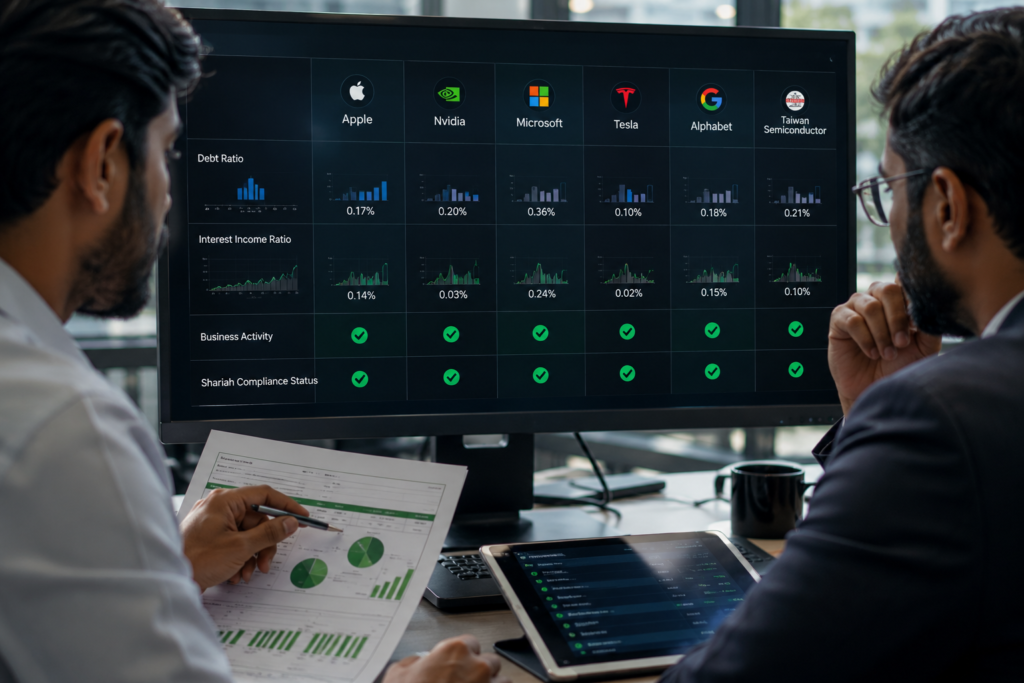
Whether you choose individual shares or a Shariah-compliant ETF, Best Halal Stocks 2026 should be viewed as a starting point for research rather than a permanent investment list. Once you’ve identified names worth considering, you have two realistic paths to actually invest, and the right choice depends on how hands-on you want to be. If you’re new to evaluating individual companies at all, it’s worth understanding the fundamentals of company stock analysis before picking stocks directly rather than through a fund.
| Direct Stock Purchase | Shariah-Compliant ETFs | |
|---|---|---|
| How it works | Buy individual shares through any standard brokerage account | One ticker (e.g. SPUS, HLAL) gives you a diversified, pre-screened basket |
| Control | Full control over exactly which companies you hold | Fund provider selects and rebalances constituents |
| Compliance monitoring | You’re responsible for tracking each position’s quarterly re-screening | Handled automatically by the fund provider |
| Diversification | Concentrated in your highest-conviction picks | Broad, instant diversification across dozens or hundreds of names |
| Best for | Investors who want to research and monitor individual holdings | Investors who want compliance handled with less ongoing effort |
Two widely-used Shariah-compliant ETFs: SPUS (SP Funds S&P 500 Shariah ETF) tracks a Shariah-screened subset of the S&P 500, and HLAL (Wahed FTSE USA Shariah ETF) tracks a broader FTSE-screened U.S. universe. Both apply AAOIFI-style criteria across a diversified basket, with rebalancing handled for you. Whichever route you choose, understanding how investors actually value a stock — P/E, PEG, and revenue multiples — helps you judge whether a compliant company is also a reasonably priced one, since Shariah screening says nothing about valuation.
Zakat and Purification: Two Separate Obligations
Most halal-stock content stops at compliance screening and never addresses what a Muslim investor actually owes once they hold a compliant stock. There are two distinct obligations here, and conflating them is one of the most common mistakes new halal investors make.
- Purification deals with impurity, not quantity owed as charity in the zakat sense — it’s the practice of calculating the small percentage of a company’s revenue that comes from incidental interest (which stays under the 5% screening threshold but still exists) and donating that equivalent portion of your dividend or capital gain to charity, rather than keeping it. Screening apps typically calculate this “purification percentage” per stock automatically.
- Zakat is the separate, obligatory annual wealth tax in Islam — commonly calculated at roughly 2.5% of a Muslim investor’s net zakatable wealth, which for actively-traded stocks generally means the market value of your holdings, and for long-term holdings may be calculated against the company’s zakatable assets instead. The exact method depends on your holding intent and the scholarly methodology you follow, so this is worth confirming with a qualified advisor rather than treating any single rule of thumb as universal.
In short: purification cleans small amounts of impure income out of an otherwise compliant holding; zakat is a wealth tax owed regardless of whether a holding is compliant at all. A fully Shariah-compliant portfolio can still carry a zakat obligation — compliance and zakat are not the same question.
How to Verify a Stock’s Halal Status Yourself
Every list, including this one, is a snapshot. Before buying anything, it’s worth checking current status directly rather than relying on an article’s publish date. A few ways to do that:
- Dedicated screening apps — Zoya, Islamicly, and Musaffa let you search any individual ticker and see its current business-activity, debt-ratio, and purification status, typically updated quarterly.
- Index constituent lists — the S&P Dow Jones Islamic Market Indices and MSCI Islamic Index Series both publish their full screening methodologies and constituent lists, which is where screening apps source much of their data from.
- The underlying standard — AAOIFI publishes its Shari’ah Standards directly, if you want to see the actual criteria rather than a summary of them (this article included).
Halal Investing vs. ESG Investing: What’s the Difference?
The two are often confused, so it’s worth understanding the difference. ESG (Environmental, Social, and Governance) investing evaluates companies based on sustainability, corporate governance, labor practices, and environmental impact. Shariah screening, on the other hand, asks a different question: whether the company’s business activities are permissible under Islamic principles and whether its financial structure avoids riba (interest). Understanding this distinction is essential when evaluating Best Halal Stocks 2026, because a company can satisfy ESG standards while failing Shariah screening, or meet Shariah requirements while scoring poorly on ESG metrics. Although both approaches often exclude industries such as gambling and tobacco, they serve different purposes, and an ESG fund should not automatically be considered halal.
Common Mistakes Investors Make With Halal Stocks
- Treating a list as permanent. Compliance is re-screened quarterly. A stock that passed when an article was published may not pass today.
- Skipping purification. Even fully compliant companies often carry a small amount of incidental interest income that should be calculated and donated, not kept.
- Confusing halal with ESG (or with “ethical” generally). They’re different screens answering different questions — see above.
- Over-concentrating in one sector. Because tech and semiconductors screen compliant more easily than debt-heavy sectors, it’s easy to end up with a portfolio that’s accidentally 80%+ technology. That’s a real diversification risk, not just a compliance nuance.
- Assuming compliance means the stock is a good investment. Screening tells you what’s permissible to buy. It says nothing about valuation, growth prospects, or whether the price you’re paying is reasonable.

Frequently Asked Questions
Is Apple stock halal?
Generally yes — Apple typically passes AAOIFI-based screening on business activity, debt ratio, and interest income, making it one of the more consistently compliant large-cap names. Status is re-verified quarterly, so a periodic re-check is worth doing rather than a one-time assumption.
Is Tesla stock halal?
Generally yes, though it’s the name on this list most worth re-checking each quarter. Vehicle manufacturing is a permissible business activity, and Tesla’s debt ratio has fallen substantially in recent years, but it has historically moved more than the other companies here.
How often are halal stocks re-screened?
Investors following Best Halal Stocks 2026 should remember that major Islamic index providers, including S&P DJI and MSCI, re-screen companies every quarter. A stock’s compliance status can change between cycles if its debt or interest income shifts, so treat any halal stock list as a snapshot, not a permanent verdict.
Are halal stocks less profitable than conventional stocks?
Not inherently. Companies like Nvidia, Apple, and Microsoft have delivered strong returns while remaining compliant — screening restricts which businesses you can invest in, not how well those businesses perform.
What’s the difference between halal investing and ESG investing?
They screen for different things. Shariah screening tests business activity and balance-sheet structure against Islamic finance principles; ESG screens for environmental, social, and governance factors. A stock can pass one and fail the other.
Do halal stocks pay dividends, and is that dividend income halal?
Yes, compliant companies can and do pay dividends. If the company is Shariah-compliant, the dividend itself is generally permissible, though the small incidental-interest portion (if any) still needs to be purified — see the zakat and purification section above.
Can I hold halal stocks in a regular brokerage account?
Yes. Shariah compliance is a property of the stock itself, not the account type. Standard brokerage accounts, IRAs, and Shariah-focused platforms can all hold the same compliant shares.
Do halal ETFs work the same way as individual stock screening?
Yes — funds like SPUS and HLAL apply the same AAOIFI-style criteria across a diversified basket, with the fund provider handling ongoing re-screening and rebalancing automatically.
Final Thoughts
Best Halal Stocks 2026 is not a permanent list to bookmark and forget. Compliance changes every quarter, so responsible investors should verify each company’s current Shariah status using a trusted screening platform before making any investment decision. It’s also not the whole picture: purification and zakat are separate obligations from compliance itself, and a diversified, well-valued portfolio still requires the same fundamental analysis any investor should do before buying.
Before adding any name to your portfolio, check its current status with a screening app, review its fundamentals, and confirm it fits your broader investing strategy — not just this list.