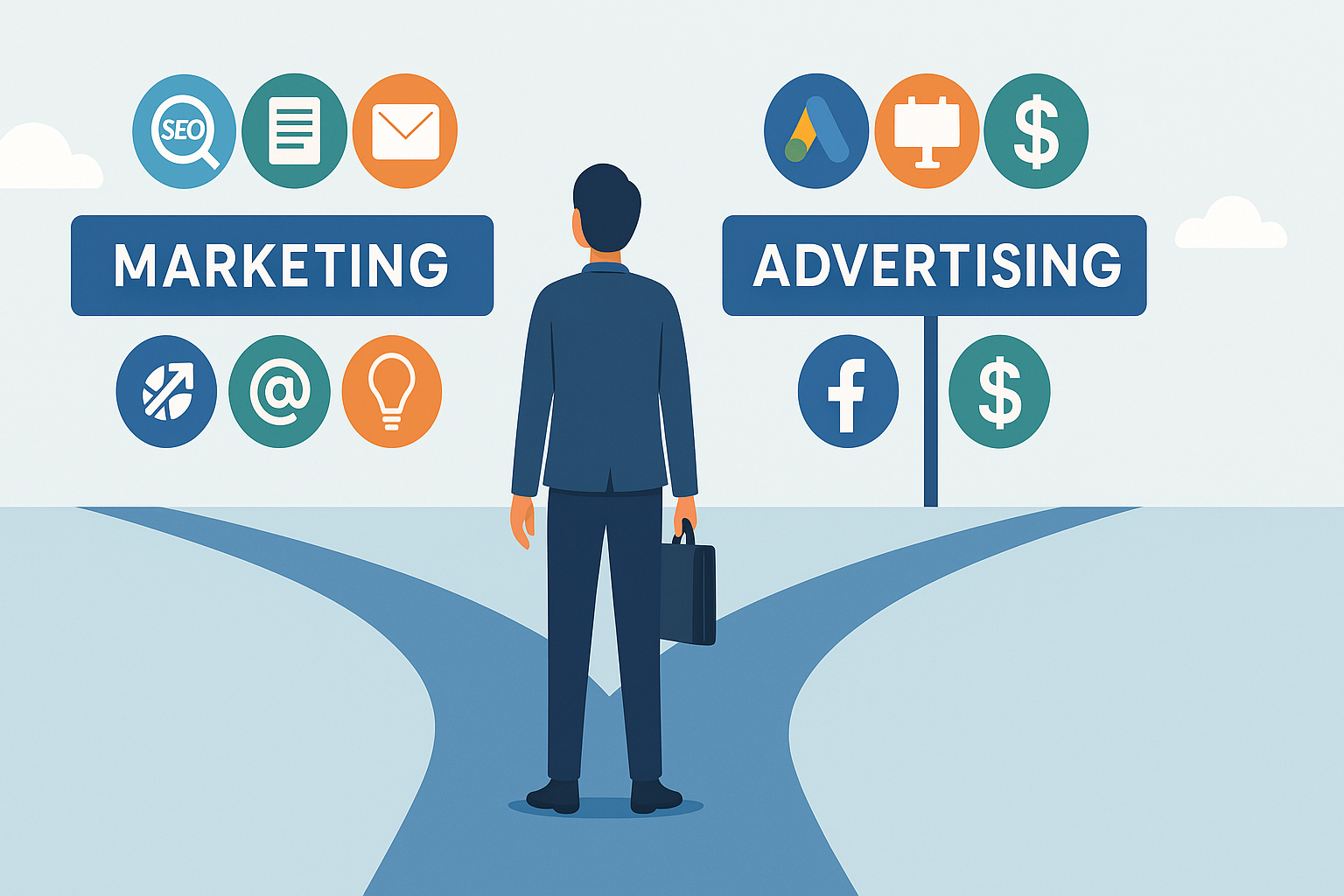
Most marketing advice online is written for a coffee shop or a hair salon, not a SaaS company trying to land its first hundred customers. That mismatch is why so much generic content fails startup founders — the channels, the budget assumptions, and even the definition of “success” are built for a completely different kind of business.
A real startup marketing strategy starts from different assumptions: limited runway, a narrow ideal customer profile, and a need to prove traction fast rather than build slow brand awareness over years. This guide lays out a practical framework for building that strategy — how to define your audience, where to spend limited budget, the mistakes that waste both time and money, and a real case study of what actually worked. No generic small-business tactics, just what applies when you’re building something new.
Why Generic Marketing Advice Doesn’t Work for Startups
Most marketing content assumes a stable business with an established customer base and a predictable budget cycle. A startup marketing strategy has to account for none of that. You’re often marketing a product that didn’t exist a year ago, to a customer segment you’re still learning about, with a runway that makes a six-month brand-awareness campaign a luxury you can’t afford.
Generic advice also tends to optimize for the wrong metric. A local business cares about foot traffic or phone calls; a startup usually needs to prove product-market fit through activation, retention, or a specific conversion signal investors or the founder actually care about. Applying small-business marketing tactics — broad local SEO, generic social posting schedules, print-style advertising thinking — wastes budget chasing metrics that don’t tell you anything useful about whether the business is working.
An honest startup marketing strategy means dropping assumptions imported from other kinds of businesses and starting instead from your actual constraints — a tight budget, a specific audience, and the pressure to find real signal quickly. Everything else in this guide builds from that starting point.

Building a Marketing Strategy Framework for Your Startup
Before picking channels, running ads, or hiring a marketer, you need two things settled: exactly who you’re selling to, and exactly why they’d choose you over the alternative sitting in their browser tab. Skipping this step is the single most common reason startup marketing spend produces nothing measurable — you can execute perfectly on the wrong audience or the wrong message, and the results will still be flat. This framework starts with those two foundations before touching a single channel decision. These two foundations are the backbone of any real startup marketing strategy, and skipping them is why so many campaigns underperform.
Define Your ICP Before Any Channel Decisions
Your Ideal Customer Profile isn’t “small businesses” or “developers” — it’s specific enough that you could describe the exact company size, role, and pain point of the person who’d buy tomorrow if they found you today. Vague ICPs lead to vague marketing: generic messaging, scattered channel choices, and campaigns that technically reach people but don’t resonate with anyone specific. Talk to your first 10-20 customers directly and look for the pattern in why they actually bought, not who you originally guessed would buy. That pattern is your real ICP, and it should narrow, not broaden, as you learn more. Every channel and message decision downstream depends on getting this right first.
Positioning: What Makes You Different
Positioning answers one question: why you, specifically, instead of the three other options your ICP is already considering. This isn’t a tagline exercise — it’s identifying the one thing your product genuinely does better or differently that your ICP actually cares about, not a feature you’re proud of that customers barely notice. Weak positioning forces every other marketing effort to work harder, because the message has to overcome “why not just use the incumbent” every single time. Strong positioning, even a simple one, makes advertising, content, and sales conversations all easier because the differentiation is already doing part of the work.

Budget-Conscious Marketing Tactics
A disciplined startup marketing strategy treats every dollar as something that needs to prove itself relatively quickly. Most startups don’t have the luxury of testing five channels at once and seeing what sticks — limited runway means every dollar spent on marketing needs to justify itself relatively quickly. That doesn’t mean marketing has to be cheap in ambition, just disciplined in where the money actually goes. The channels worth prioritizing early are rarely the flashiest ones; they’re the ones that let you learn fast without burning through months of budget on a bet that hasn’t been validated yet.
Low-Cost Channels Worth Prioritizing
Founder-led content and organic distribution — writing directly about the problem you solve, sharing it where your ICP already spends time — often outperforms paid channels early on, because it costs time rather than cash and builds a compounding asset instead of a one-time impression. Community engagement in spaces your ICP already frequents (niche forums, industry Slack groups, relevant subreddits) can generate real signal without ad spend, provided it’s genuine participation rather than disguised self-promotion. Referral and word-of-mouth mechanics, even informal ones, are worth building deliberately from your very first customers rather than waiting until you have “enough” of a base to bother.
Where Founders Waste Marketing Budget
The most common waste is broad paid advertising before positioning and ICP are validated — you end up paying to test messaging that was never going to convert anyone, at scale. A close second is hiring a full-time marketing generalist too early, before there’s a validated channel worth someone’s full attention; that budget usually goes further as a targeted contractor solving one specific problem. Founders also frequently overspend on brand assets — logos, brand guidelines, polished websites — before validating that anyone wants the product at all, effort better spent proving demand first.

Content, SEO & Brand Strategy Basics
Content and SEO are a long-term piece of any startup marketing strategy, even though the payoff doesn’t show up immediately. Brand, similarly, isn’t about polish at this stage; it’s about consistency that lets people recognize and trust you as you show up in more places over time.
Building Organic Visibility Early
Start by writing directly to the specific questions your ICP is already searching for, not broad topics meant to impress a general audience. Founder-led content — genuine expertise shared consistently, not polished marketing copy — tends to build trust faster than generic blog posts, especially in technical or niche B2B categories. SEO compounds slowly, so the earlier you start publishing consistently around your actual expertise, the sooner that investment starts paying back in organic traffic that doesn’t require ongoing ad spend to sustain.
Brand Positioning That Scales
Early-stage brand work should focus on clarity and consistency, not visual polish — the same core message and tone across your website, content, and outreach, even if the design is simple. A brand that scales is one built around a genuine point of view about the problem you solve, not a set of visual guidelines. That point of view is what carries forward as you add channels, hire a team, and eventually invest in the polish that comes later.
Common Marketing Strategy Mistakes Startups Make
Most breakdowns in a startup marketing strategy come down to a handful of repeated mistakes, not bad luck.
- Skipping ICP definition and marketing to “everyone” — vague targeting produces vague messaging and campaigns that reach people but convert almost no one, since nothing about the message speaks specifically to any one group.
- Spending on paid ads before positioning is validated — this just pays to discover that unclear messaging doesn’t convert, at scale, instead of fixing the messaging first with cheaper, smaller tests.
- Hiring a marketing generalist too early — before there’s a validated channel worth someone’s full-time attention, that salary usually produces less than a focused contractor solving one specific, proven problem.
- Chasing vanity metrics over real signal — follower counts and impressions feel good but don’t tell you whether the business is actually working; track activation, retention, or conversion instead.
- Overinvesting in brand polish before validating demand — a beautiful logo and brand guidelines don’t matter if nobody’s confirmed anyone wants the product yet; that effort is better spent proving demand first.
- Copying competitor tactics without checking underlying strategy — a competitor’s channel or campaign might work for their stage, budget, or ICP, not yours; copying the tactic without the reasoning behind it usually fails.
- Giving up on content and SEO too early — organic channels take months to show results, and abandoning them at month two because they “aren’t working yet” wastes the investment already made without letting it compound.
- Treating marketing strategy as a one-time plan instead of an ongoing process — the ICP, positioning, and channels that work at launch often need real adjustment as you learn more; a strategy that never gets revisited goes stale fast.
Case Study: What Actually Worked
A B2B SaaS startup selling scheduling software spent its first six months running broad Facebook and Google ads targeting “small business owners” — a wide, undefined audience that produced clicks but almost no paying customers. Founders assumed the problem was ad creative, not targeting, and kept tweaking copy instead of the audience.
The shift came from talking directly to the 12 customers who had actually converted. A clear pattern emerged: nearly all of them were independent contractors in field services — plumbers, electricians, landscapers — juggling scheduling across multiple job sites with no dedicated admin staff. That was the real ICP, not “small business owners” broadly.
Ad spend redirected entirely toward that narrow audience, with messaging built around the specific pain of missed appointments and double-bookings rather than generic “save time” language. Conversion rates on the same budget roughly tripled within two months, and cost per acquisition dropped by more than half.
The lesson wasn’t that paid ads don’t work for startups — it’s that they only work once the ICP and positioning are actually validated. Money spent broadly before that validation is functionally the same as money spent testing a hypothesis nobody had confirmed yet.
This case study is a clear example of what a validated startup marketing strategy looks like in practice, not just theory.

How to Build Your Own Marketing Plan Step by Step
Turning this into your own startup marketing strategy comes down to six concrete steps.
Step 1: Interview your existing customers. Talk to your first 10-20 customers directly and look for the pattern in why they actually bought — not who you originally guessed would buy. This pattern becomes your working ICP.
Step 2: Write your positioning in one sentence. Define who you’re for, what problem you solve, and why you’re different from the alternative they were already considering. If it takes a paragraph to explain, it’s not sharp enough — keep cutting until it fits in one sentence you could say in a sales call.
Step 3: Narrow to one or two channels instead of spreading across five. Choose based on where your specific ICP already spends attention, not where marketing conventionally happens. A technical B2B audience behaves very differently from a consumer audience.
Step 4: Set one metric that actually indicates progress. Activation, retention, or a defined conversion signal — not vanity metrics like impressions or followers, which don’t tell you whether the business is working.
Step 5: Run each channel long enough to get a real read. Weeks, not days. Early data on any channel is noisy, and judging too soon usually means killing something that just needed more time to show signal.
Step 6: Revisit the whole plan monthly. What you learn about your ICP and what’s working changes fast at this stage. A plan built two months ago may already be slightly wrong — treat it as a working hypothesis you’re actively testing, not a document you write once and follow blindly.
FAQs
These are the questions that come up most when founders start building a startup marketing strategy from scratch.
How much should a startup spend on marketing?
There’s no universal percentage — it depends on runway and stage. Early on, prioritize time-intensive, low-cost channels (content, community, referrals) overpaid spend. Once positioning and ICP are validated, allocate paid budget deliberately toward the channel showing the clearest signal, rather than spreading thin across many.
When should a startup hire a marketing person?
Once a channel is validated and needs consistent execution beyond what the founder can sustain — not before. Hiring a generalist to “figure out marketing” from scratch often produces less than a founder who’s already found initial signal, then hires someone to scale a proven channel.
What’s the difference between marketing strategy and marketing tactics?
Strategy is the framework — who you’re targeting, why you’re different, which channels make sense given that. Tactics are the specific execution — a particular ad, a blog post, a social media schedule. Tactics without strategy behind them tend to produce activity without results.
Closing
A startup marketing strategy isn’t about doing more — it’s about doing the right few things in the right order. Define your ICP from real customer conversations, sharpen your positioning until it fits in one sentence, and prioritize the one or two channels where your specific audience already pays attention, before spending real money to scale anything. The founders who waste the most budget usually aren’t lazy — they’re just executing well against the wrong audience or an unvalidated message. Get the framework right first, and the tactics that follow have something solid to build on instead of guessing in the dark.