Most startups burn through their first advertising budget before figuring out which channel actually works for them — spreading a small amount across five platforms instead of concentrating it where their specific audience actually spends time. That scattershot approach rarely produces enough signal to learn anything useful.
A real startup advertising and social media plan works differently: it picks fewer channels deliberately, tests them long enough to get real data, and treats organic and paid as two tools serving different purposes rather than competing priorities. This playbook covers both sides — where paid ads make sense at your stage, which organic and social tactics actually build momentum without a big budget, and how to measure whether any of it is working. This is execution, not strategy — if you haven’t nailed down your ICP and positioning yet, start with our Startup Marketing Strategy guide first.
Paid Advertising for Startups: What Actually Works
Paid advertising can work for startups, but only once there’s something worth scaling — a validated message, a defined audience, and at least a rough sense of what conversion looks like. Running paid ads to “see what happens” before that groundwork is done just pays to discover problems you could have found for free through smaller, cheaper tests first.
Choosing the Right Ad Platform for Your Stage
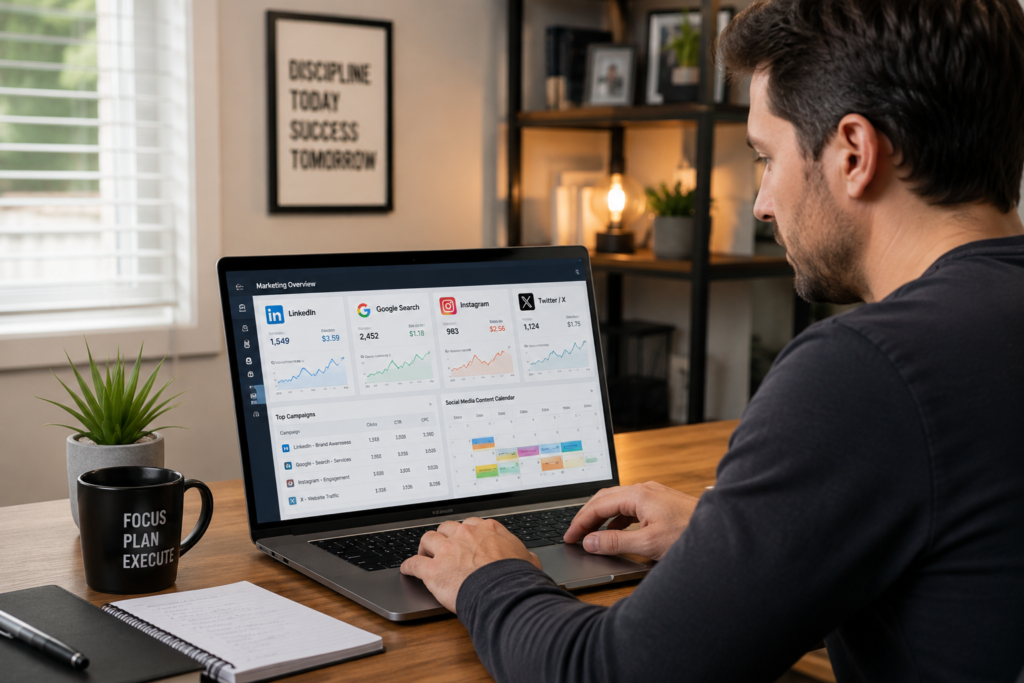
Pick your ad platform based on where your ICP actually spends attention, not what’s trending in startup advice. LinkedIn works well for B2B SaaS targeting specific roles or company sizes, even at a higher cost per click, because the precision justifies the price. Google Search ads capture people already searching for a solution — strong once you know their exact terms. Meta and Instagram suit consumer products or founder-led branding, but usually underperform for narrow B2B audiences. Match the platform to actual buyer behavior, not the lowest cost per click.
Budget Allocation for Early-Stage Paid Ads
Start with a budget small enough that losing it entirely wouldn’t hurt, but large enough to generate statistically meaningful data — usually a few hundred to low thousands of dollars over several weeks, not a single day. Resist the urge to split this across multiple platforms simultaneously; concentrated spend on one channel produces a real read faster than diluted spend across three. Set your budget expectations around learning, not immediate ROI — the goal at this stage is figuring out whether the channel and message combination works at all, with scaling decisions coming only after that’s confirmed.
Organic & Low-Cost Advertising Tactics
Not every effective startup advertising and social media approach requires a media budget. Organic channels take longer to compound, but for early-stage companies with more time than cash, they often produce more durable results than paid spend that stops the moment you stop paying for it.
Community & Founder-Led Distribution
Showing up genuinely in spaces your ICP already frequents — niche Slack communities, industry forums, relevant subreddits — builds trust in a way paid ads can’t, provided it’s real participation and not disguised self-promotion. Founder-led posting, where the person building the product shares genuine insight rather than polished marketing copy, tends to outperform brand-account content in the early stages, since audiences respond to a real person more than a logo. This is slow, but it’s also nearly free, making it one of the highest-leverage tactics available before there’s budget for anything else.
Partnerships & Co-Marketing
Partnering with complementary (non-competing) businesses serving the same audience lets you reach a pre-built audience without ad spend — a joint webinar, a co-written guide, or a simple mutual shoutout. This works best when both sides genuinely benefit, not when one party is clearly extracting more value than they’re offering. Even a handful of well-matched partnerships can outperform a paid campaign, since the audience arrives with built-in trust from the partner’s endorsement.
Social Media Marketing for Startups
Social media is often the most overinvested part of a startup advertising and social media plan relative to its actual payoff — founders post consistently on three platforms and wonder why nothing converts. The fix isn’t posting more, it’s posting on fewer platforms, chosen deliberately, with content built for how people actually use each one.

Choosing the Right Platform for Your Audience
LinkedIn tends to work well for B2B SaaS and professional audiences, where founder insight and industry commentary get genuine engagement from the people who make buying decisions. Twitter/X suits founders building in public or targeting a technical, fast-moving audience that values real-time commentary. Instagram and TikTok fit consumer products or highly visual brands, but rarely justify the effort for narrow B2B targeting. Pick the one platform where your actual ICP spends time and engages with content, rather than trying to maintain a presence everywhere at once with diluted effort.
What to Post When You Have No Following Yet
Before you have an audience, the content that works best isn’t promotional — it’s genuinely useful commentary, behind-the-scenes building updates, or direct answers to questions your ICP is already asking elsewhere. Engaging authentically in others’ comments and communities often builds visibility faster than posting into a void with zero followers. Consistency matters more than volume here: showing up regularly with real substance for a few months typically outperforms sporadic bursts of high-effort content followed by silence.
Measuring What’s Actually Working
Without proper measurement, a startup advertising and social media budget just disappears with no way to know what actually earned it back.
- Track activation or conversion, not vanity metrics — a real read on your startup advertising and social media efforts comes from signups, demos booked, or sales, not likes and impressions that don’t indicate buying intent.
- Give each channel a real testing window — 2-4 weeks minimum before judging paid ads or social content, since early data on any channel is noisy and premature conclusions kill things that just needed more time.
- Compare cost per acquisition across channels, not just cost per click — a cheap click that never converts is more expensive than an expensive click that does; total cost to an actual customer is the number that matters.
- Separate organic and paid results clearly — attribute conversions to the actual channel that drove them using UTM tracking or platform analytics, rather than guessing which effort deserves credit.
- Watch for engagement that doesn’t translate to pipeline — a post that gets shared widely but produces zero qualified leads is a signal to adjust targeting or messaging, not a success to repeat.
- Revisit measurement monthly, not just at campaign end — waiting until a quarter is over to evaluate what’s working wastes budget that could have been redirected sooner toward what’s actually converting.
Common Advertising & Social Media Mistakes
Most startup advertising and social media budgets get wasted the same handful of ways, regardless of industry or product:
- Spreading budget across too many platforms at once — running small paid campaigns on three platforms simultaneously produces weak, inconclusive data on all three instead of a clear read on one.
- Posting on social media without a defined ICP in mind — content built for “everyone” resonates with no one specifically, and engagement stays flat regardless of posting frequency.
- Copying competitor ad creative without their context — a competitor’s ad might work because of their audience size, brand recognition, or budget scale; copying the format without those underlying advantages usually underperforms.
- Judging paid campaigns too early — killing an ad set after two days of underwhelming results before the platform’s algorithm has had time to optimize delivery wastes the learning period entirely.
- Treating organic social as a broadcast channel instead of a conversation — startups that only post without engaging in comments or communities miss the trust-building that makes organic distribution valuable in the first place.
- Ignoring measurement until the budget is already spent — reviewing performance only at the end of a campaign, rather than checking in weekly, means bad spend continues far longer than it should.
How to Build Your Advertising & Social Calendar
Building a working startup advertising and social media calendar doesn’t require complex tools — it requires consistency and a clear plan for what gets posted or spent where, and when:
- Start with one core channel, not a full multi-platform calendar — commit your calendar structure to the single platform you’ve chosen for social, and the one ad channel you’re testing, before adding complexity.
- Plan content around your ICP’s actual questions and pain points — build a running list of the problems your audience asks about, and turn each one into a post or ad angle, rather than guessing at topics.
- Set a realistic, sustainable posting frequency — three genuinely useful posts a week beats daily posting that burns out after a month; consistency over a longer period outperforms an unsustainable initial pace.
- Block dedicated time for engagement, not just posting — schedule time to respond to comments and participate in relevant communities, since the trust-building happens in the interaction, not the post itself.
- Review and adjust the calendar every two weeks — use early performance data to drop what isn’t working and double down on the content types or ad angles that are, rather than running the same static plan for months.
FAQs
These are the questions that come up most once a startup advertising and social media plan is actually running.
How much should a startup spend on paid ads?
Start small enough that losing it wouldn’t hurt — a few hundred to low thousands of dollars over several weeks, concentrated on one platform. The goal early on is generating a real read on what works, not immediate ROI. Scale spend only once a channel shows validated signal.
Which social platform should a startup start with?
Whichever platform your specific ICP actually uses and engages with — LinkedIn for B2B SaaS and professional audiences, Twitter/X for technical or build-in-public audiences, Instagram or TikTok for consumer products. Pick one platform to do well rather than several done poorly.
Is organic social media still worth it for startups?
Yes, especially with limited budget — organic and community-based distribution builds trust paid ads can’t buy, and compounds over time. It requires more patience than paid ads, but often produces more durable results for startups without large marketing budgets.

Closing
A working startup advertising and social media plan doesn’t come from doing everything at once — it comes from picking one paid channel and one social platform, testing them long enough to get real signal, and measuring by conversion, not vanity metrics. Organic distribution and paid ads serve different purposes, but both only work once you know who you’re actually talking to. Get the execution disciplined here, and it becomes the natural extension of the strategy you’ve already built — not a separate scramble every time you want to grow.