
Why are growth stocks crashing in high interest rates? This question has become increasingly common among investors during periods of rising borrowing costs.
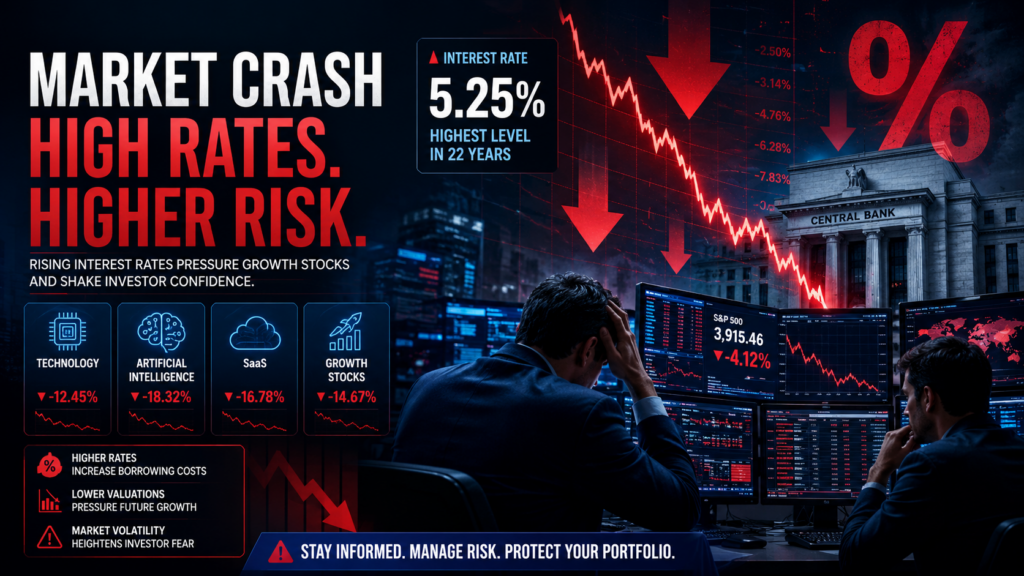
Growth stocks often fall sharply when interest rates rise because higher rates reduce the present value of future earnings. In simple terms, investors buy growth stocks because they expect these companies to generate much bigger profits years into the future. When interest rates increase, those future profits become less valuable in today’s money, which puts pressure on stock prices.
This is one of the main reasons growth stocks frequently underperform during periods of rising interest rates. Companies in sectors such as technology, software, biotech, and artificial intelligence are especially sensitive because much of their valuation depends on long-term growth rather than current profits.
What Are Growth Stocks?
Growth stocks are shares of companies expected to grow revenue, earnings, or market share faster than the broader market. These companies usually reinvest most of their profits back into expansion instead of paying dividends to shareholders.
Many growth companies focus heavily on scaling operations, acquiring customers, building products, or entering new markets. Because of this, investors are often willing to pay premium valuations for them.
Common examples of growth-oriented sectors include:
- Artificial intelligence companies
- SaaS companies
- Cloud computing businesses
- Electric vehicle manufacturers
- Biotechnology firms
Investors typically buy growth stocks because they believe these companies can generate substantial profits in the future. Rather than valuing them mainly on current earnings, the market often values them based on future potential.
That future potential is exactly why interest rates matter so much.
Why Are Growth Stocks Crashing in High Interest Rates?
When central banks raise interest rates, borrowing becomes more expensive across the economy. Businesses face higher financing costs, consumers may spend less, and investors become more cautious.
Growth stocks are hit especially hard for several reasons.
First, higher rates make future earnings worth less. Investors discount future cash flows back to present value using a discount rate. When interest rates rise, that discount rate rises as well, reducing today’s value of expected future profits.
Second, growth companies often rely on external capital. Many fast-growing firms borrow money or raise funding to finance expansion. Higher interest rates increase the cost of that capital, which can slow growth.
Third, investor behavior changes during rate hikes. When safer investments such as bonds or savings products start offering higher returns, some investors move money away from riskier growth stocks into more stable assets.
As a result, valuations compress.
A company trading at a high price-to-earnings or price-to-sales ratio may experience a large drop even if its business remains strong. The market is not always reacting to weaker fundamentals; sometimes it is simply repricing risk under a higher-rate environment.
This explains why growth stocks often decline much faster than other market segments when interest rates rise.
This also explains why are growth stocks crashing in high interest rates whenever central banks aggressively tighten monetary policy.
Why Future Earnings Become Less Valuable When Rates Rise
One of the best ways to understand why growth stocks fall during high interest rate periods is through discounted cash flow (DCF) analysis.
DCF is a valuation method used to estimate what a company is worth today based on the cash it is expected to generate in the future. The basic idea is simple: money earned in the future is worth less than money earned today because today’s money can be invested to earn returns.
Think of it this way: capital available right now creates opportunities immediately, while future cash remains uncertain and delayed. If interest rates rise, the difference becomes even larger because investors can earn higher returns elsewhere with lower risk.
This matters greatly for growth stocks because much of their expected value comes from profits that may arrive many years later. When the discount rate rises, those future cash flows lose more value when converted into present-day terms.
As a result, even if a growth company’s long-term business outlook remains strong, its stock price can still decline because investors adjust the valuation model.
A Simple Example
Imagine two companies.
Company A is a mature business already generating strong profits today.
Company B is a fast-growing technology company expected to generate most of its profits five to ten years from now.
If interest rates rise, Company A is less affected because investors are already receiving profits in the near term.
Company B, however, becomes much more sensitive to valuation changes because its expected profits are far in the future. Since those future earnings are discounted more aggressively, the stock may fall significantly.
This is why many technology, software, and AI-related stocks experience sharp sell-offs during aggressive rate-hiking cycles.
Even companies with strong revenue growth can see their share prices decline if the market believes future cash flows are becoming less valuable.
Growth Stocks vs Value Stocks in High-Rate Environments
Growth and value stocks often react differently when interest rates rise.
Growth stocks usually trade at higher valuations because investors expect rapid expansion and larger future earnings. Their prices are therefore more sensitive to changes in interest rates and investor sentiment.
Value stocks, on the other hand, are typically companies with stable earnings, lower valuation multiples, and established cash flows. These businesses often operate in sectors such as banking, energy, consumer goods, or industrials.
Because value companies generate more immediate earnings, they tend to hold up better during periods of rising rates.
This does not mean all growth stocks are bad or all value stocks are safe. It simply means that market conditions can favor one category over another depending on monetary policy and investor expectations.
Investor Takeaway
Rising interest rates do not automatically mean growth stocks are poor investments. Instead, they change how the market values future growth.
When rates rise, investors become more selective and focus more on profitability, cash flow, and financial strength. Companies with strong balance sheets and sustainable growth tend to perform better than speculative businesses with uncertain earnings.
Understanding the relationship between interest rates and stock valuation can help investors make better decisions during volatile market conditions.
For investors asking why are growth stocks crashing in high interest rates, the answer usually comes down to valuation pressure, financing costs, and changing risk appetite.
In short, growth stocks fall during high interest rate periods because higher rates reduce the present value of future earnings, increase financing costs, and shift investor preference toward safer assets.