
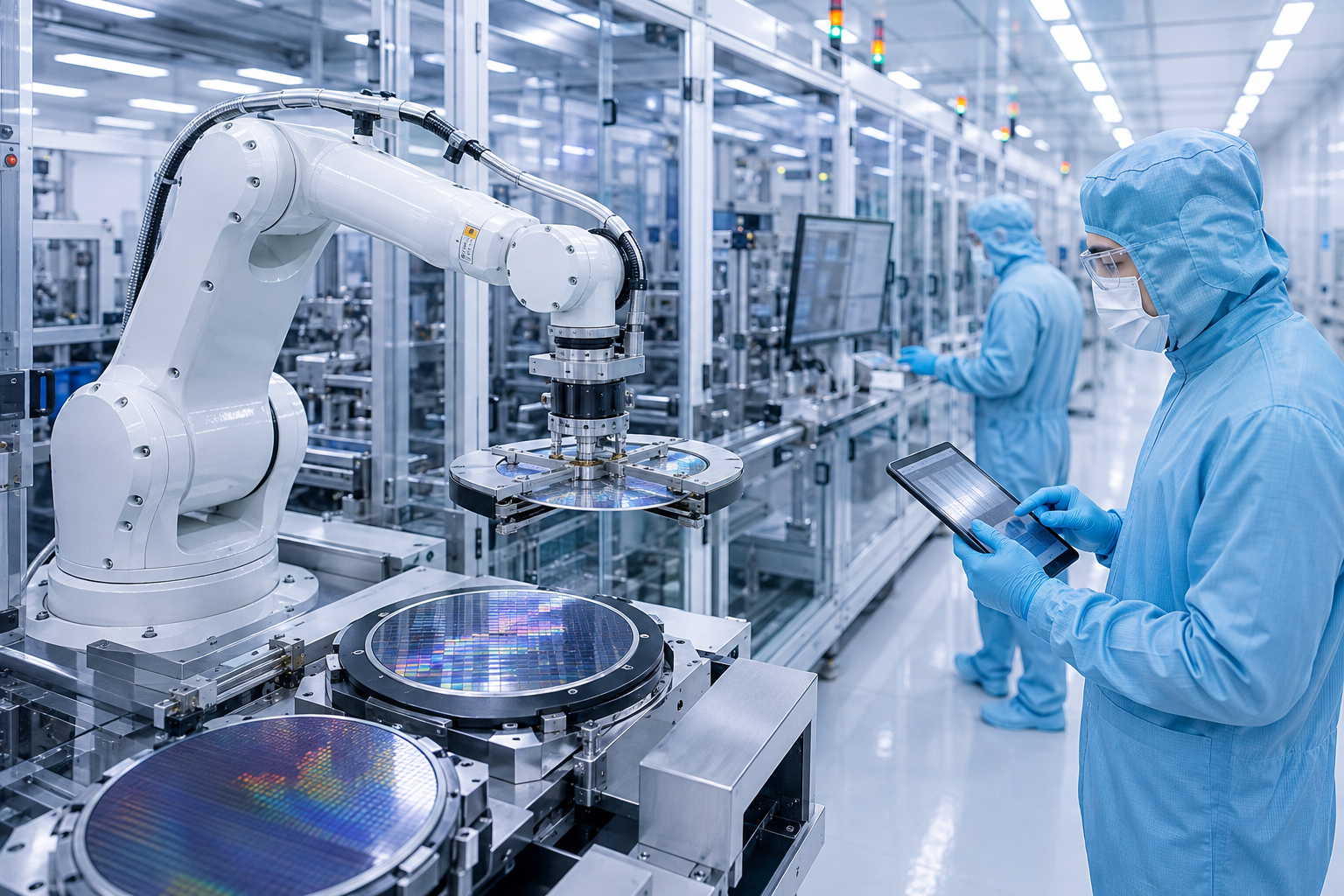
Explore semiconductor companies, chip manufacturers, silicon wafer technologies, AI processors, integrated circuits and the technologies powering modern computing, cloud infrastructure and digital innovation.
Discover company profiles, semiconductor manufacturing, chip design, fabrication technologies, AI hardware, electronic components and industry research shaping the future of computing.
Semiconductor Companies & Industry Profiles
Explore semiconductor companies, chip designers, silicon manufacturers, foundries, processor developers and hardware innovators supporting AI, cloud computing and enterprise technology.
NVIDIA
Leading designer of the GPUs and AI accelerators that power modern AI training and data-center computing.
View Company Profile →Broadcom
Designs networking chips and custom semiconductors used across data centers, enterprise networks, and cloud providers.
View Company Profile →Advanced Micro Devices
Designs CPUs and GPUs competing directly in AI accelerators, data-center processors, and consumer computing chips.
View Company Profile →Texas Instruments
Manufactures analog and embedded semiconductors used widely across industrial and automotive electronics.
View Company Profile →Qualcomm
Designs wireless and mobile processors that power smartphones and an expanding range of connected devices.
View Company Profile →Intel
Designs and manufactures processors while expanding its own foundry business to fabricate chips for other companies.
View Company Profile →This is an early-design selection meant to demonstrate the page layout — the companies shown here will be refined further as the section is developed.

Semiconductor Articles & Industry Guides
Explore semiconductor research, chip manufacturing trends, AI hardware developments and practical industry guides.
Why Cloud Costs Are Rising for AI Startups
Seven hidden cost drivers behind rising infrastructure bills, closely tied to demand for AI-capable chips and compute.
Read Article →Why AI Startups Burn Cash Fast
How the cost of compute and specialized chips pushes many AI-focused startups to burn through capital quickly.
Read Article →AI Investment Opportunities 2025
An overview of high-growth technology sectors, including chipmakers and hardware providers, that investors are watching.
Read Article →How AI Will Disrupt the Finance Industry by 2026
How AI hardware and tooling are changing forecasting, compliance, and decision-making in finance.
Read Article →ChatGPT Product Profile
Features, pricing, and alternatives for one of the most widely used AI products, built on large-scale chip infrastructure.
Read Article →What Are Semiconductors?
Semiconductors are materials, typically silicon, engineered to form the integrated circuits at the heart of nearly every electronic device. These circuits combine microprocessors, which perform computation, with memory chips, which store data, along with the other electronic components needed to route power and signals across a chip. Specialized versions, including AI processors optimized for the parallel calculations used in machine learning, have become central to modern computing demand.
Turning raw silicon into a finished chip requires chip fabrication, a precise, capital-intensive manufacturing process carried out in specialized facilities that print billions of microscopic transistors onto a single silicon wafer. Each finished wafer is then cut into individual chips, tested, and packaged before it reaches the devices consumers and businesses actually use.
How Semiconductor Companies Create Value
Semiconductor companies create value primarily through continuous chip innovation, since faster, more efficient designs command premium pricing until competitors catch up. Actually manufacturing those designs at scale requires enormous capital investment, which is why some companies design chips while relying on specialized foundries to manufacture them rather than owning fabrication facilities themselves.
Demand is driven by several large, overlapping end markets: AI and data centers, enterprise technology, automotive electronics, and consumer devices all compete for chip supply, supported by complex global supply chains spanning design, fabrication, and assembly across multiple countries. This demand connects closely with related fields such as Artificial Intelligence, Cloud & Infrastructure, Cybersecurity, SaaS & Software, and FinTech, since modern chips underpin nearly every category of listed technology company.
Industry Challenges
The semiconductor industry faces a distinct set of structural challenges. Global supply chains concentrate advanced fabrication in a small number of facilities, making the industry sensitive to geopolitical tension and export restrictions between major economies. Building advanced fabrication capacity requires enormous, multi-year research investment and manufacturing costs that only a handful of companies can sustain. Demand also moves in pronounced cycles, swinging between shortage and oversupply as global demand shifts, while intense competition and a persistent shortage of specialized engineering talent add further pressure across the industry. For a broader industry perspective, readers can consult SEMI semiconductor industry resources.
Continue Exploring Semiconductor Technologies
Explore listed semiconductor companies, industry research and the latest technology articles across SaGeminieTech.