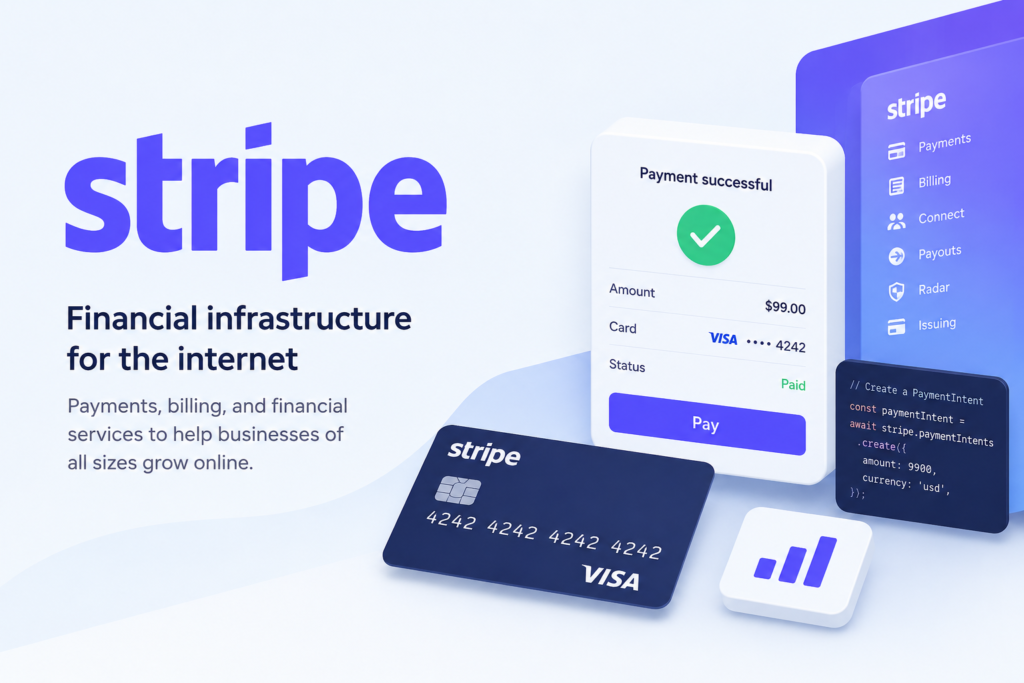
Stripe is a financial-technology platform that helps businesses accept payments, manage subscriptions, move money and embed financial services through software and APIs. This profile reviews Stripe’s main products, public U.S. pricing, developer ecosystem, security position, advantages, limitations and the types of businesses most likely to benefit from the platform.
Stripe Company Profile
A structured overview of Stripe’s payments platform, product ecosystem, pricing, intended users, alternatives, advantages, limitations, security and overall market position.
1. Stripe Identity and Company Category
Stripe is a technology company that builds economic infrastructure for the internet. Businesses use its software and APIs to accept payments, manage subscriptions, automate financial operations and build payment-enabled products.
Its platform serves startups, online retailers, software companies, marketplaces, platforms and large enterprises through developer tools, hosted payment interfaces and financial services.
2. Main Stripe Products and Features
Stripe Payments
Accepts online payments through cards, wallets, bank methods and other supported payment options.
Stripe Checkout
Provides a prebuilt, conversion-focused payment page that can be embedded or Stripe-hosted.
Payment Links
Creates no-code payment pages for one-time purchases, subscriptions and other transactions.
Stripe Billing
Manages subscriptions, recurring billing, usage-based pricing and revenue workflows.
Stripe Connect
Enables marketplaces and platforms to onboard users, route funds and monetize payments.
Stripe Radar
Uses machine learning and payment-network signals to identify and help prevent fraud.
Stripe Terminal
Supports in-person payments through developer tools, certified readers and partner systems.
Stripe Tax
Automates supported sales-tax, VAT and GST calculation, monitoring and compliance workflows.
Developer APIs
Provides APIs, SDKs, webhooks, documentation and testing tools for custom integrations.
3. Stripe Pricing Structure
| Product or Service | Designed For | Representative U.S. Pricing | General Positioning |
|---|---|---|---|
| Online Card Payments | Online businesses and software companies | 2.9% + 30¢ per successful domestic-card transaction | Standard pay-as-you-go online payment processing. |
| In-Person Payments | Retail and unified-commerce businesses | 2.7% + 5¢ per successful domestic-card transaction | Card-present processing through Stripe Terminal. |
| Payment Links | Businesses wanting no-code payment pages | Included with standard Payments pricing | Hosted links for accepting payments without building a checkout. |
| Stripe Checkout | Businesses wanting a prebuilt checkout | Included with standard Payments pricing | Stripe-hosted or embedded checkout optimized for conversion. |
| Stripe Billing | Subscription and usage-based businesses | Pay-as-you-go pricing commonly starts at 0.7% of Billing volume | Recurring billing, subscriptions and usage-based revenue management. |
| Stripe Connect | Marketplaces and software platforms | Included in some configurations; platform-controlled pricing may start at 0.25% | Onboarding, payment routing and monetization for connected accounts. |
| Custom Pricing | High-volume or complex businesses | Negotiated quote | Volume discounts, country-specific rates and tailored commercial terms. |
4. Best-Fit Users and Stripe Alternatives
Stripe Is Best For
- Online businesses accepting digital payments
- SaaS companies managing subscriptions
- Marketplaces and multi-sided platforms
- Startups requiring developer-friendly APIs
- International businesses supporting multiple currencies
- Enterprises needing configurable payment infrastructure
Popular Stripe Alternatives
Alternatives may be considered according to country availability, transaction volume, technical resources, in-person requirements, settlement needs and pricing.
5. Stripe Pros and Cons
Pros
- Strong developer tools, APIs and documentation
- Broad online-payment and financial-product ecosystem
- Supports numerous currencies and payment methods
- Scales from startups to large global businesses
- Built-in fraud detection through Stripe Radar
- Offers hosted, low-code and fully custom integrations
Cons
- Fees can increase through add-ons and international transactions
- Some advanced integrations require technical expertise
- Availability and features vary by country
- Account reviews or reserves can affect some businesses
- Complex pricing can be difficult across multiple products
- Chargebacks and disputes may create additional costs
Stripe Security and Compliance
Payment Security
Stripe provides PCI-compliant payment infrastructure, tokenization tools and hosted payment components designed to reduce the amount of sensitive card data handled directly by a merchant’s systems.
Fraud and Risk Management
Stripe Radar evaluates payments using machine learning, network data and configurable controls to help identify suspicious transactions and manage fraud risk.
Final Verdict
Best overall fit: Stripe is a strong choice for internet businesses that need flexible, developer-friendly payment infrastructure and room to expand into subscriptions, marketplaces, fraud management, tax automation and financial operations. Businesses with very simple local-payment needs should still compare total fees and operational requirements against simpler alternatives.
FAQ
1.What is Stripe?
Stripe is a financial-technology company that provides payment processing and financial infrastructure for online and in-person businesses.
2. How much does Stripe charge for online card payments in the United States?
Its standard published U.S. rate for domestic online cards is 2.9% plus 30 cents per successful transaction, although additional fees and custom pricing may apply.
3. Does Stripe offer an API?
Yes. Stripe provides extensive APIs, SDKs, webhooks and developer documentation.
4. Is Stripe suitable for subscriptions and marketplaces?
Yes. Stripe Billing supports recurring revenue, while Stripe Connect supports platforms and marketplaces.
5. Is Stripe available everywhere?
Availability, products, payment methods and pricing differ by country and regulated-business eligibility.
Conclusion
Stripe is a strong option for digital businesses that want flexible APIs, rapid payment deployment and access to a broad financial-technology ecosystem. Its greatest advantages are developer experience and product breadth, while its main drawbacks are layered fees, regional restrictions and possible account-risk controls. Businesses should compare total transaction cost, support needs, settlement terms and account stability before selecting a processor.