Technology remains one of the most important sectors for long-term U.S. investors, and finding the best tech stocks starts with understanding what actually drives durable performance: artificial intelligence adoption, cloud computing infrastructure, semiconductor demand, cybersecurity spending, and enterprise software platforms with recurring revenue. This article is educational, not investment advice — identifying the best tech stocks requires weighing financial fundamentals, valuation, competitive advantages, and risk rather than chasing hype or headlines. Many of the companies discussed below trade on the Nasdaq, where technology names make up a large share of total market value.
What Makes a Tech Stock a Strong Long-Term Investment?
Revenue Growth and Scalability
Sustainable revenue expansion matters more than a single strong quarter. Scalable business models — software, cloud platforms, and asset-light services — can grow revenue faster than costs, which is a key trait separating durable technology companies from businesses that simply grew alongside a temporary trend.
Profitability and Free Cash Flow
Operating margins and free cash flow show whether growth is financially sustainable rather than funded by continuous cash burn. Companies that convert revenue growth into expanding margins and durable cash generation are generally better positioned to fund innovation without diluting shareholders.
Competitive Advantage
Network effects, high switching costs, proprietary technology, and ecosystem lock-in help protect market leadership. Companies with a genuine moat can defend pricing power even as competition intensifies, which matters more over a multi-year holding period than any single product cycle.

Best Tech Stocks to Watch in 2026
No single company is a guaranteed winner, but several established and high-growth names are consistently part of the conversation around the best tech stocks for long-term U.S. portfolios.
Large-Cap Technology Leaders
Apple (AAPL) centers on a tightly integrated hardware-and-services ecosystem — iPhone, Mac, wearables, and a growing services business including the App Store and subscriptions. Its competitive position rests on brand loyalty and ecosystem lock-in. The long-term growth driver is services revenue and AI features layered across existing devices; the major risk is a maturing hardware upgrade cycle and regulatory scrutiny of App Store economics.
Microsoft (MSFT) spans enterprise software, Azure cloud infrastructure, and AI through its Copilot products and OpenAI partnership. Deep enterprise relationships and Office 365 lock-in give it a durable competitive position, reinforced by its role as one of the largest enterprise software vendors globally. Azure growth and AI monetization across its product suite are the primary long-term drivers; the key risk is the scale of AI-related capital spending relative to near-term returns.
Alphabet (GOOGL) generates most of its revenue from search advertising, alongside Google Cloud and AI research through Gemini and DeepMind. Its advantage is search distribution scale and deep AI research capability. Cloud growth and AI integration into search and advertising are key drivers; the main risk is that AI chat interfaces could disrupt traditional search behavior over time, alongside ongoing antitrust litigation.
High-Growth Technology Companies
Palantir (PLTR) provides data-analytics and AI software to government agencies and, increasingly, commercial enterprises through its Gotham and Foundry platforms. Its advantage lies in deep government relationships and an expanding commercial AI platform. The growth driver is accelerating commercial adoption; the major risk is a valuation that already prices in substantial future growth, alongside historical revenue concentration in government contracts.
Snowflake (SNOW) operates a cloud-based data platform used by enterprises to store, manage, and analyze data across multiple cloud providers. Its advantage is multi-cloud neutrality and strong developer adoption. AI and data-workload growth, including its Cortex AI features, are key drivers; the main risk is intensifying competition from Databricks and cloud providers’ native data tools, plus a consumption-based revenue model that can be volatile quarter to quarter.
AI, Cloud and Semiconductor Opportunities
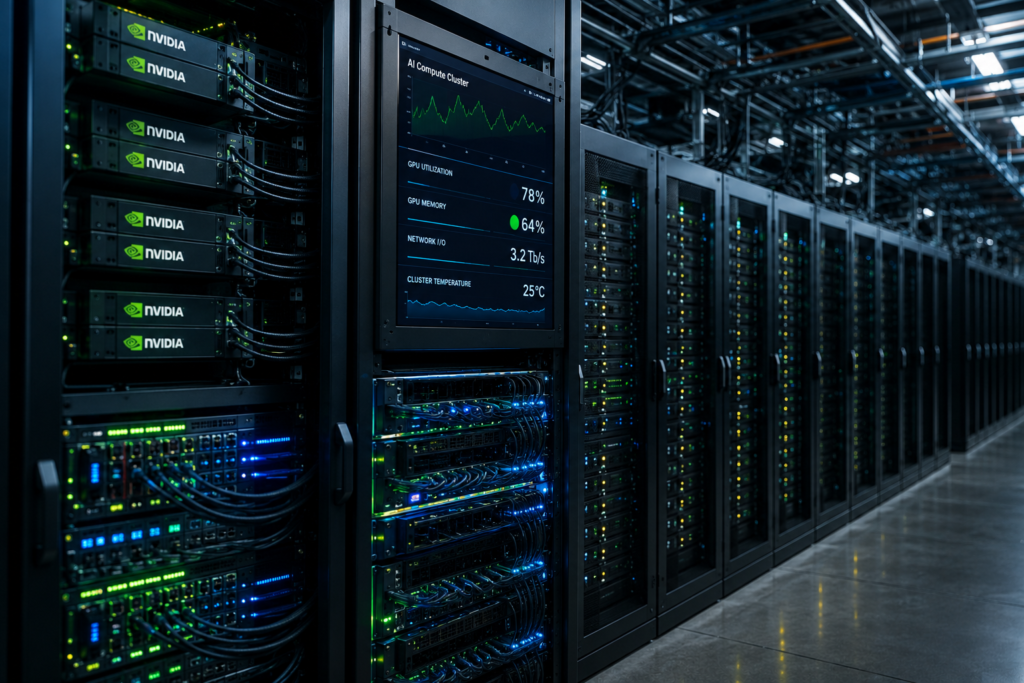
NVIDIA (NVDA) is the dominant supplier of GPUs and accelerated-computing infrastructure powering AI training and inference. Its CUDA software ecosystem creates real switching costs alongside hardware leadership. Continued AI infrastructure spending across hyperscalers is the core growth driver; risks include customer concentration among a handful of large buyers, competitive pressure from custom AI silicon, and the cyclicality inherent in semiconductor demand. These structural categories — AI infrastructure, cloud computing, and semiconductors — may remain important because enterprise digital transformation and AI adoption are still in relatively early stages across most industries, as explored further in our comparison of Amazon and Nvidia stock.
Best Tech Stocks Comparison
The table below summarizes each company’s positioning qualitatively rather than through live financial figures, which change frequently and should be verified directly before any investment decision.
| Company | Primary Technology Exposure | Growth Profile | Profitability Profile | Competitive Advantage | Key Risk |
|---|---|---|---|---|---|
| Apple | Consumer devices & services | Moderate, services-led | High margin, strong cash generation | Brand loyalty, integrated ecosystem | Hardware cycle maturity, regulatory scrutiny |
| Microsoft | Enterprise software, cloud, AI | Steady, cloud-driven | High margin, diversified | Enterprise lock-in, Azure scale | Heavy AI capital spending, cloud competition |
| NVIDIA | AI accelerators, data-center compute | High, AI-infrastructure-led | Currently very high margin | CUDA ecosystem, hardware leadership | Customer concentration, cyclicality |
| Alphabet | Search, digital ads, cloud, AI | Moderate-to-high | High margin, ad-driven | Search distribution, AI research depth | AI disruption to search, antitrust litigation |
| Palantir | Enterprise & government AI software | High, early-stage scaling | Improving, still maturing | Government relationships, AIP platform | Valuation risk, revenue concentration |
| Snowflake | Cloud data platform | High, consumption-based | Improving, pre-full profitability | Multi-cloud neutrality, developer adoption | Competitive intensity, revenue volatility |
How to Evaluate the Best Tech Stocks
Revenue Growth
Look at year-over-year growth and, more importantly, multi-year consistency rather than a single strong quarter. Customer expansion and the size of a company’s addressable market indicate how much runway remains for continued growth.
Profit Margins and Cash Flow
Gross margin, operating margin, and free cash flow reveal whether a company’s growth is financially efficient. Improving margins over multiple periods generally signal a more scalable business model than growth achieved through heavy discounting.
Valuation
Price-to-earnings and price-to-sales ratios help contextualize how much growth is already priced into a stock. The SEC’s investor education resources outline how these ratios work; the key is comparing valuation against growth and profitability rather than judging any single multiple in isolation.
Balance Sheet Strength
Cash reserves, debt levels, and liquidity determine how much flexibility a company has to keep funding innovation and weather a slowdown without diluting shareholders or cutting growth investment.
Tech Stock Comparison Chart
Editorial framework, not measured financial data. The scores below (1–5, where 5 is highest) reflect a qualitative editorial assessment of each company’s relative characteristics, intended to help readers compare investment profiles at a glance rather than represent audited or sourced figures.
| Company | Established Scale | Growth Potential | Profitability Maturity | AI Exposure | Relative Investment Risk |
|---|---|---|---|---|---|
| Apple | 5 | 2 | 5 | 3 | 2 |
| Microsoft | 5 | 3 | 5 | 4 | 2 |
| NVIDIA | 4 | 5 | 4 | 5 | 4 |
| Alphabet | 5 | 3 | 5 | 4 | 3 |
| Palantir | 2 | 5 | 2 | 5 | 5 |
| Snowflake | 2 | 4 | 2 | 4 | 4 |
Technology Sector Opportunity Comparison
Beyond individual companies, entire technology categories carry different long-term characteristics. The editorial ratings below (1–5) compare structural demand and risk across major sectors.
| Sector | Long-Term Demand | Market Maturity | Competitive Intensity | Revenue Scalability | Risk |
|---|---|---|---|---|---|
| Artificial Intelligence | 5 | 2 | 5 | 5 | 4 |
| Semiconductors | 5 | 3 | 4 | 4 | 4 |
| Cloud Computing | 5 | 4 | 4 | 5 | 2 |
| Cybersecurity | 5 | 3 | 3 | 4 | 2 |
| SaaS | 4 | 4 | 4 | 4 | 3 |
| Automation | 4 | 2 | 3 | 3 | 3 |
Risks of Investing in Tech Stocks
High Valuations
Many leading technology companies are priced for continued strong growth. When expectations run ahead of results, even a modest earnings miss can trigger sharp declines regardless of underlying business health.
Market Volatility
Technology stocks, and growth stocks generally, tend to experience larger price swings than more established sectors, particularly around earnings reports and shifts in interest-rate expectations.
Competition and Disruption
Technological leadership can shift quickly. A dominant position today does not guarantee the same standing in two or three years, especially in fast-moving categories like AI and semiconductors.
Regulation and Macroeconomic Conditions
Interest rate policy, data-privacy regulation, emerging AI governance rules, and antitrust scrutiny of the largest technology companies are all live risks that can affect valuations independent of company-specific execution.
Long-Term Strategy for Investing in Tech Stocks
Dollar-cost averaging — investing a fixed amount at regular intervals — helps reduce the risk of buying entirely at a market peak. Portfolio diversification across sectors and company sizes matters, since even the best tech stocks concentrated in a single portfolio can add outsized volatility. Avoiding hype-driven buying, monitoring fundamentals rather than headlines, holding positions with a genuine long-term horizon, and periodically reviewing a portfolio as company fundamentals evolve are all part of a disciplined approach. Even the best tech stocks should be sized according to an investor’s own diversification needs and risk tolerance rather than conviction alone, a principle covered further in our guide to high-growth technology stocks for long-term investors.

Future Trends That Could Shape the Best Tech Stocks
Artificial Intelligence
Enterprise AI adoption and continued AI infrastructure buildout — data centers, custom chips, and model deployment — remain among the clearest structural themes likely to influence technology stocks through the rest of the decade.
Cloud and Data Infrastructure
Continuing demand for computing power, storage, and enterprise digitization supports ongoing growth for cloud stocks and the infrastructure providers underneath them, even as competition among major providers intensifies.
Cybersecurity and Automation
Expanding cloud footprints and growing digital attack surfaces support structural demand for security spending, while automation technologies continue to draw enterprise investment as companies look to improve productivity.

Frequently Asked Questions
What are the best tech stocks to buy in 2026?
There is no single answer that fits every investor. Companies like Apple, Microsoft, NVIDIA, Alphabet, Palantir, and Snowflake are frequently discussed as candidates for the best tech stocks based on their fundamentals, but the right picks depend on an investor’s goals, risk tolerance, and time horizon rather than a guaranteed formula.
Are tech stocks good for long-term investing?
Many technology companies offer strong long-term growth potential due to structural demand for AI, cloud computing, and digital services, but they also carry higher volatility than more established sectors, so long-term suitability depends on individual risk tolerance.
How do I choose the best tech stocks?
Evaluate revenue growth consistency, profit margins and free cash flow, valuation relative to growth, balance sheet strength, and competitive advantage together, rather than relying on any single metric or headline in isolation.
What financial metrics should I check before buying tech stocks?
Revenue growth, gross and operating margins, free cash flow, valuation multiples such as P/E and P/S ratios, and balance sheet strength (cash and debt levels) are the core metrics worth reviewing before any purchase decision.
Are AI stocks too risky for long-term investors?
AI stocks can carry higher valuation and concentration risk than the broader market, but risk varies significantly by company. Diversifying across established and emerging AI-exposed names, rather than concentrating in a single stock, is one way long-term investors manage that risk.
Conclusion
Identifying the best tech stocks requires evaluating growth, profitability, competitive advantages, valuation, financial strength, and long-term industry positioning together, rather than chasing any single headline or trend. A disciplined, long-term approach — grounded in fundamentals rather than hype — tends to serve investors better than reacting to short-term price swings. This article is educational and does not constitute personalized investment advice; past performance does not guarantee future returns, and readers should consider their own financial situation or consult a licensed advisor before investing.