Not long ago, understanding how to invest in pre-IPO shares meant having institutional connections most people simply didn’t have. That’s changed. A growing number of platforms and secondary marketplaces now let accredited — and in some cases non-accredited — investors buy into private companies before they ever ring the opening bell on Nasdaq or the NYSE. The appeal is obvious: get in at a valuation set before public market hype (or panic) takes over.
But easier access doesn’t mean lower risk. Pre-IPO investing still comes with real constraints — eligibility requirements, limited liquidity, and companies that may never actually go public at all.
This guide breaks down who can invest, where to do it, how much capital you actually need, the risks worth taking seriously, and a step-by-step path for making your first pre-IPO investment with your eyes open.
What Are Pre-IPO Shares and Why Investors Want Them
Before getting into how to invest in pre-IPO shares, it helps to understand exactly what they are. Pre-IPO shares are equity in a private company — stock that exists before that company lists on a public exchange like the Nasdaq or NYSE. They typically come from a few sources:
- Employee equity — stock options or shares held by current or former employees, often available through secondary marketplaces once vesting requirements are met
- Direct company rounds — shares issued during late-stage private funding rounds, usually reserved for institutional or accredited investors
- Secondary marketplace listings — platforms that match willing sellers (employees, early investors) with buyers looking for pre-IPO exposure
Investors are drawn to this stage for a few clear reasons:
- Valuation upside — buying in before a public listing can mean a lower entry price than the eventual IPO valuation
- Access to high-growth companies — some of the fastest-growing private companies delay going public for years, locking retail investors out of early gains
- Portfolio diversification — pre-IPO exposure adds a private-market asset class most portfolios don’t otherwise touch
Anyone learning how to invest in pre-IPO shares should start by understanding which of these paths is actually realistic for their situation.
Who Can Actually Invest in Pre-IPO Shares
Anyone researching how to invest in pre-IPO shares needs to understand one thing upfront: most opportunities aren’t open to everyone. Eligibility depends heavily on accreditation status and the specific platform or offering.
- Accredited investors — under SEC rules, this typically means an individual with a net worth over $1 million (excluding primary residence) or annual income over $200,000 ($300,000 combined with a spouse) for the past two years. Most direct pre-IPO deals and many secondary marketplaces restrict access to this group.
- Non-accredited investors — some platforms operating under Regulation A+ or Regulation Crowdfunding exemptions allow non-accredited investors to participate, though usually with lower investment caps and more limited company selection.
- Institutional and qualified purchasers — larger investment minimums often unlock access to late-stage private funding rounds not available to individual retail investors at all.
- Employees and early stakeholders — a separate path entirely; those already holding equity through employment don’t need external accreditation to hold shares, though selling them still involves its own restrictions.
Verification usually happens directly through the platform — expect to submit income documentation, net worth statements, or a letter from a financial professional confirming accredited status.
The practical takeaway: before getting deep into how to invest in pre-IPO shares, confirm which eligibility category applies, since it determines which platforms and deals are actually accessible in the first place.
Platforms and Ways to Invest in Pre-IPO Shares
Once eligibility is sorted, the next question in how to invest in pre-IPO shares is where to actually do it. Access generally falls into a few categories, each with different minimums, liquidity, and risk profiles.
- Secondary marketplaces — platforms built specifically to match sellers (usually employees or early investors) with buyers seeking pre-IPO exposure. These typically require accreditation, charge transaction fees, and involve company approval before a trade can close, since most private companies restrict who can hold their stock.
- Popular trading and investing apps — several mainstream brokerage and investing apps have added pre-IPO or “pre-market” access features in recent years, usually through partnerships with secondary marketplaces rather than direct company offerings. These lower the barrier to entry somewhat, but eligibility and available companies still vary significantly by platform.
- Venture capital funds and SPVs (special purpose vehicles) — pooled investment vehicles that give investors indirect exposure to a private company through a fund structure, often with lower individual minimums than investing directly, though typically still restricted to accredited investors.
- Regulation A+ and crowdfunding platforms — some platforms operate under SEC exemptions that allow non-accredited investors to participate in select private offerings, usually with lower investment caps per deal.
- Direct company rounds — later-stage funding rounds occasionally open to outside investors, though this route is the least accessible for most individuals and usually requires existing industry connections or institutional relationships.
Each route comes with a different tradeoff between accessibility, fees, and how quickly (or whether) you can exit the position before an actual IPO happens. Anyone serious about how to invest in pre-IPO shares should compare platforms on eligibility requirements, fee structure, and how established their track record is before committing capital.

How Much Money You Need to Get Started
A common question in how to invest in pre-IPO shares is whether this is only for investors with serious capital. The honest answer: it depends heavily on the route chosen.
- Direct secondary marketplace deals — often require several thousand dollars minimum, sometimes more, since individual share blocks and transaction fees add up quickly.
- SPVs and pooled funds — can lower the entry point meaningfully, with some structures accepting investments in the low thousands rather than requiring a large lump sum.
- Regulation A+ and crowdfunding platforms — generally the most accessible route for investing with limited capital, with some offerings open for a few hundred dollars, though annual investment caps apply based on income and net worth.
- Fees matter as much as minimums — platform fees, carry on gains, and transaction costs can eat into smaller investments disproportionately, so a low minimum doesn’t always mean a genuinely low-cost entry point.
The realistic takeaway: it’s possible to start learning how to invest in pre-IPO shares without six figures in capital, but the lowest-minimum routes usually come with tradeoffs in company selection, fees, or investment caps that are worth weighing carefully.
Risks of Investing in Pre-IPO Shares
No honest guide to how to invest in pre-IPO shares can skip the risks — and in this asset class, they’re significant enough to shape how much capital anyone should reasonably commit.
- Illiquidity — pre-IPO shares can’t be sold on demand the way public stock can. Investors may be locked in for years with no clear exit if a company delays going public or gets acquired instead.
- No guarantee of an IPO at all — plenty of well-funded private companies never go public. An investment thesis built entirely around an eventual listing can simply fail to materialize.
- Limited financial transparency — private companies aren’t required to disclose financials the way public companies are, making it harder to properly evaluate the investment before committing.
- Valuation uncertainty — private company valuations are set through funding rounds, not public market pricing, and can be marked up or down dramatically before any liquidity event occurs.
- Dilution risk — additional funding rounds after your investment can dilute your ownership stake if you don’t have pro-rata rights.
- Platform and counterparty risk — secondary marketplaces and SPV structures add another layer of complexity and fees, and not all platforms have long track records.
None of this means pre-IPO investing is a bad idea — it means anyone learning how to invest in pre-IPO shares should treat it as a small, high-risk allocation within a broader portfolio, not a core holding.

Step-by-Step: How to Invest in Your First Pre-IPO Company
Putting everything together, here’s a practical walkthrough of how to invest in pre-IPO shares for the first time.
- Step 1: Confirm your eligibility. Determine whether you qualify as an accredited investor, or identify platforms operating under exemptions that accept non-accredited investors. This determines which doors are actually open to you.
- Step 2: Choose your access route. Decide between a secondary marketplace, an SPV/fund structure, a Regulation A+ offering, or a trading app with pre-IPO features, based on your capital, risk tolerance, and desired level of involvement.
- Step 3: Vet the platform. Look at how long it’s been operating, its fee structure, how it verifies company information, and whether it has a track record of completed transactions — not just listed opportunities.
- Step 4: Research the specific company. Since private companies disclose far less than public ones, dig into whatever financial information, funding history, and growth metrics are available before committing capital.
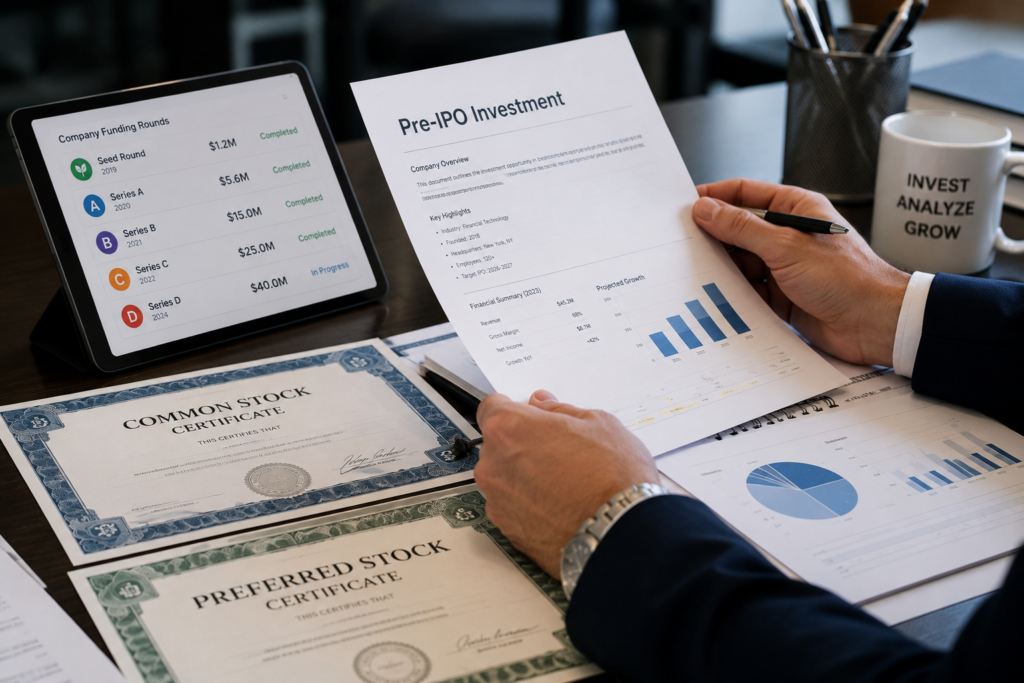
- Step 5: Understand the terms of your investment. Know exactly what you’re buying — common stock, preferred shares, or a fund interest — along with any lockup periods, transfer restrictions, or company approval requirements attached to it.
- Step 6: Size the investment appropriately. Given the illiquidity and risk involved, treat this as a small allocation relative to your overall portfolio, not a concentrated bet.
- Step 7: Plan for a long holding period. Go in assuming your capital could be tied up for years with no interim liquidity, and avoid investing money you might need access to in the near term.
- Step 8: Track the company post-investment. Follow funding rounds, leadership changes, and IPO signals so you’re not caught off guard by a liquidity event or, just as importantly, a stalled one.
Following this process is the difference between speculating and actually knowing how to invest in pre-IPO shares responsibly.
Pre-IPO Investing vs. Waiting for the Public Listing
A fair question after learning how to invest in pre-IPO shares is whether it’s even worth it compared to simply waiting and buying after the company lists. Both paths have real tradeoffs.
- Potential upside — pre-IPO investors sometimes capture growth that happens before public markets get access, especially if the company’s valuation rises significantly between the private round and its public debut.
- Liquidity — waiting for the public listing means you can buy and sell whenever markets are open. Pre-IPO investors give that up entirely until a liquidity event occurs.
- Information available — public companies file regular, standardized disclosures. Private companies don’t, so post-IPO investors make decisions with far more transparency.
- Volatility at listing — IPOs can pop or drop sharply on debut, meaning “waiting” doesn’t guarantee a better entry price either.
- Long-term growth exposure — some of the strongest growth years for high-performing companies happen while still private, which is the core case for pre-IPO investing despite the added risk.
Neither approach is universally better. The decision to learn how to invest in pre-IPO shares versus simply waiting for the listing comes down to individual risk tolerance and time horizon.

FAQs
How do I start learning how to invest in pre-IPO shares?
Start by confirming your accreditation status, then research secondary marketplaces, SPVs, or Regulation A+ platforms that match your eligibility and capital.
Can I invest in pre-IPO shares without being an accredited investor?
Yes, in some cases — platforms operating under Regulation A+ or crowdfunding exemptions accept non-accredited investors, typically with lower investment caps.
How long do I have to hold pre-IPO shares before I can sell?
It varies by company and platform, but expect lockup periods that can extend well beyond a year, with no guarantee of a public listing at all.
Is pre-IPO investing riskier than buying public stocks?
Generally yes — limited liquidity, less financial transparency, and no guarantee of an eventual IPO make this a higher-risk allocation than public equities.
What’s a realistic amount to start with?
It depends on the platform — some Regulation A+ offerings start in the low hundreds, while direct secondary deals often require several thousand dollars minimum.
Closing
Learning how to invest in pre-IPO shares comes down to understanding your eligibility, choosing the right platform for your capital and risk tolerance, and going in with realistic expectations about liquidity and timelines. This isn’t a shortcut to guaranteed gains — it’s a higher-risk, higher-potential allocation that deserves careful research, not hype-driven decisions.
For more on evaluating high-growth companies before they go public, explore our IPO and public company coverage for the latest listings, trends, and analysis. Check back regularly — this guide will be updated as new platforms and regulations shape pre-IPO access.