Introduction
Cloud computing has moved beyond being just a cost-saving tool — it’s now the backbone of digital transformation for businesses worldwide. In 2025, trends like AI integration, hybrid architectures, edge computing, sustainability initiatives, and industry-specific cloud solutions are shaping how companies innovate, scale, and compete.
In this case study, we explore key cloud computing trends, real-world examples, and the strategic implications for businesses aiming to stay ahead in an increasingly competitive and tech-driven market.

1. Hybrid and Multi-Cloud Strategies Dominate
Why Hybrid is Winning Over Pure Cloud Models
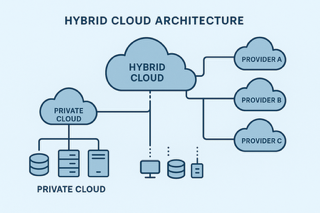
In 2025, over 80% of enterprises are adopting a hybrid or multi-cloud strategy. Rather than relying on a single vendor, companies are blending private and public clouds to achieve flexibility, cost control, and regulatory compliance.
This approach is driven by the fact that no single cloud provider can meet every requirement. Public clouds offer scalability, while private clouds offer control and compliance. Multi-cloud setups allow businesses to distribute workloads strategically, mitigating the risks of downtime, data breaches, or vendor lock-in.
Case Example:
A multinational bank uses AWS for AI-driven analytics, Azure for compliance-related workloads, and an on-premises private cloud for storing sensitive customer data. This multi-cloud approach reduces vendor lock-in while ensuring each workload is handled on the most suitable platform.
Strategic Insight:
Businesses that mix providers can negotiate better pricing, avoid single points of failure, and adapt faster to regulatory changes. For instance, if a compliance regulation changes in one market, workloads can be quickly shifted to a compliant region or provider.
2. AI-Driven Cloud Services Transform Operations
From Automation to Autonomous Decision-Making
The integration of artificial intelligence into cloud platforms is no longer experimental — it’s mainstream. AI now powers predictive analytics, real-time decision-making, and automated customer engagement across industries.
In 2025, AI in the cloud is evolving from simply automating workflows to enabling autonomous operations. Businesses can forecast supply chain bottlenecks before they happen, optimize energy consumption in manufacturing plants, or personalize marketing campaigns at scale.
Case Example:
E-commerce giant Shopify uses AI-powered cloud tools to analyze purchasing behavior and automatically adjust inventory and pricing. This optimization has boosted profit margins by 12% year-over-year while reducing stock-outs by 18%.
Strategic Insight:
Without AI-driven capabilities, companies risk falling behind on both efficiency and innovation. AI’s integration into cloud services is also making advanced analytics accessible to small and mid-sized businesses that previously lacked the infrastructure.
3. Edge Computing Reduces Latency
Why Businesses Are Moving Closer to the User
Edge computing brings data processing closer to the source — such as IoT devices, mobile apps, and local servers — drastically reducing latency and improving real-time responsiveness.
This shift is crucial in sectors where milliseconds matter. In healthcare, it could mean processing patient vitals instantly during surgery. In finance, it could be executing a high-frequency trade faster than competitors.
Case Example:
Tesla integrates edge computing into its self-driving systems, processing sensor data locally for split-second decision-making. The car still syncs with Tesla’s central cloud for long-term analytics, but immediate actions happen on the edge to avoid dangerous delays.
Strategic Insight:
For industries like autonomous vehicles, telemedicine, manufacturing, and gaming, edge computing is becoming a non-negotiable investment. Cloud providers are now offering edge zones in multiple cities to help companies expand without building their own infrastructure.

4. Industry-Specific Cloud Solutions Rise
One-Size-Fits-All Cloud Is Dead
Generic cloud platforms are giving way to industry-specific solutions that address unique compliance, security, and operational needs.
Cloud providers now offer pre-configured environments with sector-specific certifications, APIs, and integrations. This accelerates adoption and reduces the need for custom development.
Case Example:
A U.S.-based hospital network adopted a HIPAA-compliant cloud platform that integrates medical imaging AI directly into its workflow. This reduced diagnosis times by 30%, allowing doctors to treat patients faster and improve survival rates.
Strategic Insight:
Specialized platforms can reduce onboarding time, improve compliance, and enhance ROI for companies in heavily regulated sectors like healthcare, banking, and government.
5. Cloud Security Moves to a Zero-Trust Model
Security No Longer an Afterthought
With the growth of cloud adoption comes an increase in cyber threats. The Zero Trust model — built on the principle of “never trust, always verify” — is now a default architecture for many enterprises.
Zero Trust assumes that threats can come from both inside and outside the organization. It enforces continuous authentication, role-based access control, and micro-segmentation of workloads.
Case Example:
A European fintech implemented Zero Trust architecture across its AWS and Azure deployments, reducing phishing-related breaches by 95% and cutting unauthorized access incidents to near zero.
Strategic Insight:
Security must be baked into cloud architecture from day one. Reactive approaches after a breach are costly, both in financial losses and brand reputation.
6. Sustainability Becomes a Cloud Priority
Green Cloud Is a Competitive Advantage
Sustainability is no longer just a corporate social responsibility checkbox — it’s becoming a competitive differentiator.
Cloud providers are moving towards renewable-powered data centers and offering clients visibility into their carbon usage. Businesses can now select providers based on environmental impact, aligning with their ESG goals.
Case Example:
Microsoft has pledged to be carbon-negative by 2030, offering cloud customers real-time carbon tracking dashboards to measure and offset their IT-related emissions.
Strategic Insight:
Choosing sustainable cloud providers not only helps the planet but can win over customers and investors who prioritize ESG metrics.
Key Statistics for 2025 Cloud Computing
- 80% of enterprises use hybrid or multi-cloud strategies
- 65% of cloud spending is now AI-related
- 50% of new enterprise data is processed at the edge
- Cloud security spending is up by 22% year-over-year
- Over 70% of large enterprises have a formal sustainability policy influencing vendor selection
Conclusion
The future of cloud computing is not just about storage and processing power — it’s about intelligence, speed, customization, security, and sustainability.
Companies that adopt these trends early will not only optimize operations but also position themselves for long-term competitive advantage. In 2025 and beyond, cloud strategy will be as critical to business success as product innovation or customer experience.