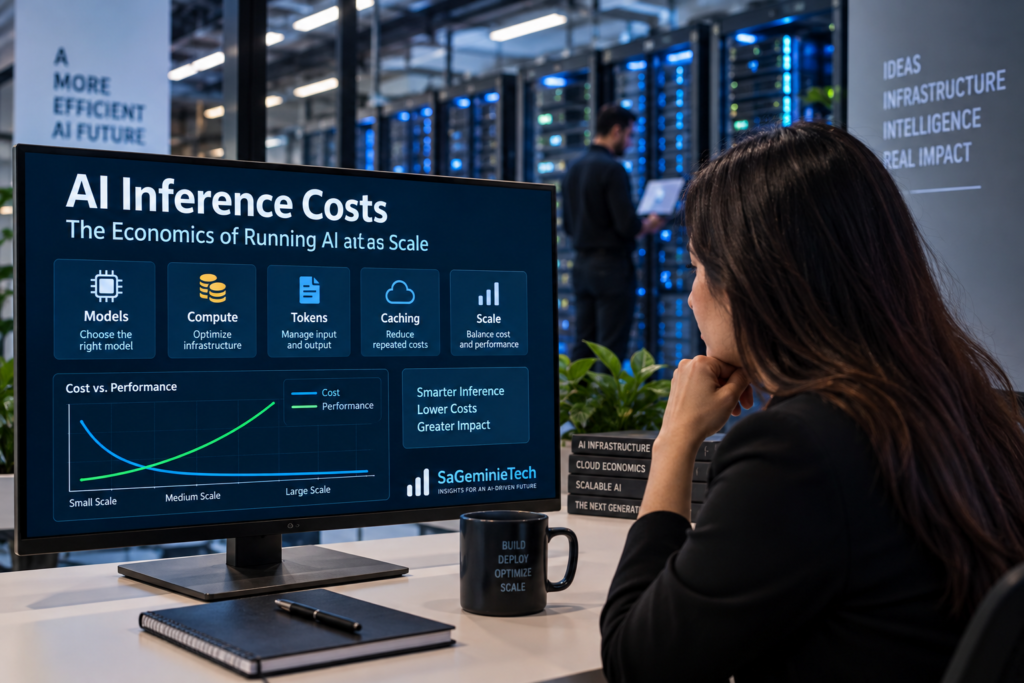
AI inference costs are becoming one of the most important economic variables in production artificial intelligence. Training a model may require a large upfront investment, but inference is what happens every time that model is actually used. A chatbot response, an AI search result, a generated image, a coding suggestion or an autonomous agent completing a multistep task all require inference. That changes the economics of AI once a product reaches scale. A company can reduce the price it pays for individual tokens and still see its total AI bill rise. More users create more requests. Longer context windows increase input processing. Reasoning systems can generate substantially more tokens. Agentic applications may call models repeatedly while completing a single task. Businesses may also adopt more capable—and more expensive—models as those capabilities become commercially useful. This creates an important distinction between unit inference cost and total inference expenditure. Gartner describes a related dynamic as the “Inference Paradox”: improving foundational-model cost economics can enable increasingly sophisticated AI products whose overall inference requirements become more expensive. In August 2026, Gartner forecast that inference costs per agentic workflow would increase more than fivefold through 2028 as applications move toward more complex, multistep execution. That is a forecast rather than a universal cost rule, but it illustrates why falling token prices alone cannot describe the economics of production AI. Understanding AI inference costs therefore requires looking beyond a provider’s headline price per token.
What Actually Determines AI Inference Costs?
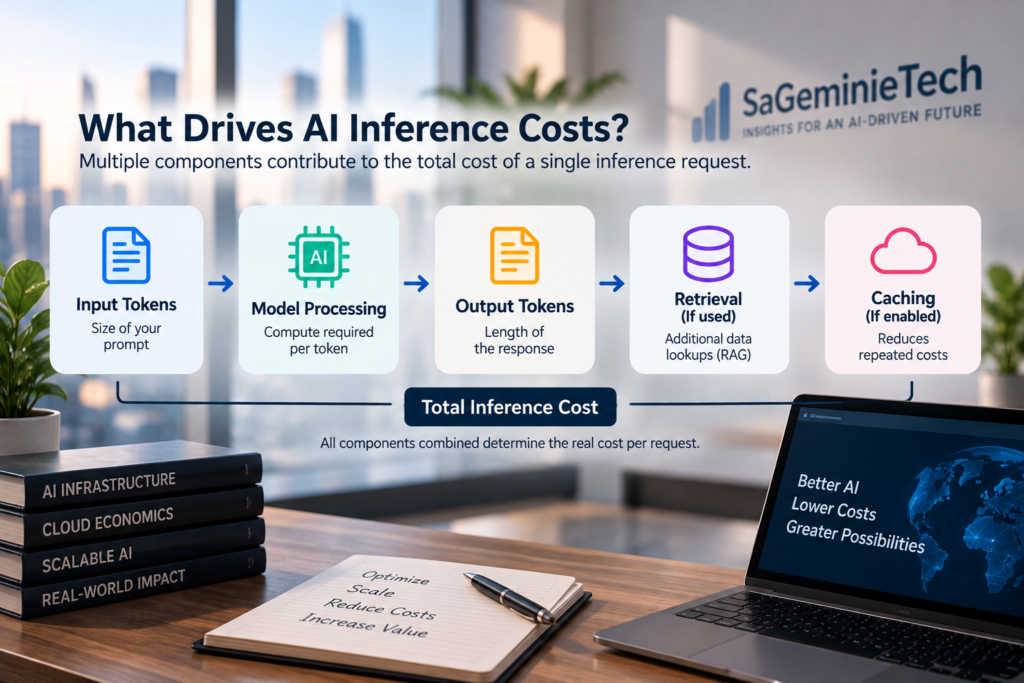
There is no universal “cost of inference.” The cost structure depends first on how the model is consumed. Managed foundation-model services commonly price usage according to input and output tokens. Self-hosted deployments instead expose infrastructure costs such as compute uptime, storage and networking. AWS specifically notes that foundation-model costs can vary substantially across providers, model families, model sizes and hosting paradigms. That means two AI applications serving the same number of users can have dramatically different inference economics. A relatively simple application might send a short prompt to a smaller model and receive a concise response. Another application might retrieve documents, construct a large context window, send the task to a reasoning model, invoke tools, evaluate intermediate results and make additional model calls before returning an answer. Both may count as one user request. Economically, they are very different workloads. A useful production cost model therefore considers at least the number of requests, average input and output token consumption, model choice, infrastructure or API pricing, traffic patterns and the performance requirements of the application. AWS recommends building cost models that include query volume, average prompt and completion token usage, LLM token pricing and supporting cloud infrastructure rather than treating the model API price as the entire cost of the application.
Tokens Are a Unit of Consumption, Not the Whole Economic Model
Token pricing is useful because it provides a measurable unit for managed model consumption. More tokens processed generally means more inference work and, under token-based pricing, more expenditure. But optimizing only the price of an individual token can produce a misleading picture. Suppose the cost per token falls while an application simultaneously begins using longer prompts, larger context windows, more output tokens and additional reasoning steps. The cost of each unit may be lower while the number of units consumed rises substantially. This is especially relevant as AI systems move beyond straightforward question-and-answer interactions. Gartner argues that increasingly sophisticated workflows can consume far more tokens than simple chatbot interactions. Its 2026 analysis says improved AI efficiency is enabling more powerful applications while the complexity of those applications increases aggregate inference requirements. For operators, the relevant equation is therefore closer to: Total inference expenditure = unit cost × inference consumption × workload volume Even that is simplified because infrastructure, caching, routing and utilization can change the effective cost of serving those workloads. This is why the economics of AI at scale cannot be reduced to a model-provider price sheet.
Model Choice Can Change the Cost Curve
Using the most capable available model for every request may be technically straightforward, but it is not necessarily economically efficient. Different tasks require different levels of intelligence. A classification request, extraction task or straightforward transformation may be handled adequately by a smaller model. Complex analysis or difficult reasoning may justify a more capable model. AWS recommends beginning with smaller models where appropriate and increasing model capability until workload requirements are satisfied. It also recommends decomposing workloads so that simpler inference requests can be routed to smaller, more cost-effective models while more difficult requests use stronger models. This introduces model routing as an economic control. Instead of asking whether Model A is cheaper than Model B, production systems can ask which requests actually require Model B. The difference matters at scale. A small saving on one request may appear insignificant. Applied across millions of requests, systematic routing decisions can materially alter the application’s cost structure. The same principle applies to deployment architecture. On-demand APIs, provisioned capacity, batch inference and self-hosted infrastructure expose different combinations of cost, operational responsibility and performance. AWS consequently recommends evaluating inference paradigms against both workload requirements and cost rather than assuming that one deployment model is universally optimal.
Utilization Changes the Economics of Self-Hosted Inference
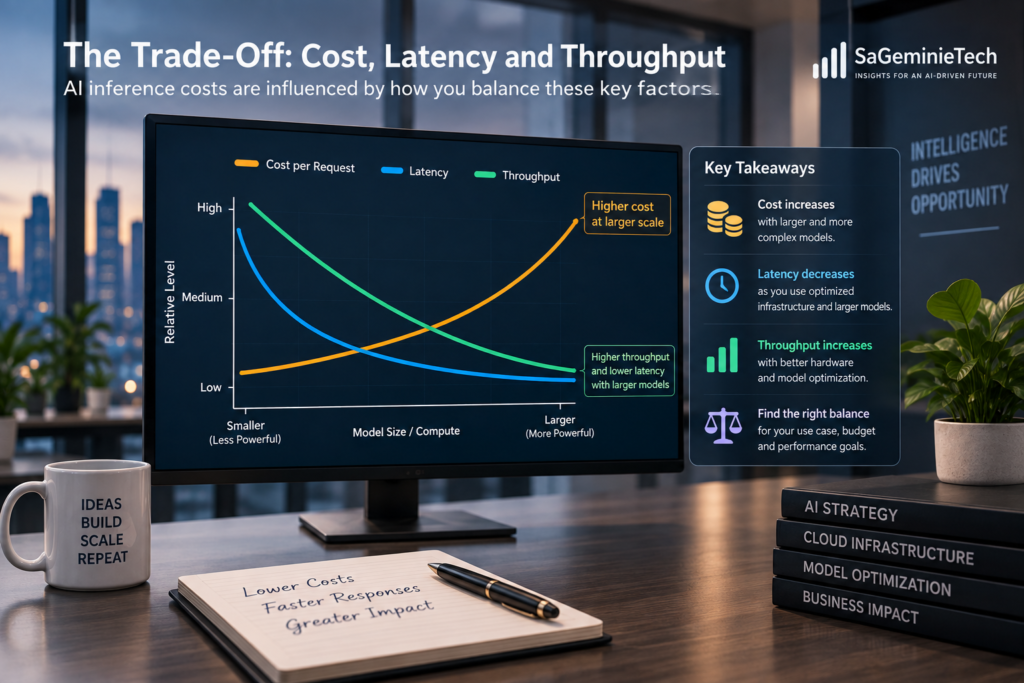
Token-based APIs make the consumption relationship relatively visible: usage generates charges. Self-hosted infrastructure introduces another problem—capacity can cost money even when it is not producing useful output. A company operating GPUs or other accelerators therefore needs to care about how effectively that infrastructure is utilized. Paying for expensive compute that spends significant time idle can produce poor unit economics even if the hardware is extremely fast when active. But there is no single utilization percentage that represents an economically optimal AI deployment. Workloads differ. Interactive applications may require spare capacity to absorb traffic spikes and maintain latency targets. Batch workloads can often prioritize throughput differently. Long-context workloads, multimodal models and different model architectures can place different demands on compute and memory. The economic objective is therefore not simply “maximize GPU utilization.” It is to achieve efficient utilization while meeting the application’s service requirements. This is where throughput and latency become economic variables. Current LLM benchmarking guidance distinguishes time to first token, inter-token latency, end-to-end request latency and throughput as separate production metrics. Amazon SageMaker Inference Recommender benchmarks endpoint configurations across performance and resource-utilization metrics, reflecting that cost and performance objectives can require different configurations. A system optimized solely for maximum throughput might not deliver the responsiveness required by an interactive product. Conversely, infrastructure provisioned for extremely low latency may carry excess capacity that raises the cost of each useful request. Inference economics therefore involve a performance-cost frontier rather than one universally optimal configuration.
Throughput Can Matter More Than the Hourly Price of Hardware
The hourly price of an accelerator does not reveal how much useful inference work that accelerator can deliver. Imagine two configurations. One costs less per hour but produces significantly fewer acceptable tokens or requests during that hour. Another has a higher hourly cost but processes considerably more useful work while satisfying the same latency requirement. The more expensive machine can potentially have the lower cost per unit of useful output. This is why production benchmarking increasingly measures tokens per second, request throughput and latency alongside infrastructure cost. NVIDIA’s benchmarking documentation defines workload metrics including time to first token, end-to-end latency, inter-token latency, tokens per second and requests per second. Its published performance claims should be understood as vendor-produced evidence, not neutral industry-wide cost guarantees, but the underlying economic principle is important: hardware price without workload performance is an incomplete cost measure. AWS takes a similar workload-specific approach through SageMaker Inference Recommender, which performs load testing across endpoint configurations and reports performance and resource-utilization metrics. The relevant question is therefore not merely: How much does this infrastructure cost? It is: How much does it cost to deliver the required amount of acceptable inference performance?
Caching Can Remove Repeated Inference Work
Not every request requires completely fresh computation. Production AI applications frequently contain repeated prompt prefixes, shared instructions or recurring context. Where supported and appropriate, caching can reduce the amount of work that must be recomputed. AWS documents prompt caching for supported Amazon Bedrock models as a method for reducing inference response latency and input-token costs. Frequently reused prompt components can be cached rather than processed identically each time. At the system level, prefix caching can similarly avoid redundant computation for repeated prompt prefixes. AWS’s production inference guidance identifies caching, continuous batching, routing and sequence-size tuning among the techniques that can improve inference efficiency. Caching does not eliminate inference economics. It changes them. Its value depends on the workload. An application with highly repetitive context may benefit considerably more than one in which almost every request is unique. The broader lesson is that token consumption is partly an architectural outcome. Application design determines how often information is sent to a model, how much context is repeatedly processed and whether previously computed work can be reused.
AI Agents Make Cost Accounting More Complicated
Agentic AI makes the difference between a user action and an inference event particularly important. A traditional chatbot interaction may involve a relatively direct sequence: receive a prompt, perform inference and return a response. An agent may perform many operations to satisfy one request. It might interpret the objective, formulate a plan, retrieve information, call external tools, inspect the results, reconsider its approach and invoke a model again. A single visible task can therefore trigger multiple inference operations and substantially more token processing. Gartner’s 2026 forecast focuses specifically on this transition. It says routing a task to an agentic reasoning model can increase provider inference costs substantially compared with a basic chatbot interaction and forecasts inference cost per agentic workflow rising more than fivefold through 2028. Those figures are Gartner’s analysis and forecast, not a universal multiplier applicable to every AI agent. This distinction matters for AI businesses because customer-facing pricing is often expressed per seat, task or workflow rather than per token. If the inference work required for each workflow expands faster than the revenue associated with it, gross margins can come under pressure even while underlying model prices decline.

Lower AI Inference Costs Do Not Automatically Mean Lower AI Spending
This is the central economic point. Technology improvements can make an individual unit of AI inference cheaper while simultaneously expanding the amount of inference businesses find worthwhile to consume. Cheaper inference can enable new features. Faster infrastructure can support higher traffic. Larger context windows can encourage applications to process more information. Better reasoning models can make previously impractical workflows commercially useful. Agents can convert a single user request into a chain of model interactions. As a result, declining unit prices and rising aggregate expenditure are not contradictory. For companies building AI products, this makes inference cost management an architectural and product-management discipline rather than a procurement exercise alone. Teams need to understand which models are serving which tasks, how many tokens their workflows consume, how infrastructure behaves under realistic traffic, what latency customers actually require, where caching can remove redundant computation and whether increasingly sophisticated workflows generate enough business value to justify their inference requirements. That analysis should also connect to the broader economics of cloud costs for AI startups and the reasons AI startups can burn cash quickly. Inference is only one part of the cost structure, but as AI products acquire users, it can become a recurring variable cost directly tied to product usage. For a broader view of the technology and economics shaping the sector, see SaGeminieTech’s Artificial Intelligence coverage.
The Economics of Inference Will Be Workload-Specific
There is unlikely to be one metric that settles every inference infrastructure decision. Cost per million tokens can be useful. So can cost per request, cost per completed workflow, tokens per second, accelerator utilization, latency and throughput. Which metric matters most depends on what the application is trying to accomplish. A consumer chatbot and an overnight document-processing pipeline should not necessarily optimize for the same performance target. Neither should a simple classification system and an autonomous research agent. The durable approach is to measure the economics of the actual workload. That means benchmarking realistic traffic, tracking input and output consumption, measuring latency and throughput, testing different model sizes, monitoring infrastructure utilization and continuously revisiting routing and caching decisions as models and prices change. Model right-sizing should be treated as an ongoing activity because models, workloads, prompting and orchestration evolve over time. AI inference costs therefore are not simply the price of running a model. They are the economic result of what model runs, how often it runs, how much work each request requires, how efficiently infrastructure processes that work and what performance the product promises its users. At small scale, those differences may be easy to overlook. At production scale, they can determine the economics of the entire AI product.