Finding the best AI tech stocks to invest in 2026 increasingly means looking past marketing language and toward the infrastructure actually powering the AI economy: compute capacity, custom silicon, cloud platforms, enterprise distribution, and the ability to convert AI adoption into real monetization and margin. Simply calling a product “AI-powered” no longer says much about durable competitive advantage. This article examines the companies with verifiable evidence behind their AI positioning, how to evaluate them, and the risks that come with the sector’s rapid growth.
Best AI Tech Stocks to Invest in 2026: Quick Comparison
The table below summarizes each company’s primary AI role before the detailed analysis that follows.
| Company | Ticker | AI Exposure / Category | Primary AI Growth Driver | Competitive Advantage | Major Risk |
|---|---|---|---|---|---|
| NVIDIA | NVDA | AI accelerators, data-center compute | AI infrastructure buildout across hyperscalers | CUDA software ecosystem, hardware leadership | Customer concentration, cyclicality |
| Microsoft | MSFT | Cloud AI, enterprise Copilot | Azure growth, Copilot seat expansion | Enterprise lock-in, OpenAI partnership | Scale of AI capital spending |
| Alphabet | GOOGL | Cloud AI, search AI, model research | Google Cloud growth, AI-integrated search/ads | Search distribution, deep AI research base | Search disruption risk, antitrust |
| Amazon | AMZN | Cloud AI infrastructure, custom silicon | AWS growth, enterprise AI compute demand | Cloud infrastructure scale, Trainium chips | Heavy capex relative to AWS returns |
| Broadcom | AVGO | Custom AI accelerators, networking | Hyperscaler custom-silicon demand | Deep hyperscaler relationships, ASIC expertise | Revenue concentration among few customers |
| Palantir | PLTR | Enterprise & government AI software | Commercial AI platform adoption (AIP) | Government relationships, deployment speed | High valuation relative to current scale |

Why AI Tech Stocks Matter in 2026
Several forces are driving investor attention toward the best AI tech stocks to invest in 2026, from raw compute demand to how quickly enterprises are actually deploying AI in production.
AI Infrastructure and Compute Demand
Training and running large AI models requires enormous specialized computing power — GPUs, custom accelerators, high-speed networking, and the data centers that house them. Hyperscalers are directing unprecedented capital toward this build-out: Amazon has guided to roughly $220 billion in 2026 capital expenditures, Alphabet raised its 2026 capex guidance to $195–$205 billion, and Microsoft’s fiscal 2026 capital expenditures totaled approximately $116 billion, nearly double the prior year. That spending flows directly to semiconductor and infrastructure suppliers.
Enterprise AI and Cloud Adoption
Cloud providers and enterprise software companies monetize AI adoption by embedding it directly into products enterprises already pay for — cloud compute, productivity software, and data platforms — rather than selling AI as a standalone product. Microsoft’s AI business reached an annualized revenue run rate of $37 billion, up 123% year-over-year, according to Microsoft’s own fiscal Q4 2026 results, illustrating how quickly enterprise AI monetization can scale once distribution already exists.
Top AI Tech Stocks to Watch in 2026
The following companies have current, verifiable business evidence supporting their inclusion among the best AI tech stocks to invest in 2026 — not simply AI branding.
NVIDIA (NVDA)
NVIDIA supplies the GPUs and accelerated-computing infrastructure that train and run most large AI models. In its most recently reported quarter (Q1 fiscal 2027, ended April 26, 2026), the company posted revenue of $81.6 billion, up 85% year-over-year, with data-center revenue of $75.2 billion, up 92%, according to NVIDIA’s investor relations results. Its moat rests on the CUDA software ecosystem and hardware leadership; the primary risk is customer concentration and rising custom-silicon competition from hyperscalers’ in-house chip programs.
Microsoft (MSFT)
Microsoft monetizes AI through Azure and Copilot across its enterprise software suite. Azure crossed $100 billion in annual revenue and grew 43% year-over-year in fiscal Q4 2026, while Microsoft 365 Copilot reached 30 million paid seats, per the company’s official results. Its moat is enterprise lock-in through Office 365 and its OpenAI partnership; the key risk is whether AI-related returns justify capital spending that nearly doubled year-over-year.
Alphabet (GOOGL)
Alphabet’s AI exposure spans Google Cloud, AI-integrated search and advertising, and foundational model research through Gemini and DeepMind. Google Cloud revenue surged 82% year-over-year to $24.8 billion in Q2 2026, with a cloud backlog of $514 billion, according to Alphabet’s investor relations disclosures. Its advantage is search distribution scale and deep AI research capability; the primary risk is that AI chat interfaces could disrupt traditional search behavior over time, alongside ongoing antitrust litigation.
Amazon (AMZN)
Amazon’s AI opportunity runs through AWS, where enterprise customers deploy AI infrastructure and models, alongside custom Trainium and Graviton silicon. AWS revenue reached $42.2 billion in Q2 2026, up 37% year-over-year — its fastest growth rate in 18 quarters — as detailed in our full Amazon Stock Analysis. Its moat is cloud infrastructure scale and an already-contracted infrastructure backlog; the key risk is whether AI-driven AWS growth justifies roughly $220 billion in 2026 capital spending.
Broadcom (AVGO)
Broadcom designs custom AI accelerators (ASICs) and networking silicon for hyperscale customers. In fiscal Q2 2026 (reported June 3, 2026), the company posted record revenue of $22.2 billion, up 48% year-over-year, with AI semiconductor revenue of $10.8 billion, up 143%, and a record 67% operating margin, according to Broadcom’s official Q2 fiscal 2026 results. Its advantage is deep, custom engineering relationships with a small number of hyperscale customers; that same concentration is also its primary risk. Broadcom has guided to $16 billion in AI semiconductor revenue for fiscal Q3 2026, though that figure remains guidance, not a reported result.
Palantir (PLTR)
Palantir provides AI-driven data analytics software to government agencies and, increasingly, commercial enterprises through its AIP platform. Total revenue reached $1.935 billion in Q2 2026, up 93% year-over-year, with U.S. commercial revenue up 149%, according to the company’s investor relations results. Its moat is deep government relationships and rapid enterprise deployment speed; the primary risk is a valuation that already prices in substantial future growth relative to its current revenue scale.

How to Evaluate the Best AI Tech Stocks
Screening for the best AI tech stocks to invest in 2026 requires more than checking which companies mention AI most often on earnings calls.
Revenue Growth and AI Monetization
Genuine AI monetization means AI directly drives new, measurable revenue — new compute demand, new subscription seats, new contract value — rather than a company simply adding AI features to an existing product without a clear path to additional revenue. Companies that separately disclose AI-specific metrics, like Microsoft’s Copilot seat counts or Broadcom’s AI semiconductor revenue, give investors a clearer read than vague references to “AI strategy.”
Margins, Free Cash Flow and Valuation
Revenue growth alone does not determine investment quality. Operating margins, free cash flow, and capital expenditure relative to revenue growth show whether AI investment is translating into sustainable profitability or simply consuming cash. Valuation multiples matter too: even a company with genuine AI monetization can be a poor investment if the price already assumes years of flawless execution.
Competitive Moat and AI Infrastructure
Switching costs, ecosystem strength, distribution advantages, proprietary technology, and access to scarce compute capacity all shape which companies can defend their position as AI competition intensifies. Scale matters too — the largest hyperscalers can outspend smaller competitors on infrastructure, which reinforces their advantage even as costs rise across the industry.
AI Stock Comparison: Growth, Valuation & Risk
Comparing candidates for the best AI tech stocks to invest in 2026 side by side helps separate genuine leaders from companies simply riding sector-wide sentiment. The table below uses only verifiable, sourced figures from each company’s most recently reported quarter as of August 2026. Forward valuation multiples are omitted where reliable, current data could not be independently confirmed at the time of publication, consistent with a policy of not estimating figures that cannot be verified.
| Company | Latest Reported Revenue Growth (YoY) | Operating Margin | AI Positioning | Relative Risk Level |
|---|---|---|---|---|
| NVIDIA | +85% (Q1 FY2027) | ~65%* (non-GAAP gross) | Core AI hardware supplier | High — customer concentration |
| Microsoft | +18% (FY2026 Q4) | Not disclosed separately for AI segment | Enterprise AI distribution | Moderate — diversified revenue base |
| Alphabet | +24% (Q2 2026) | 34% (consolidated) | Cloud AI + search AI | Moderate — antitrust overhang |
| Amazon | +20% (Q2 2026) | 39.4% (AWS segment only) | Cloud AI infrastructure | Moderate — high capex |
| Broadcom | +48% (FQ2 2026) | 67% (record, company-wide) | Custom AI silicon | High — customer concentration |
| Palantir | +93% (Q2 2026) | 62% (adjusted operating) | Enterprise/government AI software | High — valuation relative to scale |
Major Risks of Investing in AI Stocks
No list of the best AI tech stocks to invest in 2026 would be complete without naming the risks plainly, since strong growth today does not eliminate real downside scenarios.
Valuation Risk
Many AI-exposed stocks already price in years of continued rapid growth. Even a modest deceleration can trigger sharp multiple compression, independent of whether the underlying business remains healthy.
Competition and Technology Risk
AI architectures are evolving quickly. Custom silicon efforts at major cloud providers, new model architectures, and the gradual commoditization of some AI capabilities could erode the pricing power of today’s leaders faster than markets currently expect. Our comparison of Amazon and Nvidia stock examines how this competitive dynamic plays out between an infrastructure buyer and a hardware supplier.
Regulation and Capital Spending
Antitrust scrutiny, data-privacy rules, and emerging AI governance frameworks create regulatory uncertainty for the largest AI companies. At the same time, the sheer scale of AI infrastructure capital spending — collectively hundreds of billions of dollars annually across just a handful of companies — means a slowdown in that spending cycle would ripple across the entire group simultaneously.
How Investors Can Build AI Exposure
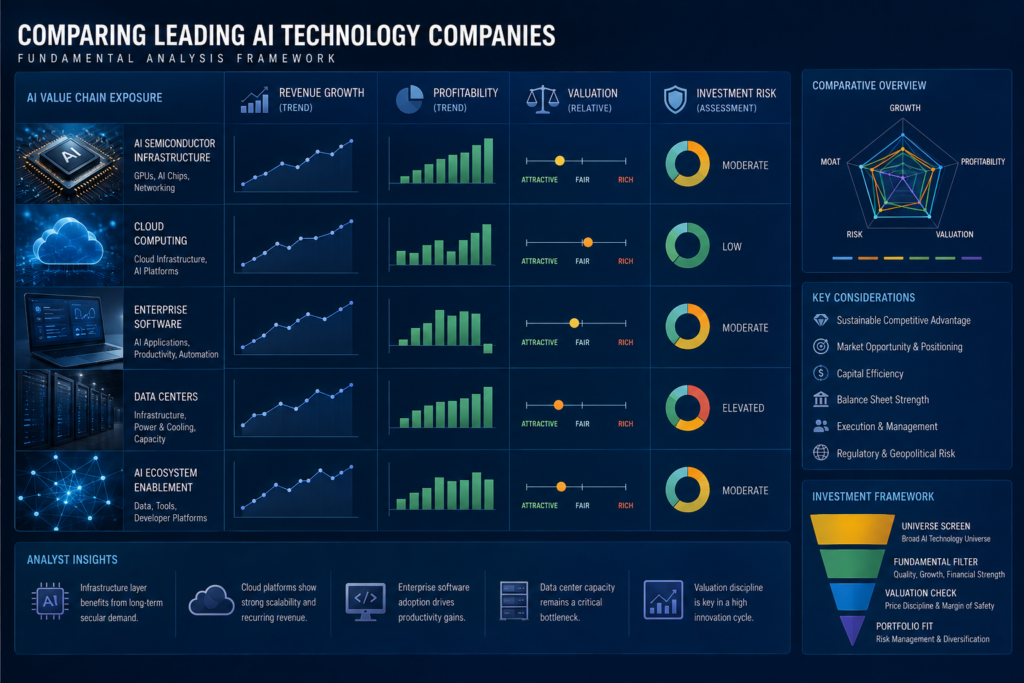
Rather than concentrating in a single name, many investors diversify exposure to the best AI tech stocks to invest in 2026 across three categories: semiconductor and compute suppliers (like NVIDIA and Broadcom), cloud and platform companies (like Microsoft, Alphabet, and Amazon), and enterprise software and applications built on top of that infrastructure (like Palantir). There is no universally correct allocation across these categories — the right mix depends on an individual investor’s risk tolerance, time horizon, and existing portfolio exposure, and this article does not prescribe a fixed percentage as appropriate for every investor. Comparisons with other best technology stocks can help contextualize AI names against the broader market, and our explainer on how the Nasdaq operates is useful background, since most of these companies trade there.
Conclusion: Which AI Stocks Stand Out in 2026?
Identifying the best AI tech stocks to invest in 2026 requires weighing business quality, genuine AI monetization, competitive moat, valuation, financial performance, and risk together, rather than favoring any single factor in isolation. Among the candidates examined here, NVIDIA, Microsoft, Alphabet, Amazon, Broadcom, and Palantir all show verifiable, current evidence of real AI-driven growth, making each a reasonable starting point for further research into the best AI tech stocks to invest in 2026. Strong business quality and an attractive entry valuation are not the same thing, however, and none of these companies is guaranteed to outperform. This article is informational and does not constitute personalized financial advice; investors should verify current data directly and consider their own risk tolerance, or consult a licensed advisor, before making investment decisions.