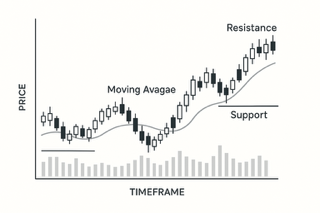
Technology Trends Shaping US Stock Market Growth in 2025–2026 refers to the broad set of technological developments that influence how publicly listed companies in the United States evolve, compete, and generate long-term value. Rather than focusing on individual stocks or short-term movements, this topic examines how technology reshapes entire sectors, business models, and capital allocation patterns within the technology trends US stock market.
From a global perspective, the US stock market holds a central role in reflecting technological progress. Many of the world’s largest technology-driven companies are listed in US exchanges, and their performance often mirrors deeper structural shifts—such as how businesses adopt new tools, automate operations, or create digital infrastructure. As a result, understanding technology trends is not only relevant to domestic observers but also to international audiences seeking clarity on how innovation influences market growth over time.
This article is written as an educational guide. Its purpose is to explain how technology trends interact with the structure of the US stock market, why these trends matter in a long-term context, and how they shape growth patterns across industries. By the end of this article, the reader will have a clear and grounded understanding of how technology trends US stock market dynamics are formed and why these forces remain relevant beyond short-term cycles.
The Structural Role of Technology in the US Stock Market
Technology has gradually shifted from being a single sector within the US stock market to becoming a foundational layer across nearly all industries. In earlier decades, technology companies were often categorized narrowly—focused on hardware, software, or telecommunications. Today, technology functions as an enabling force that affects manufacturing, healthcare, finance, logistics, and consumer services.
This structural shift matters because market growth is no longer driven only by product demand but also by efficiency, scalability, and data-driven decision-making. Companies that integrate technology into their operations tend to scale faster, adapt more easily to economic changes, and improve productivity over time. These characteristics influence how markets value firms and how long-term growth is distributed across sectors.
Another important aspect is market weighting. Technology-oriented companies now represent a significant portion of overall market capitalization in the United States. This means that broader market performance is increasingly sensitive to how technology trends unfold, rather than being tied solely to traditional industrial or commodity cycles.
Why Technology Trends Matter Beyond Short-Term Market Movements
Technology trends shape growth through gradual adoption rather than immediate disruption. Innovations often move through predictable phases—research, early adoption, scaling, and normalization. The US stock market reflects these phases by reallocating capital toward companies that successfully integrate new technologies into sustainable business models.
Understanding this process helps explain why technology trends US stock market behavior tends to evolve steadily over multi-year periods. Growth is often the result of cumulative improvements in productivity, infrastructure, and global connectivity, rather than sudden changes. This long-term perspective forms the foundation for analyzing specific technology trends, which will be explored in the next section.
Technology Trends Shaping US Stock Market Growth in 2025–2026: Core Forces at Work
As Technology Trends Shaping US Stock Market Growth in 2025–2026 continue to unfold, their influence can be understood by examining the core technological forces that reshape how companies operate, scale, and compete. These forces do not act in isolation. Instead, they interact with corporate strategy, labor structures, and capital efficiency, gradually shaping long-term market growth.
Rather than introducing abrupt change, most technology trends alter the underlying mechanics of value creation. Over time, this leads to measurable shifts in revenue stability, operating margins, and competitive positioning—factors that are closely reflected in market performance across the technology trends US stock market.
Digital Infrastructure as a Foundation for Market Expansion
Digital infrastructure plays a central role in enabling growth across industries. Cloud computing, data centers, and advanced networking systems allow companies to operate at larger scales with lower incremental costs. This infrastructure reduces dependency on physical expansion and enables firms to reach global markets more efficiently.
From a market perspective, companies that invest in scalable digital infrastructure often demonstrate more predictable growth patterns. Their ability to manage data, streamline operations, and respond to demand fluctuations contributes to steadier earnings profiles. Over time, this stability becomes a key driver of market valuation and sector-wide growth.
Automation and Productivity Enhancement
Technology as an Efficiency Multiplier
Automation has evolved beyond manufacturing into areas such as finance, customer service, logistics, and software development. By reducing repetitive tasks and optimizing workflows, automation increases output without proportional increases in labor or overhead.
This productivity effect is significant for market growth because it improves profitability at scale. When companies can grow revenues faster than costs, they generate stronger cash flows, which supports reinvestment and long-term expansion. Across the technology trends US stock market, these efficiency gains often translate into sustained growth rather than short-lived performance spikes.
Data-Driven Decision Systems
From Information to Strategic Advantage
Data analytics and intelligent systems have become integral to business planning and execution. Companies increasingly rely on real-time data to manage supply chains, forecast demand, and personalize services. These capabilities reduce uncertainty and improve resource allocation.
In market terms, firms that effectively leverage data tend to show resilience during economic shifts. Their decisions are informed by patterns rather than assumptions, allowing them to adapt more quickly to structural changes. This adaptability supports long-term confidence in technology-led growth.
The interaction between digital infrastructure, automation, and data systems explains why technology trends influence market growth gradually but persistently. In the next section, the focus will shift to how these trends reshape entire industries and redefine sector-level dynamics within the US stock market.
Technology Trends Shaping US Stock Market Growth in 2025–2026: Industry-Level Transformation
Technology Trends Shaping US Stock Market Growth in 2025–2026 become more visible when viewed at the industry level. Rather than affecting companies individually, technology often reshapes entire sectors by changing cost structures, competitive dynamics, and long-term growth potential. These shifts help explain why market growth increasingly concentrates around industries that adapt effectively to technological change.
As technology becomes embedded across business functions, sector boundaries grow less rigid. Industries that once operated independently—such as finance, healthcare, retail, and manufacturing—now share common technological foundations. This convergence alters how value is created and measured across the technology trends US stock market.
Artificial Intelligence as a Cross-Sector Enabler
From Specialized Tools to Embedded Systems
Artificial intelligence has moved from niche applications to embedded systems within mainstream operations. Rather than functioning as a standalone product, AI increasingly supports forecasting, risk assessment, quality control, and customer interaction across sectors.
This broad integration matters for market growth because it improves consistency and scalability. Companies using AI-driven systems often reduce error rates, optimize pricing, and improve resource allocation. Over time, these incremental improvements accumulate, strengthening earnings quality and supporting sustained market expansion.
Platform-Based Business Models
Network Effects and Market Concentration
Technology-enabled platforms have altered how companies grow by emphasizing ecosystems rather than isolated products. Platforms connect users, service providers, and data streams, allowing businesses to scale through network effects rather than linear expansion.
From a market perspective, platform models tend to produce durable revenue streams once adoption reaches maturity. Their growth is supported by user engagement, data accumulation, and integration costs that make switching less frequent. These characteristics influence how investors evaluate long-term growth across the technology trends US stock market, particularly within technology-adjacent sectors.
Capital Allocation and Technology Adoption
Shifting Investment Priorities
As technology reshapes industries, capital allocation follows structural change. Companies increasingly direct investment toward software, data systems, and automation rather than physical assets alone. This shift reflects a broader understanding that long-term competitiveness depends on adaptability and efficiency.
Market growth is influenced by how effectively companies deploy this capital. Firms that align technology adoption with clear operational goals often demonstrate stronger resilience and more consistent returns. Over time, this alignment reinforces technology’s role as a driver of structural market growth rather than short-term performance.
Industry-level transformation highlights how technology trends shape market behavior beyond individual innovations. By altering how sectors function, compete, and allocate resources, these trends establish the foundation for long-term growth patterns. The final section will bring these elements together, summarizing their broader significance and long-term implications.
Technology Trends Shaping US Stock Market Growth in 2025–2026: Long-Term Perspective and Conclusion
Technology Trends Shaping US Stock Market Growth in 2025–2026 can be best understood by stepping back from individual innovations and examining how technology reshapes market structure over time. Across the previous sections, the focus has been on how digital infrastructure, automation, data systems, artificial intelligence, and platform-based models collectively influence productivity, scalability, and capital allocation. Together, these forces form a structural foundation that supports long-term market growth rather than short-term fluctuation.
One of the most important takeaways is that technology-driven growth tends to be cumulative. Improvements in efficiency, decision-making, and operational flexibility often appear incremental when viewed in isolation. However, when these changes are adopted across industries and sustained over multiple years, they reshape how value is created and distributed within the market. This explains why the technology trends US stock market is increasingly influenced by companies that demonstrate consistent integration of technology into their core operations.
Another key insight is the global relevance of these trends. Although the focus is on the United States, many of the underlying technologies—such as cloud computing, automation, and data analytics—are adopted worldwide. The US stock market serves as a visible indicator of how these technologies mature, scale, and translate into measurable economic outcomes. For a global audience, understanding this relationship offers clarity on how innovation influences market growth without relying on regional assumptions or short-term speculation.
It is also important to recognize that technology trends do not replace traditional economic drivers; instead, they modify them. Revenue growth, cost control, and competitive positioning remain central, but technology changes how these elements are achieved. Companies that align technological adoption with long-term strategy tend to show greater resilience during economic cycles, which gradually shapes broader market performance.
In conclusion, Technology Trends Shaping US Stock Market Growth in 2025–2026 represent a structural evolution rather than a temporary phase. By understanding how technology trends US stock market dynamics emerge—from infrastructure to industry transformation—readers gain a clearer, more grounded perspective on why technology remains a central force in market growth. This long-term view emphasizes understanding over urgency, offering clarity on how technological progress continues to shape market behavior in a stable and enduring way.