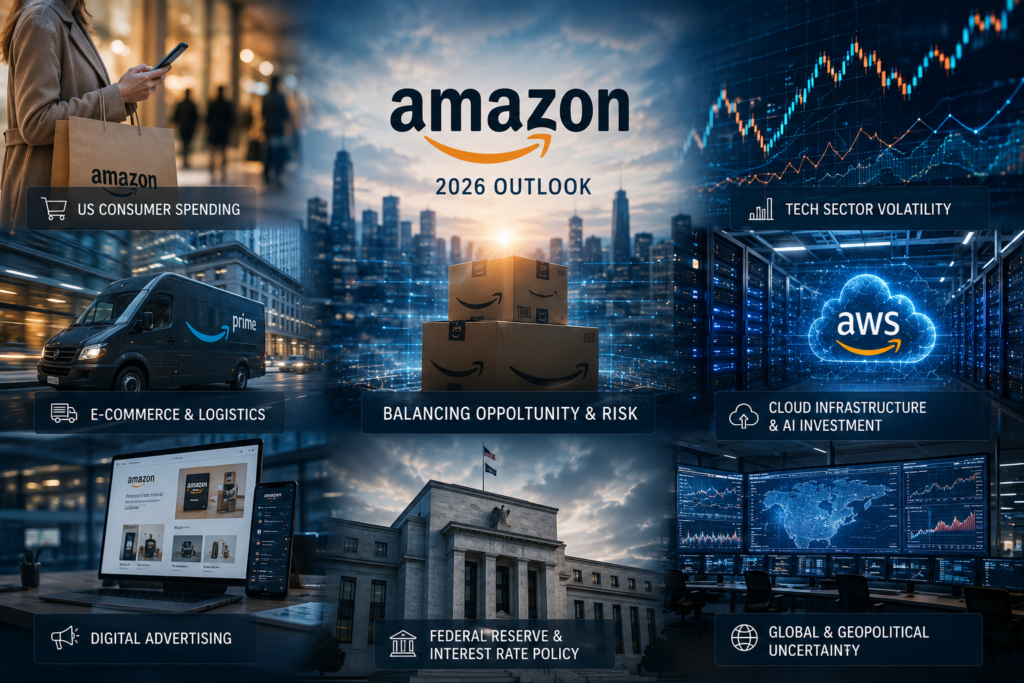
Amazon stock performance in Nasdaq 2026 has become one of the more closely watched storylines for US technology investors, as the company’s results increasingly reflect several forces at once: AWS growth, artificial intelligence investment, digital advertising, e-commerce demand, and shifting Federal Reserve policy. Amazon remains one of the largest Nasdaq technology stocks by market capitalization, and its quarterly results are frequently used as a reference point for broader sentiment across the US technology sector. This article examines the fundamental drivers, evaluation framework, risks, and 2026 outlook shaping Amazon shares, without predicting a specific price outcome.
Quick Answer: What Could Drive Amazon Stock in 2026?
Several factors are likely to shape Amazon stock performance in Nasdaq 2026: continued AWS growth and enterprise cloud demand, AI infrastructure investment and adoption, advertising revenue expansion, e-commerce and consumer spending trends, and Amazon’s ability to convert growth into operating margin and free cash flow. Federal Reserve policy and broader Nasdaq volatility will also influence how investors value the stock. None of these factors guarantees a particular outcome; they are the variables most likely to shape the Amazon stock outlook 2026 investors are watching based on current business trends.
Understanding Amazon Stock Performance in Nasdaq 2026
Amazon’s Position in the Nasdaq Market
Amazon is one of the largest companies listed on the Nasdaq-100, and its scale means that shifts in its business can meaningfully influence how investors read Nasdaq technology stocks as a group. Because Amazon spans cloud infrastructure, retail, and advertising, its results offer a broader read on technology and consumer conditions than a single-segment company can provide, which is part of why its Amazon Nasdaq performance draws attention well beyond its own shareholder base. Index funds and actively managed technology portfolios alike hold meaningful Amazon positions, so shifts in sentiment toward the stock can ripple into fund flows well beyond direct shareholders.
Amazon’s Business Model Beyond E-Commerce
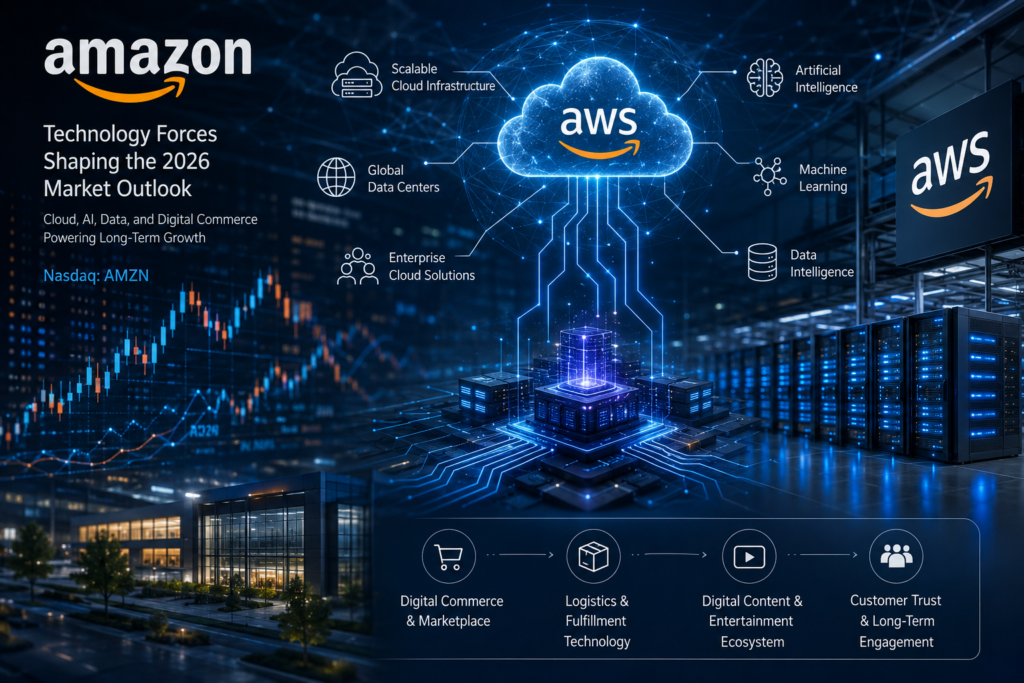
Amazon’s revenue now comes from a connected set of businesses: AWS cloud infrastructure, digital advertising, e-commerce, logistics, Prime and other subscriptions, and a growing layer of artificial intelligence and enterprise technology infrastructure built largely through AWS. AWS and advertising contribute a disproportionate share of operating profit relative to their share of revenue, which is why analysts increasingly evaluate Amazon as a diversified technology company rather than a pure retailer. That shift in mix is also why Amazon shares increasingly trade in step with enterprise software and cloud infrastructure names rather than traditional consumer-retail peers.
Why Amazon Matters to US Investors
Amazon’s results connect several themes institutional investors track closely: US consumer spending strength, enterprise cloud demand, technology capital investment, and broader large-cap technology sentiment. Because Amazon reports results that touch all of these areas in a single release, its numbers are often treated as an early read on conditions that later show up in sector-wide data, as detailed further in our in-depth Amazon Stock Analysis.
Key Drivers of Amazon Stock Performance in 2026
Several company-specific drivers are central to any assessment of Amazon stock performance in Nasdaq 2026.
AWS and Cloud Computing Growth
AWS revenue reached $42.2 billion in the second quarter of 2026, up 37% year-over-year — its fastest growth rate in 18 quarters — according to Amazon’s investor relations disclosures. That AWS growth reflects continued enterprise cloud computing migration and rising AI infrastructure demand, and because AWS carries significantly higher margins than retail, its growth rate has an outsized effect on Amazon’s consolidated earnings profile.
Artificial Intelligence and Automation
Amazon AI growth shows up across AWS enterprise services, warehouse automation and robotics, advertising targeting, and customer service tools. Amazon has guided to roughly $220 billion in 2026 capital expenditures, much of it directed at AI data-center capacity, alongside continued investment in custom Trainium and Graviton silicon. These are real, reported commitments rather than speculative claims, though the eventual return on that spending is not yet fully proven.
E-Commerce and US Consumer Spending
Amazon’s North America segment sales rose 16% year-over-year to $116.2 billion in the second quarter of 2026, while international sales rose 15% to $42.2 billion. Retail remains the largest share of total revenue, and its growth rate is closely tied to US consumer spending strength, inflation trends, and labor costs.
Advertising and Higher-Margin Businesses
Advertising generated $19.8 billion in revenue in the second quarter of 2026, up 26% year-over-year. Because ads run directly against first-party shopping data, advertising carries higher margins than retail and has become an increasingly important contributor to overall profitability and investor sentiment.
How Investors Can Evaluate Amazon in 2026
A practical framework can help investors form their own view of Amazon stock performance in Nasdaq 2026 and build an Amazon investment outlook grounded in fundamentals rather than reacting to headlines alone.
Revenue and Earnings Growth
Total revenue reached $200.6 billion in the second quarter of 2026, up 20% year-over-year. Reviewing growth by segment — AWS, advertising, and retail — rather than the consolidated figure alone shows whether growth is broad-based or concentrated in a smaller number of higher-margin businesses.
Operating Margin and Free Cash Flow
Operating income rose 43% year-over-year to $27.5 billion in the same quarter, with AWS operating margin near 39.4%. Investors typically track operating margin, free cash flow, and capital expenditures together, since elevated AI-related spending can pressure near-term cash flow even as underlying profitability improves. Amazon’s blended margin remains diluted by lower-margin retail and logistics operations, so segment-level trends matter more than the consolidated figure alone.
Valuation and Market Expectations
Amazon valuation already reflects substantial expectations for continued AWS and AI growth, so forward guidance matters as much as reported results. Investors commonly reference measures such as forward earnings and free cash flow yield, though the appropriate benchmark depends on the company’s margin structure and growth stage; this is a framework for analysis, not a speculative price target.
Competitive Advantage
Amazon’s competitive position rests on AWS’s infrastructure scale, its logistics network, a large and habitual consumer ecosystem, brand recognition, its advertising business, and growing AI infrastructure — advantages that are difficult and capital-intensive for smaller competitors to replicate, even as Microsoft Azure and Google Cloud continue investing heavily in the same categories.
Investment Strategy and Risk Management
How an investor approaches Amazon stock performance in Nasdaq 2026 depends heavily on time horizon and risk tolerance, and none of the following is personalized financial advice.
Entry Timing and Market Volatility
Many investors use phased entry approaches, such as dollar-cost averaging, rather than attempting to perfectly time short-term Nasdaq volatility, since consistently predicting near-term price movements is difficult even for professional investors.
Portfolio Allocation and Diversification
Because Amazon already carries significant weight across many technology and growth-oriented portfolios, concentrated exposure can add volatility. Diversification across sectors and company sizes is a general principle worth considering, though the right allocation depends on each investor’s own circumstances.
Long-Term Holding Approach
Long-term investors often focus more on fundamental execution — AWS growth, margin trends, and free cash flow — than on daily price movements, treating short-term Nasdaq swings as noise relative to multi-year business performance.
Major Risks Investors Should Watch
Amazon stock risks include a valuation that already prices in substantial growth, slower-than-expected AWS growth, weaker consumer spending, AI capital expenditure that outpaces revenue growth, regulatory pressure including an unresolved FTC antitrust suit scheduled for trial in February 2027, competition from Microsoft and Google, rising interest rates, and broader Nasdaq volatility tied to macroeconomic uncertainty. Any one of these risks could weigh on Amazon stock performance in Nasdaq 2026 independent of how well the underlying business actually executes.
Amazon and Nasdaq Market Outlook for 2026
Federal Reserve and Interest Rates
Federal Reserve policy and interest rates directly affect the discount applied to future earnings, and higher-for-longer rates tend to pressure high-multiple growth stocks like Amazon more than steadier, lower-growth businesses.
AI and Cloud Industry Trends
AI infrastructure investment, enterprise cloud adoption, data-center expansion, and automation remain structural themes likely to influence Amazon and the broader technology companies scaling recurring revenue throughout 2026, alongside continued competition among the largest cloud providers.
Potential Opportunities and Risks
Continued AWS acceleration, disciplined AI spending, and advertising growth could strengthen Amazon’s investment case, while slower cloud growth, margin pressure, or a less favorable rate environment could weaken it. Both outcomes are plausible, and neither should be treated as guaranteed; investors comparing Amazon against other best technology stocks should weigh these factors alongside company-specific fundamentals. Taken together, these puts and takes are what will ultimately determine Amazon stock performance in Nasdaq 2026 rather than any single catalyst on its own.
Conclusion: Amazon Stock Performance in Nasdaq 2026
Amazon stock performance in Nasdaq 2026 will likely depend on execution across AWS, AI infrastructure, advertising, retail, profitability, and capital expenditure, set against a backdrop of consumer demand, interest rates, and broader Nasdaq market conditions. None of these factors guarantees that Amazon shares will rise, outperform, or deliver a particular return. For investors tracking high-growth technology stocks for the long term, Amazon’s breadth across cloud, AI, advertising, and retail makes it a useful company to monitor closely, provided expectations stay grounded in reported fundamentals rather than assumptions about guaranteed future performance.