NASDAQ Stock Market Explained: NASDAQ is one of the world’s largest electronic stock exchanges and is home to companies such as Apple, Microsoft, Amazon, Nvidia, and thousands of other listed businesses. Unlike the NYSE’s traditional floor-based trading, NASDAQ runs entirely electronically through a network of market makers — firms that continuously quote buy and sell prices, which is part of why it became the natural home for fast-moving, high-volume tech stocks starting in the 1970s.
This guide covers what NASDAQ actually is, how its two main indices differ, how trades on it actually get filled, and how a U.S. investor gets exposure to it — whether through individual stocks or a fund.
Key Takeaways
- NASDAQ is an electronic exchange run through competing market makers, not a physical trading floor like the NYSE.
- “The NASDAQ” usually refers to the Nasdaq Composite Index (ticker: COMP), which tracks roughly 2,500+ listed companies across every sector — not just tech.
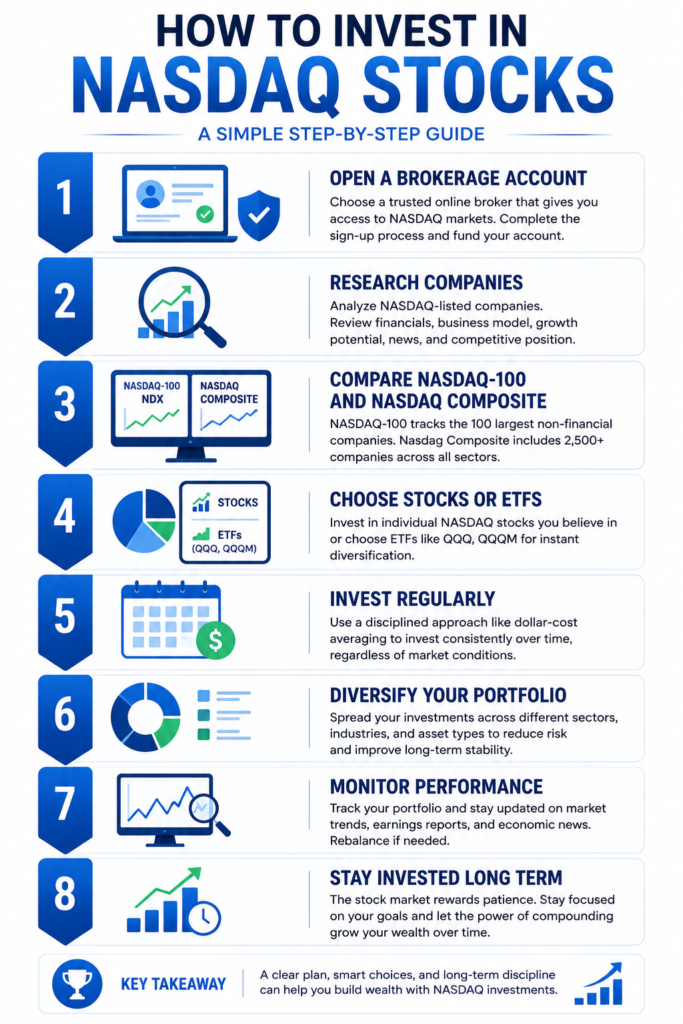
- The Nasdaq-100 (ticker: NDX) is a narrower, separate index of the 100 largest non-financial companies on NASDAQ, and it’s what most NASDAQ-tracking ETFs actually follow.
- Because both indices are heavily weighted toward a handful of giant tech companies, NASDAQ-based funds carry more concentration risk than a broader fund like an S&P 500 tracker.
- Meeting NASDAQ’s listing requirements is a compliance and disclosure threshold, not a guarantee of financial health or future performance.
NASDAQ Stock Market Explained: What Is NASDAQ?
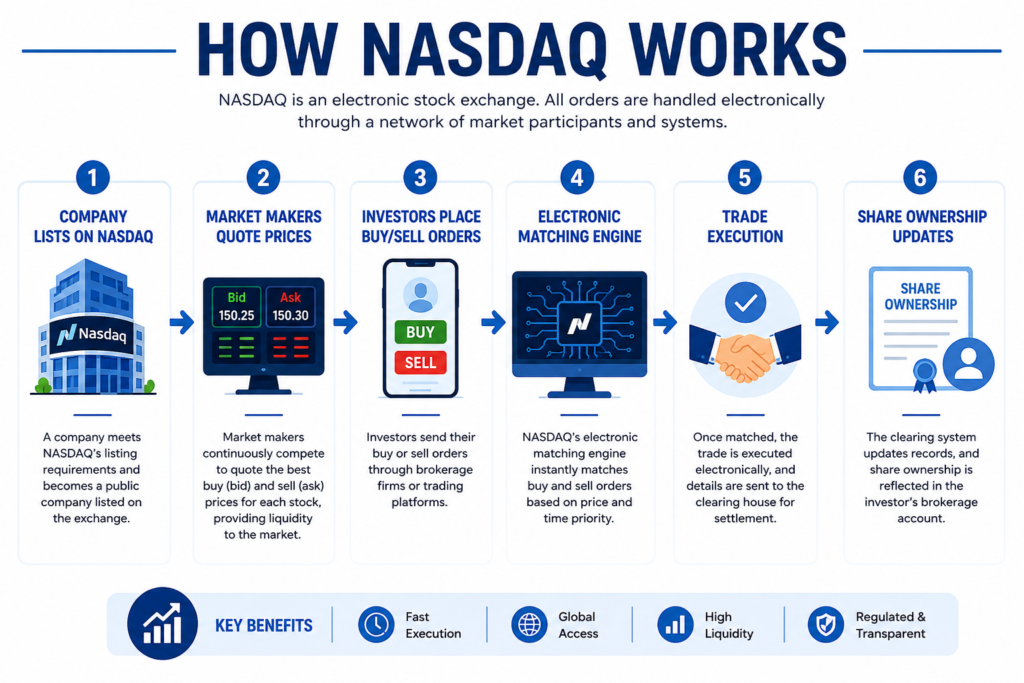
This NASDAQ Stock Market Explained guide begins with understanding what NASDAQ actually is. NASDAQ (originally an acronym for the National Association of Securities Dealers Automated Quotations) is a U.S. stock exchange that lists more than 3,000 companies, with a structural concentration in technology, biotech, and other growth-oriented sectors. It’s the second-largest stock exchange in the world by market capitalization, behind the NYSE.
One of the defining characteristics of NASDAQ Stock Market Explained is its fully electronic trading model. Unlike traditional floor-based exchanges, NASDAQ operates through a network of competing market makers that continuously quote bid (buy) and ask (sell) prices for listed securities. This allows trades in highly liquid stocks such as Apple and Microsoft to be executed quickly with tight bid-ask spreads, while less actively traded stocks can experience wider spreads during periods of increased market volatility.
Nasdaq Composite vs. Nasdaq-100: The Distinction Most Guides Skip
When financial media reports “the NASDAQ was up today,” they’re almost always quoting the Nasdaq Composite Index (COMP) — but that’s not the only index that matters, and confusing the two leads to real misunderstandings about what you actually own if you buy a “NASDAQ fund.”
| Nasdaq Composite (COMP) | Nasdaq-100 (NDX) | |
| Coverage | Virtually every company listed on NASDAQ — 2,500+ companies | The 100 largest non-financial companies on NASDAQ |
| Sectors included | All sectors, including financials | Excludes banks, insurers, and other financial companies |
| What it’s used for | The general “how did NASDAQ do today” headline number | The index most NASDAQ-tracking ETFs (like QQQ) actually follow |
The Nasdaq Composite and the Nasdaq-100 often move in the same direction because both are heavily influenced by the performance of large technology companies. However, the Nasdaq Composite also includes thousands of smaller and mid-sized companies, so its performance can differ significantly during periods when small-cap stocks outperform or underperform mega-cap technology firms. Understanding this distinction is one of the most important concepts covered in NASDAQ Stock Market Explained, especially for investors deciding whether to invest in a Nasdaq Composite fund or a Nasdaq-100 ETF. Nasdaq’s official newsroom provides a detailed explanation of the differences between the Nasdaq Composite and the Nasdaq-100 for readers who want additional information: Nasdaq Composite vs. Nasdaq-100.
NASDAQ vs. NYSE: What’s Actually Different
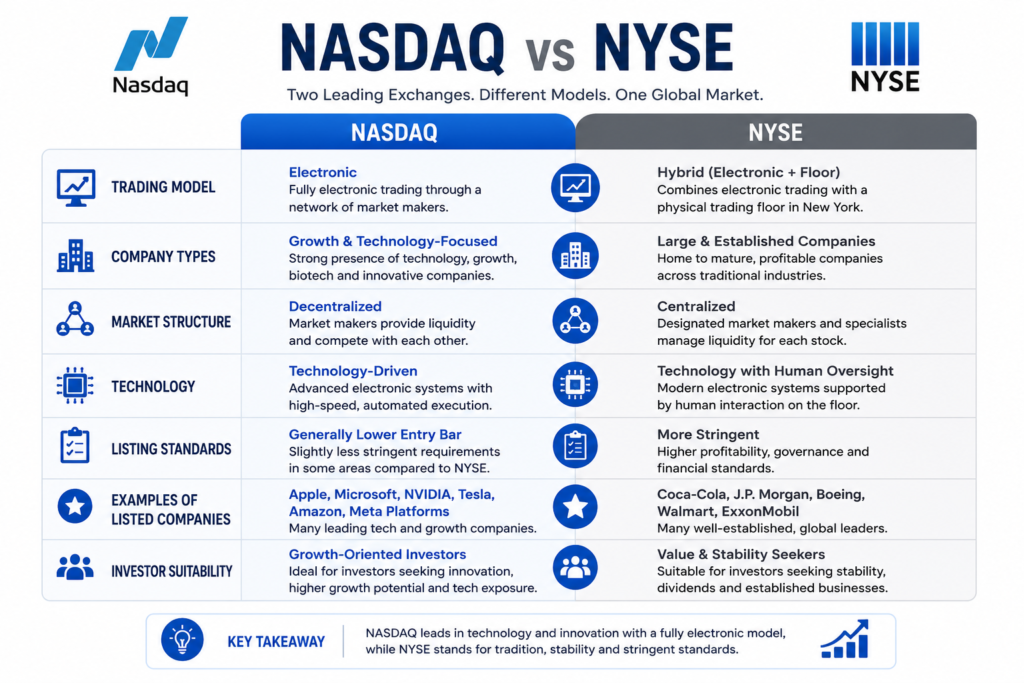
| NASDAQ | NYSE | |
| Trading model | Fully electronic, market-maker driven | Hybrid: electronic plus a physical trading floor with designated market makers |
| Typical company profile | Tech, biotech, growth-oriented companies | Broader mix, historically more industrial, financial, and consumer blue-chips |
| Notable listings | Apple, Microsoft, Amazon, Nvidia, Meta | JPMorgan, Coca-Cola, Walmart, ExxonMobil |
Neither exchange is inherently “safer” — the practical difference for an investor is that NASDAQ’s company mix, and therefore its indices, run more concentrated in growth and technology than the broader market.
How to Get Exposure to NASDAQ Stocks
Buying Individual NASDAQ-Listed Stocks
Any standard U.S. brokerage account lets you buy shares of any NASDAQ-listed company directly — there’s no special account or extra step required beyond opening a normal brokerage account. The trade-off is concentration risk in whichever individual companies you pick, rather than diversification across the index.
NASDAQ-Tracking Index Funds and ETFs
Funds that track the Nasdaq-100 (rather than the full Nasdaq Composite) are the most common way for retail investors to gain broad exposure to NASDAQ through a single investment. Because the Nasdaq-100 is capitalization-weighted, a small group of the largest technology companies accounts for a significant share of the index’s performance. As discussed in NASDAQ Stock Market Explained, this concentration can generate strong returns during periods of technology-sector growth but can also increase volatility during market downturns. In contrast, a broad market fund such as an S&P 500 index fund spreads investments across 500 companies in multiple sectors, providing greater diversification.
NASDAQ Listing Requirements: What They Actually Guarantee
To list on NASDAQ, a company must meet minimum thresholds around market capitalization, shareholder equity, share price, and corporate governance disclosure, all under SEC oversight. It’s worth being precise about what this does and doesn’t mean: these standards reduce the risk of outright fraud and enforce baseline transparency, but they say nothing about whether a specific company will be a good investment. Listing is a compliance threshold, not an endorsement — companies meeting these minimums have still gone on to lose most of their value or delist entirely.
Who NASDAQ Exposure Fits — and Who It Doesn’t
- Good fit: long time-horizon investors (early-career professionals, long-dated retirement accounts) who can ride out tech-sector volatility over years or decades in exchange for its historical growth premium.
- Poor fit: investors close to retirement, or anyone needing predictable income or low volatility, since NASDAQ-heavy portfolios lean growth-oriented and can swing harder in downturns than a broad, sector-balanced index.
- Common mistake: assuming a “NASDAQ fund” is automatically diversified. Because both major NASDAQ indices are capitalization-weighted and tech-heavy, a NASDAQ-100 fund can leave you far more concentrated in a handful of mega-cap names than a broad market fund would.
Frequently Asked Questions
What does NASDAQ stand for?
In this NASDAQ Stock Market Explained guide, NASDAQ stands for National Association of Securities Dealers Automated Quotations — though today it’s simply known and referred to as NASDAQ.
Is NASDAQ only for technology companies?
No. The Nasdaq Composite includes companies across every sector. The perception that it’s tech-only comes from the Nasdaq-100 — the narrower, more widely tracked index — which does concentrate heavily in large technology names.
Which is bigger, NASDAQ or NYSE?
The NYSE has a larger total market capitalization, but NASDAQ often has higher trading volume on a given day due to the concentration of heavily-traded tech stocks.
Can I buy NASDAQ stocks through any broker?
Yes. Any standard U.S. brokerage account provides access to NASDAQ-listed securities — no separate account type is required.
Is a NASDAQ index fund riskier than an S&P 500 index fund?
Generally yes, in the sense of concentration: NASDAQ-tracking funds are more concentrated in fewer sectors and fewer mega-cap names than the S&P 500, which spreads exposure across 500 companies in many more industries.
Final Thoughts
NASDAQ Stock Market Explained is more than an introduction to a stock exchange—it provides the knowledge investors need to understand how technology-focused companies trade, how the Nasdaq Composite and Nasdaq-100 differ, and how to invest with greater confidence. The key consideration for most investors is concentration risk: NASDAQ’s flagship indices are heavily weighted toward a relatively small group of dominant technology companies, which has historically driven strong returns but can also result in sharper market declines than a broadly diversified portfolio. Whether you choose the Nasdaq Composite, the Nasdaq-100, or individual NASDAQ-listed stocks, your investment should align with your financial goals, risk tolerance, and long-term investment horizon.
If you’re deciding how to actually evaluate an individual NASDAQ-listed company before buying, our company stock analysis guide and guide to valuation metrics are the natural next steps.