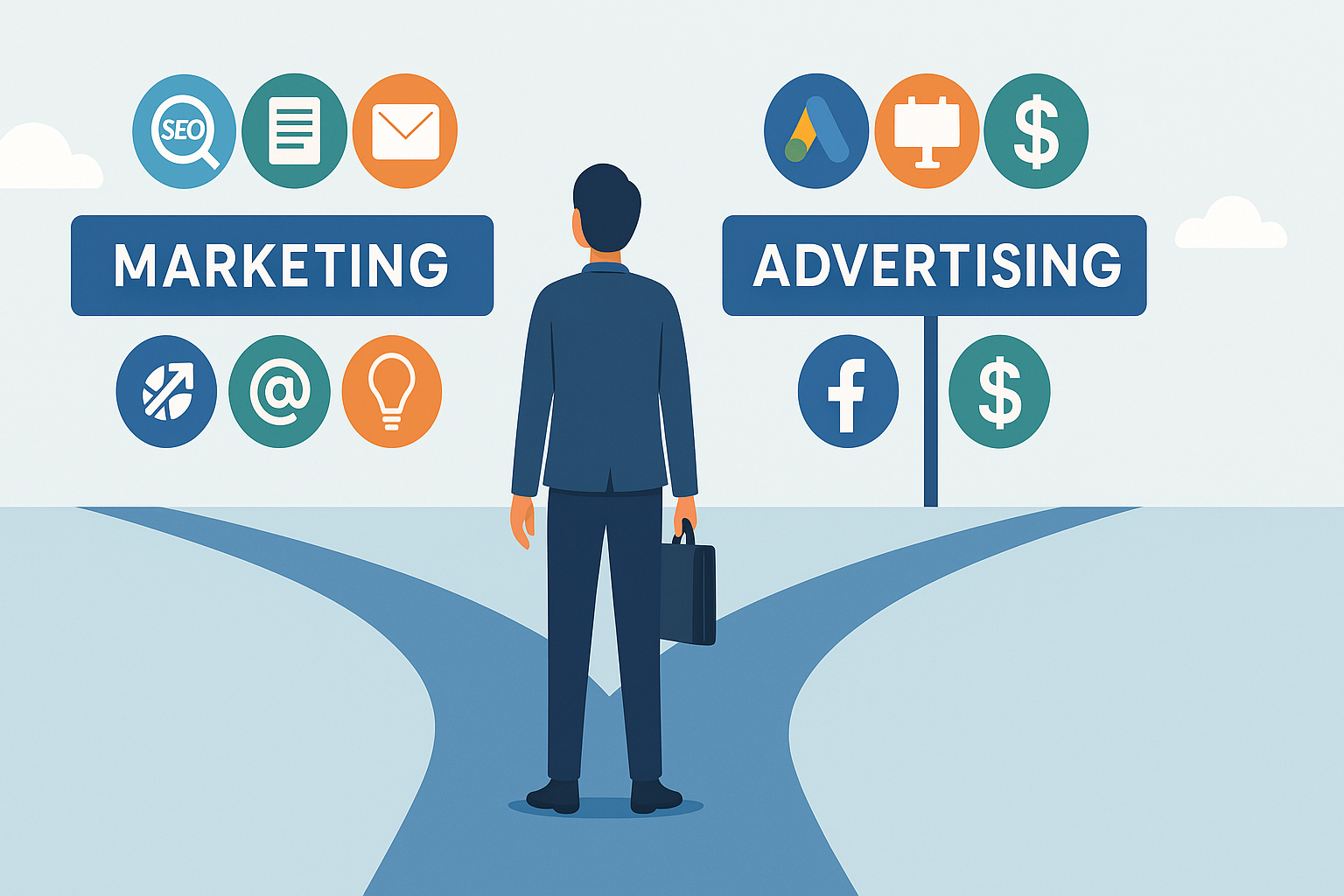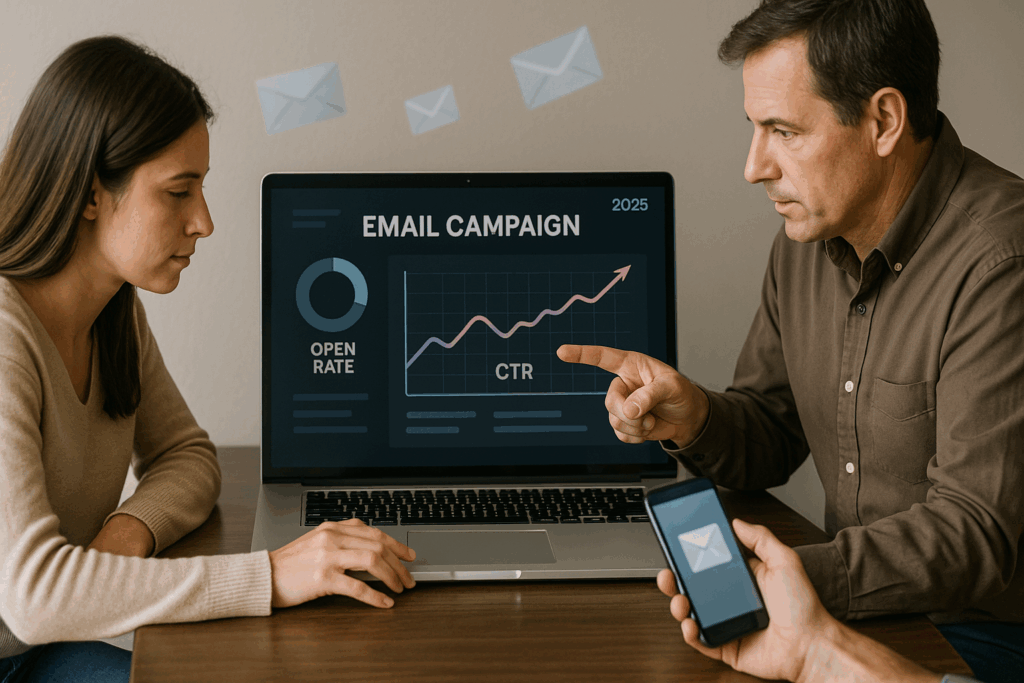
Small business marketing strategy is the process of promoting products or services to attract the right customers, generate leads, and grow revenue using cost-effective strategies. Unlike large corporations with massive advertising budgets, small businesses must market strategically focusing on channels, messaging, and tactics that deliver the highest return on investment.
In today’s competitive market, having a great product or service is no longer enough. Customers now research businesses online, compare reviews, evaluate pricing, and engage with brands across multiple channels before making a buying decision. Whether someone is searching for a local plumber on Google, comparing software providers, or browsing Instagram for product recommendations, the buying journey increasingly begins online.
This shift means small businesses can no longer rely only on referrals, walk-in traffic, or word of mouth. They need a structured marketing system that creates visibility, builds trust, and consistently converts attention into sales.
A strong small business marketing strategy helps answer critical questions such as:
- Who are your ideal customers?
- What problems do they need solved?
- Why should they choose you over competitors?
- Which marketing channels will deliver the best results?
- How do you measure success and improve over time?
Small business marketing is not about being everywhere at once. It is about reaching the right audience with the right message at the right time.
For example, a local bakery may benefit most from Google Business Profile optimization, Instagram content, and customer reviews. A SaaS startup, on the other hand, may rely more heavily on SEO, content marketing, email automation, and paid search campaigns. The channels may differ, but the goal remains the same: attract qualified customers and convert them efficiently.
The businesses that grow consistently are not always the ones spending the most on marketing—they are the ones operating with clarity, consistency, and measurable strategy.
This guide walks through a practical small business marketing framework that helps you build sustainable growth, optimize your budget, and create a repeatable customer acquisition system.
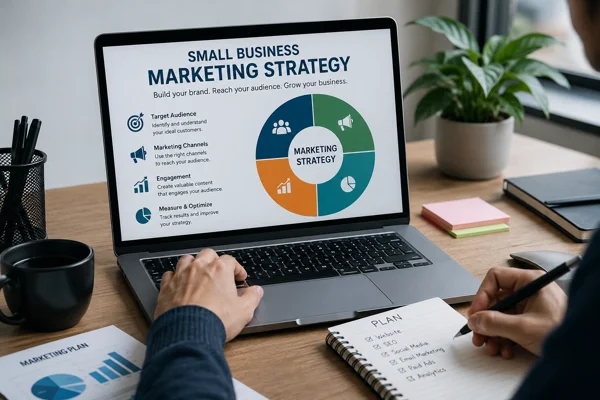
Why Small Business Marketing Strategy Matters
A clear small business marketing strategy helps small businesses grow predictably instead of relying on guesswork, inconsistent referrals, or random promotions. Without a structured approach, even great businesses struggle to attract customers consistently.
In competitive markets, every marketing dollar matters. A strategy ensures your time, budget, and effort are invested in channels that actually generate leads and revenue.
Better Customer Targeting
A strong marketing strategy helps you identify who your ideal customers are and where they spend their time. This allows you to create messaging that speaks directly to their needs, pain points, and buying behavior.
Instead of marketing to everyone, you focus on the people most likely to convert.
Higher Return on Investment
Small businesses usually operate with limited budgets. A strategy helps prioritize high-ROI channels such as SEO, email marketing, local search, or paid ads while eliminating wasteful spending.
When campaigns are planned and tracked properly, customer acquisition becomes more efficient and scalable.
Long-Term Sustainable Growth
Marketing is not just about short-term sales. It builds brand awareness, trust, and customer loyalty over time. Businesses that market consistently create compounding growth, where each campaign strengthens future performance.
Rather than chasing quick wins, a well-executed strategy creates a repeatable system for lead generation and revenue growth.
Step 1: Define Your Goals and Ideal Customer Profile (ICP)
Every successful small business marketing strategy starts with clarity. Before choosing marketing channels or creating campaigns, you need to define what success looks like and who you are trying to reach.
Without clear goals and a well-defined customer profile, marketing becomes reactive and inefficient.
Set Clear Marketing Goals
Your marketing goals should align with your broader business objectives. Instead of vague targets like “get more customers,” define measurable outcomes that guide decision-making.
Examples of strong goals include:
- Generate 100 qualified leads per month
- Increase website traffic by 30% in 6 months
- Improve conversion rate from 2% to 4%
- Reduce customer acquisition cost by 20%
A practical way to set goals is using the SMART framework: goals should be Specific, Measurable, Achievable, Relevant, and Time-bound.
Clear goals help determine where to invest budget, what channels to prioritize, and how success will be measured.
Identify Your Ideal Customer Profile (ICP)
Your Ideal Customer Profile defines the type of customer most likely to buy from you and generate long-term value.
Key factors to understand include:
- Age, location, and income
- Pain points and challenges
- Buying triggers
- Preferred online platforms
- Budget and purchasing behavior
For example, a local dental clinic may target families within a 10-mile radius searching for trusted healthcare providers, while a B2B software company may focus on operations managers looking to improve workflow efficiency.
The more specific your ICP, the easier it becomes to create relevant messaging and higher-converting campaigns.
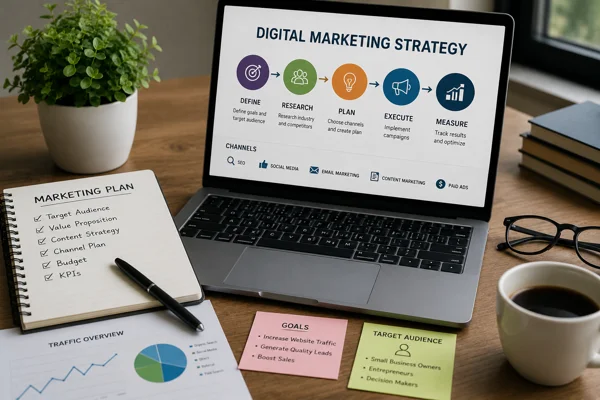
Align Goals With Customer Needs
Strong marketing happens when business goals and customer needs overlap. Your strategy should solve real problems while supporting measurable growth.
When you understand both your objectives and your ideal customers, every marketing decision becomes more focused, efficient, and profitable.
Step 2: Craft Your Brand Message and Value Proposition
Once you understand your goals and target audience, the next step is defining how your business should be perceived. Your brand message and value proposition shape the first impression customers have and heavily influence whether they trust you or choose a competitor.
A strong brand message communicates who you help, what problem you solve, and why your solution is valuable.
Define Your Unique Value Proposition (UVP)
Your Unique Value Proposition explains what makes your business different. It should clearly answer one question:
Why should customers choose you instead of competitors?
A simple framework is:
We help [target audience] achieve [desired result] without [major pain point].
Examples:
- We help small businesses generate leads without wasting money on ineffective ads.
- We help manufacturers improve operations without complex software implementation.
A strong UVP focuses on outcomes, not features.
Build Consistent Brand Messaging
Your messaging should stay consistent across every customer touchpoint, including:
- Website
- Landing pages
- Social media
- Ads
- Email campaigns
Consistency builds familiarity, and familiarity builds trust.
Your messaging should reflect your brand personality as well. Ask yourself:
- Are you professional or conversational?
- Premium or budget-friendly?
- Technical or simple and approachable?
Communicate Benefits, Not Just Features
Customers rarely buy features—they buy solutions to problems. Instead of only explaining what your product or service does, highlight the results it creates.
Strong messaging connects emotionally and practically, making customers feel understood while giving them a clear reason to take action.

Step 3: Choose the Right Marketing Channels for Your Small Business Marketing Strategy
One of the biggest mistakes small businesses make is trying to market on every platform at once. More channels do not automatically mean better results. In most cases, spreading resources too thin leads to inconsistent execution and poor returns.
Instead of being everywhere, focus on 2–3 marketing channels that best align with your audience, business model, and goals. Begin with a manageable budget, evaluate results consistently, and increase investment only in channels that prove profitable.
Search Engine Optimization (SEO)
SEO helps your business attract high-intent customers who are actively searching for solutions on Google. It is one of the most powerful long-term marketing channels because it generates compounding organic traffic over time.
SEO works especially well for businesses that benefit from educational content, local visibility, or solution-based searches.
Examples include:
- Local service businesses targeting “near me” searches
- SaaS companies publishing comparison and educational content
- Professional service firms answering customer questions
Although SEO takes time to produce results, it often delivers strong long-term ROI with lower acquisition costs.
Social Media Marketing
Social media helps build brand awareness, trust, and audience engagement. The key is choosing platforms based on where your customers spend time.
Common platform fit:
- Instagram / TikTok — visual consumer brands, food, fashion, fitness
- Facebook — community-driven local businesses
- LinkedIn — B2B services, SaaS, consulting, manufacturing
Social media works best when you consistently publish useful, engaging, and authentic content rather than purely promotional posts.
Email Marketing and Paid Ads
Email marketing is one of the highest-ROI channels because it allows direct communication with leads and existing customers. It works especially well for nurturing prospects, follow-ups, promotions, and repeat sales.
Paid ads such as Google Ads or Meta Ads can accelerate growth by generating targeted traffic quickly. They are useful when you need immediate visibility or want to test offers rapidly.
The best strategy is not choosing the most popular channel—it is choosing the channels most likely to deliver qualified leads for your specific business.
Focus on a few channels, execute consistently, and let performance data guide future expansion.
Step 4: Build a Digital-First Presence with Local SEO
In today’s market, most customer journeys begin online. Before contacting a business, people typically search on Google, compare reviews, visit websites, and evaluate credibility. That is why every small business needs a strong digital-first system.
A digital-first approach ensures customers can easily discover, trust, and engage with your business across online channels.
Build a Strong Online Presence
Your website acts as your digital storefront. It should clearly communicate what you offer, who you serve, and why customers should choose you.
A strong website should be:
- Mobile-friendly
- Fast-loading
- Easy to navigate
- Optimized for conversions with clear calls-to-action
Important conversion elements include contact forms, booking buttons, pricing information, testimonials, and service pages.
Your website should not simply attract traffic—it should convert visitors into leads or customers.
Optimize for Local SEO
Local SEO improves your visibility in location-based searches, making it easier for nearby customers to discover your business when they actively need your products or services.
- plumber near me
- best bakery in Austin
- digital marketing agency in London
This is especially important for service-based and location-dependent businesses.
Key local SEO actions include:
- Optimize your Google Business Profile
- Collect customer reviews consistently
- Add location-based keywords to service pages
- List your business in trusted local directories
A well-optimized local presence increases visibility in Google Maps and local search results, often generating highly qualified leads.
Create a Connected Digital System
Your marketing channels should work together as one system rather than isolated efforts. For example, social media can drive traffic to your website, blog content can improve SEO, and email campaigns can nurture leads generated from both.
When your website, local SEO, content, and communication channels work together, customer acquisition becomes more predictable, scalable, and efficient.
Step 5: Create a Content and SEO Plan
Content and SEO work together to help small businesses attract qualified traffic, build authority, and generate leads over time. Instead of constantly paying for visibility through ads, a strong content strategy allows your business to earn organic traffic from search engines.
When done consistently, content becomes a long-term growth asset that compounds over time.
Create Content Around Customer Pain Points
Effective content aligns with customer intent by addressing the informational, commercial, and transactional questions that shape buying behavior. Focus on topics related to their problems, buying concerns, and decision-making process.
Examples include:
- How-to guides
- Comparison articles
- Case studies
- Frequently asked questions
- Industry insights and trends
Educational content builds trust by positioning your business as a helpful authority rather than just a seller.
Optimize Content for SEO
SEO ensures your content can be discovered when potential customers search online. Start by identifying keywords with strong search intent and relevance to your business.
Focus on SEO fundamentals such as:
- Keyword-optimized titles and headings
- Clear meta descriptions
- Internal linking between related pages
- Optimized images and page speed
Long-tail keywords often perform best for small businesses because they attract more specific and higher-intent visitors.
Build Consistency
SEO and content marketing reward consistency, not one-time effort. Publishing valuable content regularly helps search engines understand your expertise and improves long-term rankings.
A simple monthly content plan with targeted topics can steadily increase traffic, authority, and qualified leads while reducing dependence on paid acquisition.
Step 6: Use Email Marketing and Automation
Email marketing remains one of the highest-return marketing channels for small businesses because it allows direct communication with leads and customers. Unlike social media platforms where algorithms control visibility, email gives you access to an audience you own.
A strong email strategy helps nurture leads, build trust, and increase repeat purchases.
Build and Grow Your Email List
The first step is collecting qualified email subscribers through your website, landing pages, or lead magnets such as free guides, checklists, or discount offers.
Useful lead magnets include:
- Free consultation or audit
- Downloadable templates
- Exclusive discounts
- Educational guides
The goal is to capture interested prospects and move them into your marketing funnel.
Automate Lead Nurturing
Marketing automation helps small businesses stay consistent without increasing manual workload. Instead of sending emails one by one, automation allows you to create sequences triggered by customer behavior.
Common automated sequences include:
- Welcome emails for new subscribers
- Follow-up emails after inquiries
- Promotional campaigns
- Abandoned cart reminders
- Re-engagement emails for inactive customers
Automation ensures leads continue moving through the sales process even when you are not actively managing every interaction.
Increase Conversions and Retention
Email is valuable not only for acquiring customers but also for retaining them. Regular newsletters, educational content, product updates, and personalized offers help strengthen long-term customer relationships.
A well-structured email system improves conversions, increases customer lifetime value, and creates a more predictable revenue stream for your business.
Step 7: Set a Budget, Track Performance, and Optimize
A strong marketing strategy is not just about launching campaigns—it is about managing resources efficiently and improving results over time. Setting a clear budget and tracking performance ensures your marketing efforts remain profitable and scalable.
Even small budgets can produce strong results when invested strategically.
Allocate a Practical Marketing Budget
Your marketing budget should align with your business size, growth goals, and available resources. Many small businesses allocate between 5–10% of revenue toward marketing, though fast-growth businesses may invest more.
A simple budget may include:
- Paid advertising (Google Ads, Meta Ads)
- Content creation and SEO
- Email marketing tools
- Design, analytics, or automation software
Start small, test carefully, and increase spending only on channels that deliver consistent returns.
Track the Right Metrics
Effective decision-making depends on accurate performance data, because growth becomes difficult to scale when channel performance remains unclear. Tracking the right performance indicators helps you make better decisions and reduce wasted spending.
Important metrics include:
- Website traffic
- Lead volume
- Conversion rate
- Customer acquisition cost (CAC)
- Return on investment (ROI)
These metrics reveal which channels are producing qualified leads and profitable growth.
Optimize Based on Data
Marketing should be treated as an ongoing optimization process. Regularly review campaign performance, identify weak areas, and make adjustments based on real data.
This may include improving landing pages, refining ad targeting, testing new messaging, or reallocating budget toward higher-performing channels.
Businesses that consistently measure and optimize their marketing gain a major competitive advantage because they improve efficiency while scaling growth predictably.
Common Mistakes, FAQs, and Final Thoughts
Even with a strong marketing strategy, many small businesses struggle because of avoidable mistakes. Understanding these pitfalls can help you save time, budget, and effort while improving long-term results.
Common Small Business Marketing Mistakes
One of the biggest mistakes is trying to be everywhere at once. Many businesses spread themselves across too many channels without mastering any of them, leading to inconsistent execution and weak results.
Other common mistakes include:
- Targeting everyone instead of a specific audience
- Ignoring conversion tracking and analytics
- Running ads without optimized landing pages
- Publishing inconsistent or low-value content
- Quitting SEO too early before results compound
Successful marketing requires focus, consistency, and patience. Small improvements made regularly often outperform aggressive but inconsistent campaigns.
Frequently Asked Questions
How much budget should a small business allocate to marketing?
A common benchmark is allocating 5–10% of annual revenue to marketing, though newer or faster-growing businesses may invest more.
Which channels work best in a small business marketing strategy?
There is no single best channel. Channel performance varies significantly across industries, so the highest-performing acquisition sources usually depend on customer intent, buying cycle, and business model.
What is a realistic timeline for seeing marketing ROI?
Paid advertising may generate leads within days or weeks, while SEO and content marketing often take 3–6 months or longer to produce meaningful results.
Can small businesses compete with larger brands?
Yes. Small businesses often compete effectively by being more agile, more personal, and more focused on customer relationships and niche positioning.
Conclusion
A well-executed small business marketing strategy becomes a long-term growth engine. With consistent optimization and disciplined execution, it can create predictable lead generation, stronger brand authority, and sustainable revenue growth.
By defining your ideal audience, choosing the right channels, investing in content, leveraging automation, and tracking performance, you create a system that consistently attracts and converts customers.
The businesses that grow sustainably are not always the ones spending the most—they are the ones executing with discipline and improving over time.
Start simple, stay consistent, and keep optimizing. Over time, these efforts compound into stronger brand authority, predictable lead generation, and sustainable business growth.