Running a business today means doing more with less. Rising labor costs, increasing competition, and growing operational complexity are forcing companies to find smarter ways to work. Teams are expected to move faster, improve output, and maintain efficiency without constantly increasing headcount or overhead.
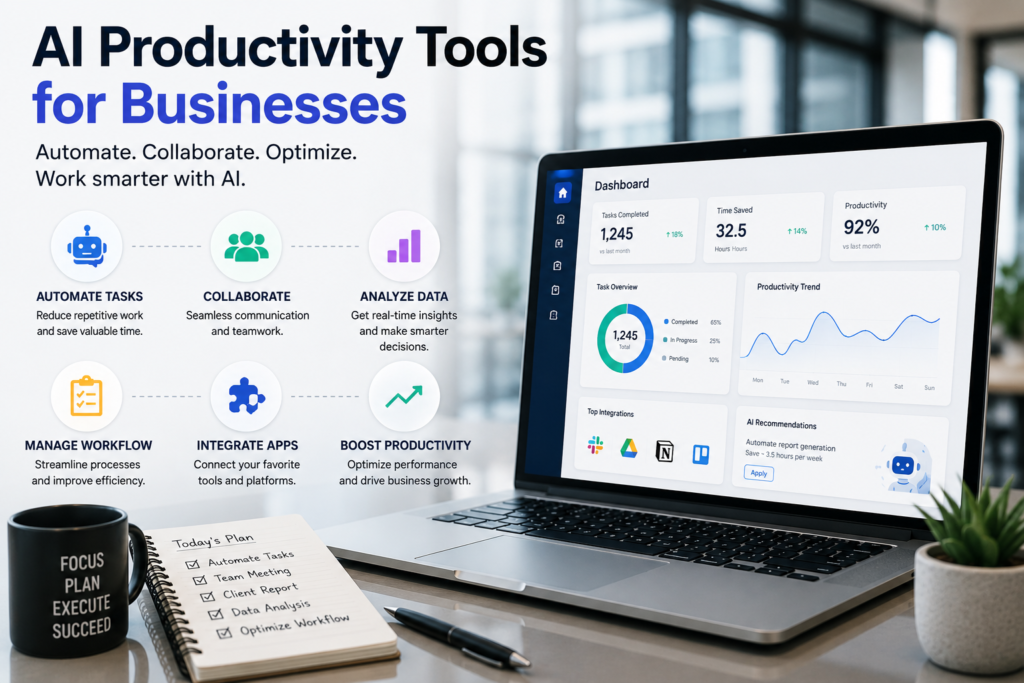
This is where AI productivity tools for businesses are becoming essential. Instead of relying solely on manual workflows, businesses are now using artificial intelligence to automate repetitive tasks, streamline communication, improve decision-making, and reduce operational bottlenecks. From managing projects and automating workflows to improving customer support and financial reporting, AI-powered tools are changing how modern businesses operate.
The biggest advantage is no longer just automation—it is scalability. Companies that adopt AI early can save valuable time, reduce costs, and create more efficient systems that support long-term growth. Meanwhile, businesses that delay adoption risk slower execution and reduced competitiveness in increasingly fast-moving markets.
Whether you run a startup, small business, agency, or enterprise, Choosing the right AI productivity tools for businesses depends on workflow needs, team structure, and operational priorities.
Why Businesses Need AI Productivity Tools
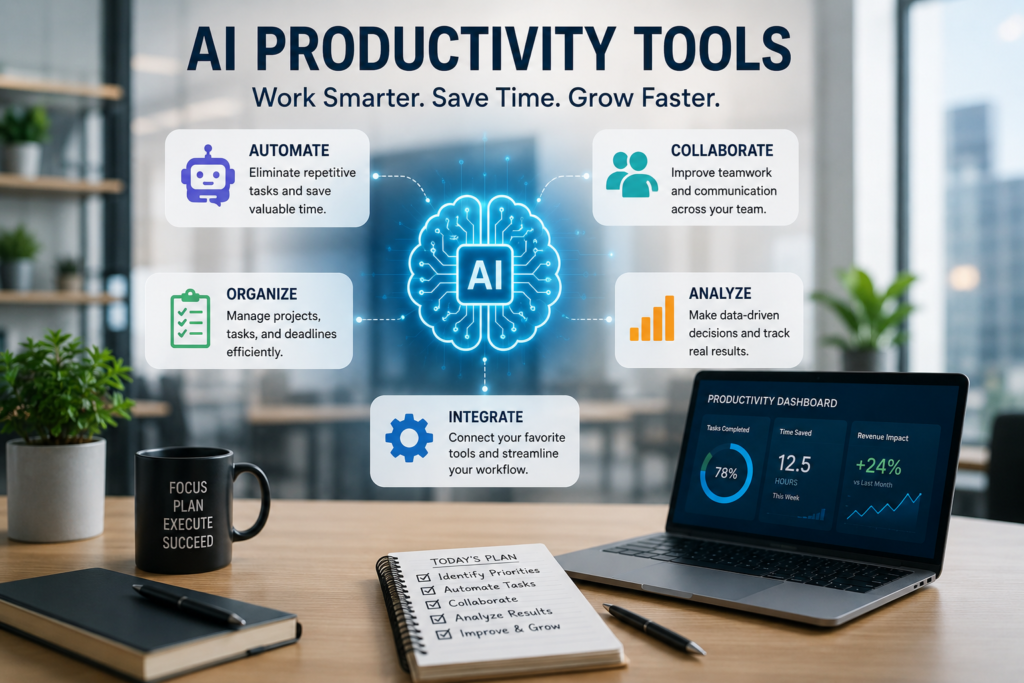
Businesses today operate in an increasingly competitive environment where efficiency, speed, and cost control directly affect profitability. Rising labor costs, growing workloads, and higher customer expectations make traditional workflows harder to sustain. AI productivity tools help businesses reduce inefficiencies, improve execution, and build more scalable operations without increasing overhead.
Save Labor Costs
Hiring more employees to manage repetitive operational work increases payroll, training, and management expenses. AI tools help businesses reduce these costs by automating routine tasks, allowing teams to handle more work without expanding headcount.
Automate Repetitive Work
Many daily tasks consume valuable time but add little strategic value. Activities such as scheduling meetings, drafting emails, updating CRM records, processing invoices, and generating reports can be automated with AI. This reduces manual workload and frees teams to focus on higher-value priorities.
Improve Output and Efficiency
AI productivity tools improve workflow efficiency by reducing delays, minimizing human error, and increasing consistency. Automated systems help teams complete tasks faster while maintaining quality, making it easier to scale operations without creating bottlenecks.
Enable Faster Decisions
Modern businesses generate massive amounts of data, but raw data has little value without actionable insights. AI tools analyze patterns, identify trends, and surface important information in seconds. This enables faster, data-driven decision-making, helping businesses respond quickly to market changes and allocate resources more effectively.
AI Productivity Tools Comparison
Choosing the right AI productivity tool for businesses depends on your business priorities, team structure, and workflow needs. Some tools specialize in content creation, while others focus on automation, project management, sales, or financial operations. The comparison table below highlights some of the best AI productivity tools for businesses, making it easier to identify which platform aligns with your goals and budget.
Quick Comparison Table
| Tool | Best For | Starting Price |
| ChatGPT | Writing, research, and content generation | Free / Paid plans |
| ClickUp | Project management and collaboration | Free / Paid plans |
| Zapier | Workflow automation and integrations | Free / Paid plans |
| HubSpot | Sales automation and CRM | Free / Paid plans |
| QuickBooks | Finance, accounting, and reporting | Paid plans |
Each tool solves a specific productivity challenge, and many businesses combine multiple tools to build a more efficient AI-powered workflow.
Best AI Productivity Tools for Businesses
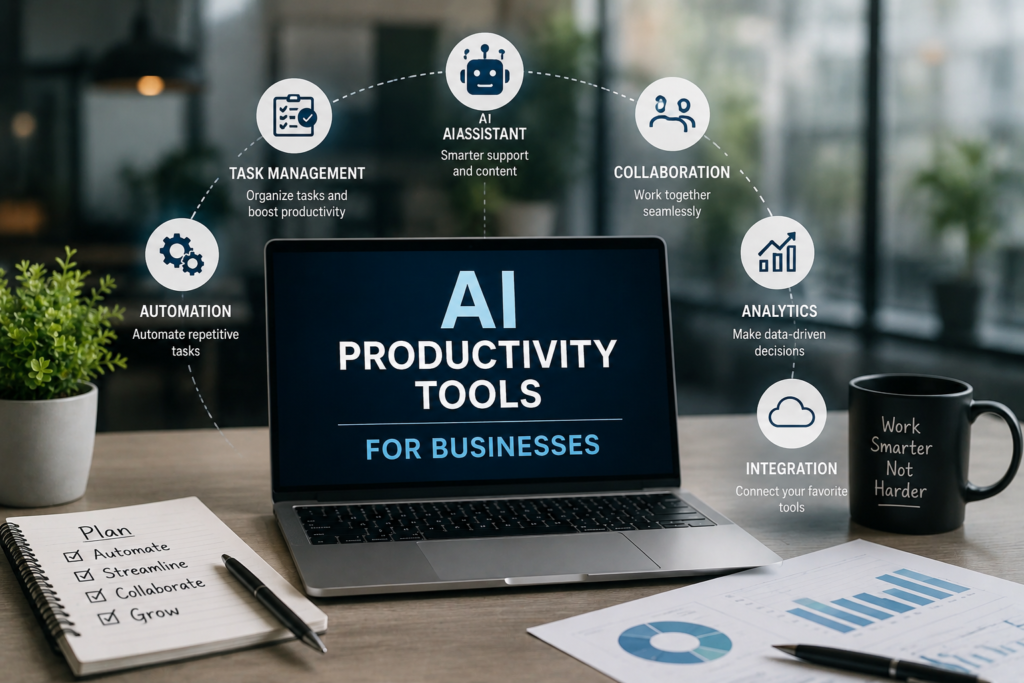
The best AI productivity tools help businesses automate repetitive work, improve collaboration, and scale operations more efficiently. While every company has different needs, the right AI tool can significantly reduce manual workload and improve team performance. Below are some of the best AI productivity tools for businesses based on practical use cases, efficiency gains, and overall business value.
ChatGPT
ChatGPT is one of the most versatile AI productivity tools for businesses available today. Businesses use it for writing emails, generating reports, creating marketing content, summarizing meetings, conducting research, and improving internal communication. Instead of spending hours on repetitive writing and analysis tasks, teams can use ChatGPT to accelerate execution and improve output.
ChatGPT is best for businesses that need a flexible AI assistant across multiple departments, including marketing, operations, customer support, and management. Its biggest advantage is speed—it can generate content, summarize information, and provide actionable insights within seconds. This helps teams save time and improve productivity without adding operational complexity.
The main limitation is that ChatGPT still requires human oversight. AI-generated responses may occasionally lack context or require fact-checking. Businesses handling sensitive data should also evaluate privacy and security requirements before implementation.
ClickUp
ClickUp is an AI-powered project management platform designed to help teams organize tasks, manage workflows, and improve collaboration. It combines task management, documentation, automation, and reporting into a single workspace, reducing the need for multiple disconnected tools.
ClickUp is best for businesses managing complex projects, cross-functional teams, or fast-moving workflows. Agencies, startups, and growing companies often use it to centralize operations and improve visibility across departments.
Its biggest strength is workflow efficiency. ClickUp helps teams automate recurring tasks, track deadlines, generate project summaries, and reduce coordination bottlenecks. The main limitation is complexity—because it offers extensive features and customization, smaller teams may face a learning curve during onboarding.
Zapier
Zapier is one of the best AI productivity tools for businesses focused on workflow automation. It connects thousands of apps and allows businesses to automate repetitive tasks without writing code. Instead of manually moving data between tools, teams can create automated workflows that run in the background, saving time and reducing operational friction.
Zapier is best for businesses that use multiple software platforms and need seamless integration across their workflows. Marketing teams, sales departments, operations teams, and small businesses commonly use it to automate lead capture, CRM updates, email notifications, reporting, and task creation.
Its biggest advantage is efficiency through automation. Zapier eliminates repetitive manual processes, reduces human error, and improves workflow consistency across departments. Businesses can automate hundreds of routine tasks, allowing employees to focus on strategic work rather than administrative execution.
The main limitation is workflow complexity. While simple automations are easy to build, advanced multi-step workflows may require careful setup and ongoing monitoring. Costs can also increase as task volume grows.
HubSpot
HubSpot is a powerful AI-driven CRM and sales platform designed to help businesses improve lead management, automate sales processes, and strengthen customer relationships. It combines CRM, marketing automation, sales tools, customer support, and analytics within a single ecosystem.
HubSpot is best for businesses focused on lead generation, customer acquisition, and sales pipeline optimization. Startups, agencies, SaaS companies, and growing sales teams use it to manage contacts, track deals, automate follow-ups, and improve conversion rates.
Its biggest strength is revenue efficiency. HubSpot helps businesses identify high-quality leads, personalize outreach, and automate repetitive sales tasks, allowing teams to close deals faster. AI-powered insights also improve forecasting and pipeline visibility, enabling smarter sales decisions.
The main limitation is pricing at scale. While entry-level plans are accessible, advanced features and larger team requirements can significantly increase costs for growing businesses.
QuickBooks
QuickBooks is one of the most widely used AI-powered accounting and financial management tools for businesses. It helps companies manage bookkeeping, track expenses, generate invoices, monitor cash flow, and automate financial reporting. By reducing manual accounting work, QuickBooks allows businesses to maintain financial accuracy while improving operational efficiency.
QuickBooks is best for small businesses, startups, and growing companies that need better control over finances without building large accounting teams. Business owners use it to simplify day-to-day financial operations, improve visibility into revenue and expenses, and make better budgeting decisions.
Its biggest advantage is financial automation. QuickBooks can automatically categorize transactions, generate reports, track profitability, and reduce human error in bookkeeping. This saves valuable time and gives business owners faster access to important financial insights.
However, companies with sophisticated financial structures, multi-entity accounting, or advanced compliance requirements may need supplementary tools or expert financial guidance. Businesses with complex financial structures or enterprise-level reporting needs may need additional accounting support or specialized software.
Grammarly
Grammarly is an AI writing assistant designed to improve written communication across emails, reports, proposals, and business documentation. It helps teams write with better clarity, grammar, tone, and professionalism.
Grammarly is best for businesses that rely heavily on written communication, including marketing teams, sales professionals, consultants, and remote teams. Its biggest strength is improving communication quality while reducing editing time, helping teams produce polished content faster.
The main limitation is that Grammarly focuses primarily on writing quality rather than broader workflow automation, making it more specialized compared to other AI productivity tools.
What to Consider Before Choosing an AI Productivity Tool
Choosing the right AI productivity tool depends on your business goals, workflow complexity, and operational needs. Not every tool delivers the same value, so businesses should evaluate software based on practical factors that directly impact efficiency, scalability, and long-term ROI. Before investing in any AI solution, focus on the following criteria.
Budget
AI software pricing varies widely, so businesses should evaluate cost in relation to actual operational value. Instead of focusing only on subscription fees, consider whether the tool can save enough time, reduce manual workload, or improve productivity to justify the investment.
Team Size
The right tool should match the size and structure of your team. Small businesses may benefit from simple, easy-to-use platforms, while larger organizations often need advanced workflow automation, analytics, and collaboration features. Choosing software that scales with team growth prevents future migration costs.
Integrations
An AI productivity tool for businesses should work seamlessly with the software your business already uses. Strong integrations with CRM systems, project management tools, communication platforms, and accounting software reduce manual data entry and improve workflow efficiency. Better integration often leads to faster adoption and stronger automation.
ROI
The most important factor is return on investment. Businesses should evaluate whether a tool saves enough time, reduces enough labor costs, or improves productivity enough to justify its cost. The best AI productivity tools are not just software expenses—they are investments that create measurable business value.
Frequently Asked Questions About AI Productivity Tools
Businesses often have common questions before investing in AI productivity software. Below are answers to some of the most frequently asked questions about AI productivity tools for businesses and how they impact business operations.
Are AI Productivity Tools Worth It?
Yes, AI productivity tools for businesses are worth it for most businesses because they help automate repetitive tasks, improve efficiency, and reduce operational costs. By saving time on manual work such as reporting, scheduling, communication, and workflow management, businesses can improve productivity and focus more on strategic growth. The long-term value often outweighs the software cost.
Can Small Businesses Use AI Tools?
Absolutely. AI productivity tools for businesses are no longer limited to large enterprises. Many platforms offer affordable pricing, free plans, and easy implementation, making them accessible to startups and small businesses. Small teams often benefit the most because AI helps them operate more efficiently without increasing headcount.
Will AI Replace Employees?
AI is more likely to enhance employee productivity than replace entire teams. Most businesses use AI to automate repetitive administrative work rather than eliminate human roles. This allows employees to spend more time on strategic thinking, creativity, customer relationships, and decision-making—areas where human judgment remains essential.
What Is the Best AI Productivity Tool for Businesses?
The best AI productivity tool for businesses depends on business needs. Tools like ChatGPT are ideal for content and communication, while platforms like Zapier or ClickUp are better for automation and workflow management.
Conclusion
AI productivity tools for businesses are no longer optional for businesses looking to stay competitive in fast-moving markets. From automating repetitive tasks and reducing labor costs to improving team efficiency and accelerating decision-making, the right AI tools can create measurable business value.
Choose the Right Tool and Start Optimizing
The best approach is to compare tools based on your workflow, budget, and business needs. Start with one AI productivity tool for businesses that solves your biggest operational challenge, then expand your AI stack as your business grows. Even small improvements in automation and workflow efficiency can deliver significant long-term gains. Businesses that adopt AI early will be better positioned to scale faster, operate leaner, and maintain a stronger competitive advantage.