The Shift From Growth Story to Financial Engine
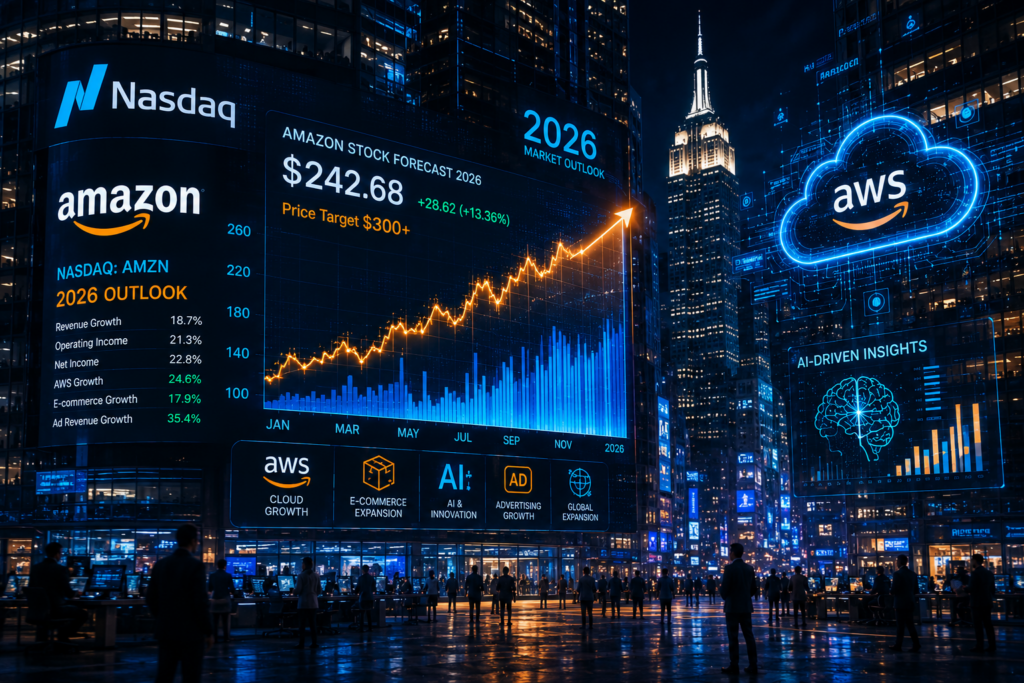
NASDAQ: AMZN Stock Analysis 2026 shows that Amazon is no longer valued purely as a growth story. In 2026, investors are increasingly focused on profitability, free cash flow, and margin expansion rather than revenue growth alone.
For years, Amazon was treated as a pure growth narrative—high reinvestment, thin margins, and long-term dominance.
But in 2026, the conversation around NASDAQ: AMZN has changed.
Investors are no longer asking “how fast can Amazon grow?”
They are asking:
“How efficiently can Amazon convert scale into profit?”
This is a critical shift.
Amazon is now operating across three fundamentally different economic engines:
- E-commerce (low margin, high volume)
- Cloud computing via Amazon Web Services
- Advertising (high margin, fast-growing)
Each segment behaves differently under macro pressure, interest rates, and capital costs.
And in a higher-rate world, profitability matters more than narrative.
Is Amazon stock still a growth stock in 2026?
Amazon remains a growth company, but growth is now driven by high-margin segments like AWS and advertising rather than retail expansion. The company is transitioning toward profitability and cash flow efficiency.
Key Insights:
- Amazon is shifting from growth to profitability
- AWS and advertising drive most profits
- Retail supports ecosystem, not margins
- Long-term outlook remains positive
Key Insights
- Amazon is transitioning from growth-first to margin-driven expansion
- AWS and advertising now drive the majority of profit, not retail
- Retail is becoming a logistics moat rather than a profit engine
- Investor expectations have shifted toward free cash flow consistency
- Amazon remains a growth company—but with valuation discipline
NASDAQ: AMZN Stock Analysis 2026 — Core Structural Shift
The biggest misunderstanding about Amazon today is this:
It is no longer one business.
It is a portfolio of businesses with different valuation models.
Let’s break this down.
1. Retail: Scale Without Margin
Amazon’s retail division dominates logistics and distribution.
But margins remain thin due to:
- Shipping costs
- Inventory management
- Price competition
This segment acts as a customer acquisition engine, not a profit center.
2. AWS: The Profit Backbone
Amazon Web Services is where real operating leverage exists.
- High margins
- Recurring enterprise revenue
- Strong switching costs
But growth has normalized compared to earlier years.
That matters for valuation.
3. Advertising: The Hidden Giant
Amazon’s ad business is now one of the most underappreciated drivers.
Why?
- High-margin revenue
- Built on existing traffic
- Minimal incremental cost
This is structurally similar to Google and Meta economics.
And it is growing fast.
Example
Imagine two investors in 2022 vs 2026:
- 2022 Investor: Buys Amazon for revenue growth
- 2026 Investor: Buys Amazon for cash flow stability
The difference?
The second investor cares about:
- Operating margins
- Segment profitability
- Capital efficiency
Not just top-line expansion.
Deep Analysis — Why This Transition Matters
Amazon’s transformation reflects a broader market reality.
Growth is no longer free.
When interest rates rise:
- Future cash flows are discounted more heavily
- Profitless growth loses appeal
- Capital efficiency becomes critical
Amazon has responded by:
- Cutting costs
- Optimizing logistics
- Focusing on high-margin segments
This is not a slowdown.
It is maturity with discipline.
Framework — How to Evaluate Amazon in 2026
Instead of looking at Amazon as one company, evaluate it like this:
Segment-Based Valuation Model
- AWS → SaaS / cloud multiple
- Advertising → digital ad multiple
- Retail → low-margin commerce multiple
Then combine.
This gives a more realistic picture than traditional P/E analysis.
Tools / Implementation
To analyze Amazon effectively:
- Financial Data: Yahoo Finance, Morningstar
- Segment Tracking: Company earnings reports
- Valuation Models: Discounted cash flow (DCF) tools
- Macro Signals: Interest rate trends, consumer spending data
Key Takeaways
- Amazon is evolving into a multi-engine profit system
- AWS and ads drive value more than retail
- The market now values efficiency over expansion
- Segment-level analysis is essential
- Amazon is still growing—but differently
Amazon in 2026 is no longer a speculative growth bet.
It is a complex, maturing financial ecosystem.
This article is for:
- Investors who think in terms of cash flow and valuation
- Long-term holders evaluating structural strength
- Analysts looking beyond headline revenue
This is not for:
- Short-term traders chasing momentum
- Investors focused only on revenue growth
The long-term implication is clear:
Amazon may still be a growth giant—but now,
it must justify that growth with disciplined profitability.
Part 2 – NASDAQ: AMZN Stock Analysis 2026 — Valuation Reality
What is Amazon actually worth in 2026?
If Part 1 established that NASDAQ: AMZN is no longer just a growth story, then the next question becomes unavoidable:
This is where most investors make a critical mistake.
They apply traditional valuation metrics—like P/E ratios—without adjusting for Amazon’s hybrid structure.
But Amazon is not a standard company.
It is a multi-layered valuation problem.
Key Insights
- Traditional P/E ratios underrepresent Amazon’s real value
- AWS alone could justify a large portion of Amazon’s valuation
- Advertising adds hidden high-margin upside
- Retail drags margins but strengthens long-term moat
- Valuation depends heavily on cash flow expectations, not revenue
Why Traditional Valuation Fails Here
Most investors still ask:
“Is Amazon expensive based on earnings?”
But that question is flawed.
Why?
Because Amazon deliberately suppresses earnings in some segments (like retail) while expanding high-margin ones.
So instead of P/E, serious investors focus on:
- Free Cash Flow (FCF)
- Segment contribution
- Operating margin expansion
This shifts the lens from accounting profit → economic value.
Breaking Down the Valuation Components
1. AWS — The Core Valuation Driver
Amazon Web Services behaves like a SaaS company.
Key characteristics:
- Recurring enterprise contracts
- High operating margins
- Predictable growth
In many institutional models:
- AWS alone is valued using cloud multiples
- Sometimes accounting for 50%+ of Amazon’s total valuation
That’s significant.
2. Advertising — The Margin Multiplier
Amazon’s ad business is often underpriced in models.
But structurally, it resembles:
- Google search ads
- Meta targeted advertising
Why this matters:
- High incremental margins
- Built on existing platform traffic
- Rapid scalability
This segment increases overall valuation quality—not just size.
3. Retail — The Valuation Discount
Retail is the largest revenue contributor.
But from a valuation perspective:
- Low margins
- High capital intensity
- Operational complexity
So analysts often apply a discounted multiple here.
Yet this is where nuance matters:
Retail may be low-margin,
but it feeds AWS and advertising growth indirectly.
Example
Consider two valuation approaches:
Approach A (Simplistic):
- Apply a single P/E ratio to total earnings
→ Conclusion: “Amazon looks expensive”
Approach B (Segment-Based):
- Value AWS like a cloud company
- Value ads like a digital media business
- Value retail conservatively
→ Conclusion: “Amazon may be fairly priced or even undervalued”
The difference is not numbers.
It’s framework.
Deep Analysis — The Real Valuation Tension
The core tension in Amazon’s valuation comes down to this:
Growth vs Efficiency
Markets in 2026 reward:
- Predictable cash flow
- Margin expansion
- Capital discipline
Amazon is improving on all three.
But there are constraints:
- AWS growth is slowing compared to peak years
- Retail still absorbs capital
- Competition in cloud and ads is increasing
So the valuation question becomes:
Can Amazon sustain high-margin growth while stabilizing retail costs?
If yes → upside remains
If not → valuation compresses
Comparison — How Amazon Stacks Against Peers
Cloud Comparison
- AWS vs Microsoft Azure (Microsoft)
- AWS vs Google Cloud
AWS still leads in scale and enterprise adoption.
Advertising Comparison
- Amazon vs Google
- Amazon vs Meta
Amazon’s advantage:
- Purchase-intent data (stronger conversion signals)
Retail Comparison
- Amazon vs Walmart (Walmart)
Amazon’s edge:
- Logistics + ecosystem integration
Tools / Implementation
To evaluate AMZN valuation in real-time:
- Valuation Models: DCF calculators, Excel-based models
- Market Data: Bloomberg, Yahoo Finance
- Earnings Analysis: Quarterly reports and guidance
- Peer Comparison: Industry benchmarks across cloud, ads, retail
Key Takeaways
- Amazon cannot be valued using a single metric
- AWS drives core valuation strength
- Advertising enhances margins and long-term upside
- Retail lowers margins but strengthens ecosystem control
- True valuation depends on cash flow durability
Amazon’s valuation in 2026 is not a simple “cheap vs expensive” question.
It is a multi-variable equation.
This section is for:
- Investors building valuation models
- Analysts comparing segment economics
- Long-term holders assessing fair value
It is not for:
- Traders relying on surface-level metrics
- Investors using single-ratio analysis
The long-term implication is clear:
Amazon’s valuation will increasingly depend on
how well it balances growth with profitability discipline.
NASDAQ: AMZN Stock Analysis 2026 — Risk Landscape
If valuation is the upside story,
then risk is where the real decision gets made.
For NASDAQ: AMZN, the key question in 2026 is not:
“Can Amazon grow?”
It’s:
“What could slow it down—or structurally weaken it?”
Because at Amazon’s scale,
even small inefficiencies compound into massive financial impact.
Key Insights
- AWS growth deceleration is the single biggest valuation risk
- Regulatory pressure could impact multiple business segments
- Retail margins remain structurally fragile
- Competition is intensifying across cloud, ads, and logistics
- Execution risk matters more than innovation at this stage
Core Risk #1 — AWS Growth Normalization
Amazon Web Services is the backbone of Amazon’s valuation.
But growth has slowed compared to its peak.
Why this matters:
- Cloud is becoming more competitive
- Enterprises are optimizing costs
- Multi-cloud strategies reduce dependency
Competitors include:
- Microsoft (Azure)
- Google (Google Cloud)
If AWS growth slows too much:
- Valuation multiples compress
- Investor confidence weakens
Core Risk #2 — Regulatory Pressure
Amazon operates across multiple sensitive sectors:
- Marketplace dominance
- Data control
- Advertising ecosystem
Regulators in the U.S. and EU are increasingly focused on:
- Anti-competitive behavior
- Seller treatment
- Platform neutrality
Potential outcomes:
- Fines
- Structural separation
- Operational restrictions
Even if extreme actions don’t happen,
uncertainty alone can affect valuation.
Core Risk #3 — Retail Margin Pressure
Amazon’s retail business remains:
- High volume
- Low margin
- Operationally complex
Key cost drivers:
- Logistics and last-mile delivery
- Labor and automation investment
- Returns and inventory losses
Even small increases in these costs:
→ Can significantly impact overall profitability
Example
Consider two scenarios:
Scenario A — Controlled Cost Environment
- Logistics optimized
- Automation reduces labor costs
- Margins improve gradually
→ Amazon strengthens profitability
Scenario B — Cost Expansion
- Fuel and labor costs rise
- Supply chain disruptions return
- Returns increase
→ Retail margins compress further
The difference directly impacts:
- Free cash flow
- Investor sentiment
- Stock valuation
Deep Analysis — Competition Is Now Structural
In earlier years, Amazon dominated multiple sectors with little resistance.
That is no longer the case.
Cloud
- Microsoft is aggressively expanding Azure
- Google is investing heavily in AI-driven cloud
This creates pricing pressure and slower growth.
Advertising
- Amazon competes directly with
- Meta
But unlike them:
- Amazon’s ad system is tied to e-commerce behavior
This is an advantage—but also a limitation in scale.
Logistics & Retail
- Walmart is strengthening its e-commerce logistics
- Regional players are improving delivery speed
Amazon no longer has uncontested dominance.
Framework — How to Assess Amazon’s Risk Profile
Use a simple 3-layer model:
1. Growth Risk
- AWS growth rate trends
- Advertising expansion speed
2. Cost Risk
- Logistics efficiency
- Fulfillment costs
- Capital expenditure
3. External Risk
- Regulation
- Competition
- Macroeconomic conditions
If all three align negatively:
→ Downside risk increases significantly
Tools / Implementation
To monitor Amazon’s risk in real time:
- Earnings Calls: Management commentary on AWS growth
- Regulatory News: Policy updates in the U.S. and EU
- Industry Reports: Cloud market share trends
- Financial Platforms: Bloomberg, Yahoo Finance
Key Takeaways
- AWS slowdown is the most critical risk factor
- Regulation could reshape Amazon’s operating model
- Retail margins remain structurally vulnerable
- Competition is now intense across all segments
- Execution quality is more important than expansion
Amazon’s risks in 2026 are not existential.
They are structural and financial.
This section is for:
- Investors stress-testing their assumptions
- Analysts evaluating downside scenarios
- Long-term holders managing portfolio risk
This is not for:
- Short-term traders ignoring fundamentals
- Investors assuming Amazon will dominate effortlessly
The long-term implication:
Amazon’s success is no longer guaranteed by scale alone.
It must now continuously defend its position across multiple fronts.
Final Verdict: Buy, Hold, or Avoid NASDAQ: AMZN in 2026?
After breaking down structure, valuation, and risk,
we arrive at the only question that matters:
What should investors actually do with NASDAQ: AMZN in 2026?
The answer is not binary.
Amazon is no longer a “buy at any price” stock.
But it is also far from a declining business.
It sits in a middle ground:
A high-quality compounder with evolving constraints.
Key Insights
- Amazon is transitioning into a disciplined, cash-flow-driven company
- Growth still exists—but is concentrated in specific segments
- Risk is manageable but requires active monitoring
- Valuation is fair to moderately attractive depending on assumptions
- The stock suits long-term investors more than short-term traders
The Core Decision Framework
To decide whether to buy, hold, or avoid Amazon,
you need to align the stock with your investment style.
1. Long-Term Investors (5–10 Years)
Amazon still fits as a core holding.
Why:
- Strong ecosystem
- Multiple revenue engines
- High switching costs
But expectations must adjust:
- Slower growth than the past
- More focus on profitability
👉 Verdict: Buy on dips / Accumulate
2. Medium-Term Investors (1–3 Years)
This group faces more uncertainty.
Key variables:
- AWS growth trajectory
- Margin expansion
- Macro conditions
If these align positively:
→ Upside exists
If not:
→ Stock may remain range-bound
👉 Verdict: Hold / Selective entry
3. Short-Term Traders
Amazon is no longer ideal for:
- Rapid momentum trades
- Speculative swings
Because:
- It’s a large-cap stock
- Moves are tied to earnings and macro signals
👉 Verdict: Neutral / Not optimal
Example
Let’s compare two investors again:
Investor A (Short-Term Focus)
- Buys based on hype or earnings spikes
- Exits on minor volatility
→ Likely inconsistent returns
Investor B (Long-Term Focus)
- Tracks AWS growth
- Monitors free cash flow
- Adds during dips
→ Benefits from compounding
The difference is not timing.
It’s strategy alignment.
Deep Analysis — The Long-Term Compounding Case
Amazon’s long-term strength lies in integration.
It controls:
- Consumer demand (retail platform)
- Infrastructure (AWS)
- Monetization layer (advertising)
This creates a powerful feedback loop:
- More users → more data
- More data → better ads
- Better ads → higher margins
Few companies operate at this level of vertical integration.
Comparable ecosystems include:
- Apple (hardware + software ecosystem)
- Microsoft (enterprise + cloud integration)
Amazon’s version is:
Commerce + Cloud + Advertising
That combination is rare.
Comparison — Risk vs Reward Profile
Upside Drivers
- AWS margin expansion
- Advertising growth acceleration
- Cost optimization in retail
Downside Risks
- AWS growth slowdown
- Regulatory constraints
- Rising operational costs
Net Position
- Balanced risk-reward
- Tilted slightly positive for long-term investors
Practical Framework — When to Buy Amazon
Use this simple checklist:
Consider Buying When:
- AWS growth stabilizes or re-accelerates
- Free cash flow trends upward
- Stock corrects due to short-term noise
Be Cautious When:
- Margins decline across segments
- Regulatory pressure intensifies
- Valuation expands without earnings support
Tools / Implementation
To execute and track your position:
- Portfolio Tracking: Seeking Alpha, Yahoo Finance
- Earnings Monitoring: Quarterly reports and investor calls
- Valuation Tracking: DCF tools, analyst estimates
- Macro Signals: Interest rates, tech sector performance
Key Takeaways
- Amazon is no longer a hyper-growth stock—but still a compounder
- AWS and advertising remain the key drivers of value
- Retail is a strategic asset, not a profit engine
- Valuation requires a segment-based approach
- Best suited for disciplined, long-term investors
Conclusion
Amazon in 2026 represents a different kind of opportunity.
Not explosive growth.
Not defensive stability.
But something in between:
A structured, multi-engine business with compounding potential.
This is for:
- Long-term investors building high-quality portfolios
- Analysts evaluating sustainable growth models
- Strategic buyers looking for durable businesses
This is not for:
- Speculators chasing quick gains
- Investors ignoring valuation discipline
Final Verdict
For most investors:
👉 Amazon is a HOLD with selective BUY opportunities
The long-term implication is clear:
Amazon’s future will not be defined by how fast it grows,
but by how efficiently it converts dominance into profit.
FAQs
Is Amazon stock still a good investment in 2026?
Amazon remains a strong long-term investment, supported by AWS and advertising growth, though short-term risks exist.
Why is AWS important for Amazon’s valuation?
AWS generates high-margin recurring revenue, making it the primary driver of Amazon’s profitability.
Is Amazon overvalued right now?
Amazon’s valuation depends on segment-based analysis rather than traditional P/E ratios.
What are the biggest risks for AMZN stock?
AWS slowdown, regulatory pressure, and rising retail costs are key risks.