In 2025, digital marketing for U.S. small and medium-sized businesses (SMBs) has entered a high-stakes, data-driven era. Rising Google Ads costs, AI-powered competitors, and increasingly selective U.S. consumers mean that traditional “post and boost” tactics no longer work. To grow in this environment, SMBs must build marketing systems that are measurable, automated, and aligned with real business outcomes.
Digital marketing for U.S. small businesses focuses on using SEO, AI-powered analytics, automation, and omnichannel engagement to create predictable lead flow and sustainable growth. Unlike large enterprises with million-dollar advertising budgets, U.S. SMBs must compete on precision — targeting the right audiences, personalizing messaging at scale, and maximizing return on every dollar spent.
This market-driven execution guide breaks down the digital marketing for U.S. small businesses into clear, actionable steps — backed by real-world examples from U.S. and global businesses — so founders, marketers, and operators can build scalable marketing engines that perform in today’s competitive U.S. economy.
Why Digital Marketing Strategies for U.S. SMBs in 2025 Matter
The competition for consumer attention has intensified dramatically. In 2025, nearly every brand—local or global—is fighting for visibility online. For SMBs, digital marketing is the most powerful equalizer. It allows small companies to:
- Compete with larger brands using SEO and niche content.
- Use automation and AI to scale lead generation.
- Leverage analytics to make data-backed decisions.
A report by HubSpot (2024) revealed that 70% of SMBs using targeted digital campaigns experienced double-digit growth. In fact, small businesses that integrated automation tools such as HubSpot CRM or ActiveCampaign saw a 40% improvement in customer retention compared to those relying solely on manual marketing.
USA Example – A Boutique Fitness Studio’s AI Transformation
In Chicago, a boutique gym called FitRevive Studio integrated AI-powered chatbots and automated email sequences to nurture leads. By personalizing offers (e.g., “Your first session is free this week!”), they achieved a 33% higher booking rate and reduced manual lead follow-up time by 60%.
These examples highlight how well-implemented digital marketing for U.S. small businesses can deliver measurable growth — even with modest budgets.
Typical Digital Marketing Budgets for U.S. SMBs in 2025
In 2025, most U.S. SMBs operate with lean but intentional digital marketing budgets, focusing on channels that deliver measurable ROI rather than broad brand spending. On average, small businesses allocate $500–$2,000 per month to SEO to build long-term organic visibility, while PPC testing budgets typically range from $300–$1,000 per month to validate demand and generate short-term leads. Email marketing and CRM tools—which power automation and customer retention—usually cost $50–$300 per month, making them one of the highest-ROI investments. Content creation, including blogs, landing pages, and short-form videos, often falls between $300–$1,500 per month, depending on quality and output volume. Rather than spending aggressively, successful U.S. SMBs prioritize consistency, testing, and optimization—scaling budgets only after channels prove profitable.
Traditional Marketing vs Digital Marketing for U.S. SMBs
| Area | Traditional | Digital |
|---|---|---|
| Cost efficiency | Low | High |
| Targeting | Broad | Hyper-local |
| Measurement | Limited | Real-time |
| Scalability | Slow | Fast |
The Core Elements of Successful Digital Marketing in 2025
To execute digital marketing for U.S. small businesses effectively, focus on these five pillars:
1. SEO & Content Marketing
Content remains king in 2025 — but now it’s smarter. Google’s Search Generative Experience (SGE) rewards value-driven, trustworthy content. SMBs must produce articles, guides, and videos that genuinely help customers.
- Use AI-assisted keyword research tools like Ahrefs, SEMrush, or SurferSEO.
- Create “People Also Ask” style FAQ sections in blogs.
- Optimize local SEO with Google Business Profile and customer reviews.
2. Social Media Storytelling
In 2025, social platforms prioritize authentic storytelling over promotional content. TikTok, Instagram Reels, and LinkedIn videos are now the fastest-growing lead channels for SMBs.
- Showcase real client success stories.
- Use micro-videos (under 60 seconds) with captions.
- Employ AI tools like Lumen5 or Pictory to convert blog posts into short videos.
Example: An Atlanta-based bakery, SweetCrumb Co., started sharing “behind-the-scenes” baking videos on TikTok. A single video went viral (400k+ views), bringing 1,200 new local customers in two months — with zero paid ads.
3. Email Automation & CRM
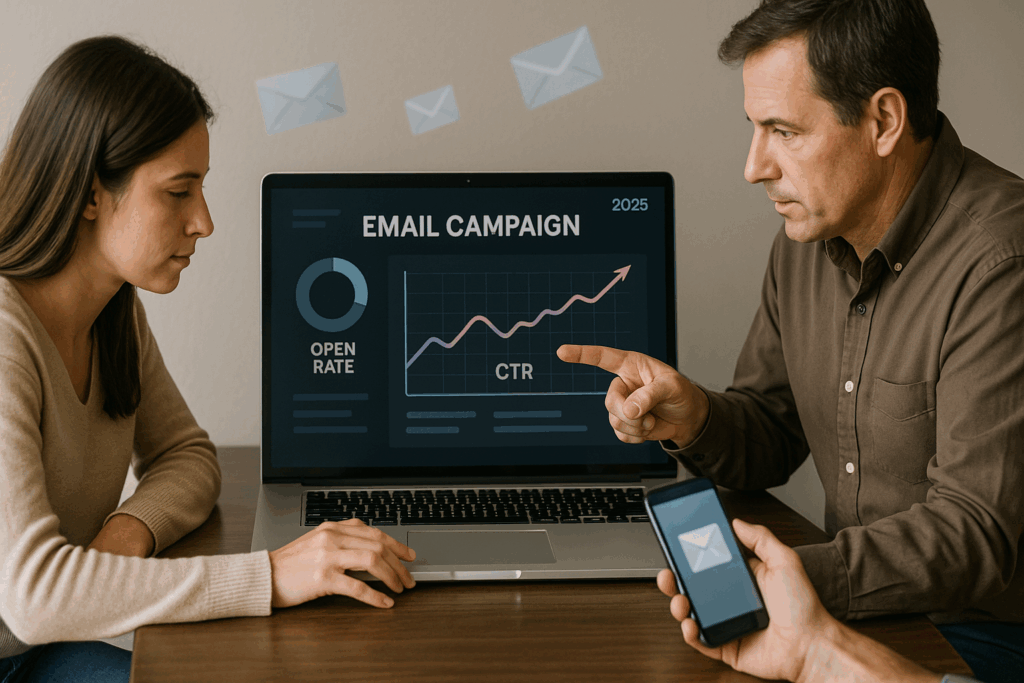
Email remains the highest ROI channel for SMBs. In 2025, automation tools make it smarter, not spammy.
- Use ActiveCampaign or Mailchimp AI to segment audiences by behavior.
- Automate cart reminders, birthday offers, and loyalty campaigns.
- Personalize every subject line and CTA.
Example: TechRevive IT Solutions, a Dallas-based support company, used email automation to re-engage dormant leads. The result? $75,000 in new contracts from past customers within one quarter.
4. Paid Advertising (PPC + Social Ads)
While organic growth is essential, paid ads provide immediate traction. Focus on high-ROI platforms like Google Ads, Meta Ads, and LinkedIn Sponsored Content for B2B audiences.
- Test small budgets ($300–$500/month) before scaling.
- Use retargeting pixels to bring back visitors who didn’t convert.
- Measure conversions through GA4 or Meta Pixel dashboards.
5. Analytics & Tracking
In 2025, guessing no longer works. SMBs must rely on real-time dashboards and data analytics to make marketing decisions.
- Implement Google Analytics 4, Hotjar, and Microsoft Clarity for behavior tracking.
- Monitor which landing pages convert best.
- Use AI tools like ChatGPT Enterprise or Notion AI for automated reporting summaries.
When SMBs analyze rather than assume, they optimize faster and waste fewer dollars.
Step-by-Step Execution Plan for SMBs
Step 1: Define Clear Objectives
Before investing in ads or automation, clarify your business goals:
- Do you want website traffic, leads, or sales?
- What KPIs will define success (e.g., conversion rate, CAC, LTV)?
Use SMART goals — Specific, Measurable, Achievable, Relevant, Time-bound.
Example: “Increase organic website traffic by 50% in six months.”
Step 2: Build an SEO Foundation
- Conduct keyword research with Ahrefs or SEMrush.
- Optimize your homepage, service pages, and blogs around target phrases like “digital marketing for SMBs.”
- Build backlinks by contributing guest posts to high-DR sites such as Entrepreneur.com or TechCrunch.
Case Example: A Boston-based web agency grew from 5 to 45 monthly leads by focusing on niche SEO keywords such as “affordable web design for startups USA.”
Step 3: Create a Consistent Content Calendar
- Publish 3–4 blog posts per month.
- Repurpose each post into short social snippets, infographics, and videos.
- Interlink with your existing articles like Emerging Technologies 2025 and How to Scale a Business Fast for better on-site SEO.
Tip: Use Notion or Trello to plan your publishing schedule, assigning each content piece a goal — traffic, awareness, or conversion.
Step 4: Use AI for Personalization
Integrate AI into your marketing funnel:
- Chatbots (e.g., Drift, ManyChat) for 24/7 client queries.
- AI copy generators for ad headlines and CTAs.
- Predictive lead scoring using CRM data.
Example: UrbanGlow Salon in New York installed an AI chatbot that automatically booked appointments, reducing missed calls by 80% and increasing monthly revenue by $10,000.
Step 5: Track and Optimize
Analyze results every month.
- Identify top-performing campaigns.
- Use A/B testing on landing pages.
- Reallocate budget to best-performing channels.
Example: A California-based consulting firm realized through GA4 that most of its paid ad conversions came from mobile devices rather than desktop. After redesigning its mobile UX, the company achieved a 35% conversion lift within two months.
Future Trends Shaping Digital Marketing Strategies for U.S. SMBs in 2025
The next wave of digital marketing will be shaped by:
- AI and Predictive Analytics – Tools like HubSpot AI and Salesforce Einstein forecast customer behavior, helping SMBs predict buying intent.
- Voice Search Optimization – Optimize content for phrases like “best web design agency near me.”
- Video-First Content – Short-form educational content is outperforming traditional blogs.
- Zero-Click Searches – Aim to appear in featured snippets and Google’s People Also Ask results.
- AR/VR Experiences – Immersive product previews and virtual consultations are becoming mainstream.
External resource: Forbes – The Future of Digital Marketing in 2025
Common Mistakes SMBs Should Avoid
- Ignoring data-driven decision-making.
SMBs that don’t measure metrics often waste up to 40% of their marketing budgets. - Not setting measurable KPIs.
Without tracking conversion rates or cost-per-lead, it’s impossible to scale. - Overinvesting in paid ads without organic foundations.
Paid traffic without trust-building content rarely converts. - Neglecting mobile responsiveness.
Over 65% of 2025 web traffic comes from mobile users — non-optimized sites lose credibility instantly.
Conclusion: How Digital Marketing and SMB Growth Work Together
The success of digital marketing for U.S. small businesses depends on consistency, clarity, and adaptability. SMBs that adopt a growth mindset — testing, analyzing, and improving continuously — will dominate their markets.
Digital marketing isn’t just a promotional tool anymore. It’s the core growth engine for every small business, bridging the gap between startups and established enterprises.
By mastering digital marketing now — from SEO and automation to storytelling and analytics — SMBs can achieve predictable, scalable growth and compete head-to-head with major players.
As we move deeper into the AI-driven era, remember: the brands that listen, adapt, and act data-first will own the future.