Tech Predictions for 2026: What AI and Automation Mean for Business is not just another future-focused headline—it’s a roadmap for survival, competitiveness, and growth. As we move closer to 2026, artificial intelligence and automation are no longer optional upgrades. They are becoming the backbone of how modern businesses operate, scale, and win.
In the United States and the United Kingdom, AI adoption has already moved beyond experimentation. Companies across finance, retail, healthcare, logistics, and SaaS are embedding automation directly into their core operations. From predictive analytics to autonomous customer service, businesses are no longer asking if AI should be adopted—but how fast.
From startups to enterprises, leaders are being forced to rethink how work is done, how decisions are made, and how value is created. Tech Predictions for 2026 suggest that companies failing to adopt AI-driven automation will face rising costs, slower execution, and declining relevance.
In this article, we break down what AI and automation will actually mean for businesses by 2026—not in theory, but in practice.
Tech Predictions for 2026 and the Rise of Autonomous Business Operations
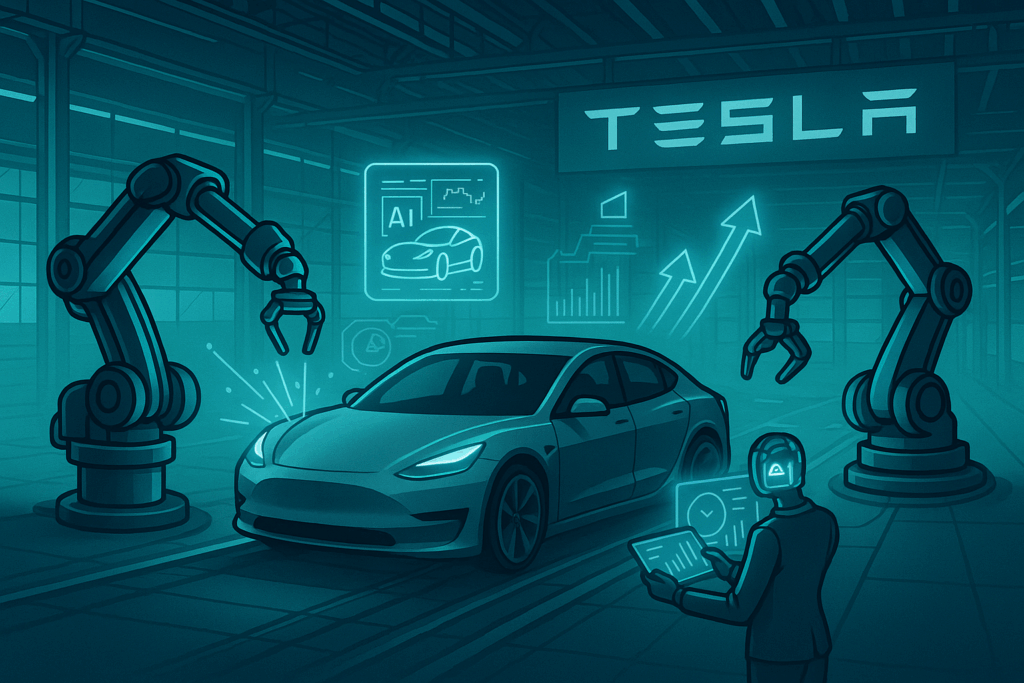
One of the most important Tech Predictions for 2026 is the shift from human-led operations to autonomous business systems.
By 2026, businesses will increasingly rely on:
- AI agents to handle customer support
- Automated workflows to manage operations
- Predictive systems to guide decisions
In the United States, companies like Amazon already use AI-driven systems to manage warehouse logistics, demand forecasting, and inventory placement with minimal human intervention. These systems continuously learn from data, adjusting supply chains in real time.
In the UK, Ocado operates one of the most automated grocery fulfillment systems in the world. Its AI-powered robotic warehouses process thousands of orders per hour, demonstrating what autonomous operations look like at scale.
Companies will move from “automation as a tool” to automation as an operating model.
🔗 Forbes on AI-driven enterprises –https://www.forbes.com/ai/
Why Tech Predictions for 2026 Matter for Business Leaders
Ignoring Tech Predictions for 2026: What AI and Automation Mean for Business is no longer a safe option.
Key reasons business leaders must pay attention:
- AI reduces operational costs by up to 30–40%
- Automation improves execution speed and accuracy
- Data-driven decisions outperform intuition-based leadership
In the US, banks like JPMorgan Chase use AI to automate contract analysis, saving hundreds of thousands of human work hours annually. In the UK, HSBC relies on machine learning for fraud detection and compliance, reducing risk while improving response times.
According to McKinsey, companies adopting AI at scale are already seeing higher margins and faster growth—while late adopters struggle to remain competitive.
🔗https://www.mckinsey.com/capabilities/quantumblack/our-insights
How AI Will Redefine Decision-Making by 2026
One of the boldest Tech Predictions for 2026 is that human-only decision-making will become a liability.
From Gut Feeling to Predictive Intelligence
By 2026:
- AI will forecast demand
- AI will recommend pricing
- AI will optimize inventory and staffing
In the United States, retailers like Walmart already use predictive AI to optimize pricing and inventory based on regional demand patterns. These systems reduce waste while improving profit margins.
In the UK, Tesco uses AI-powered analytics to predict customer buying behavior and personalize promotions at scale.
Executives won’t ask “What do you think?”
They’ll ask “What does the data predict?”
🔗 Investopedia on predictive analytics:
https://www.investopedia.com/terms/p/predictive-analytics.asp
Automation and the Future of Jobs — A Business Reality Check
Tech Predictions for 2026: What AI and Automation Mean for Business often raise fears about job losses. The reality is more nuanced.
Jobs Will Shift, Not Disappear
By 2026:
- Repetitive roles will decline
- Strategy, oversight, and creativity roles will grow
- Human-AI collaboration will become standard
In the UK, the NHS uses AI tools to automate administrative tasks, allowing healthcare professionals to focus more on patient care. In the US, companies like Salesforce are training employees to work alongside AI copilots rather than replacing them.
Businesses that reskill their workforce will gain a massive advantage.
🔗 World Economic Forum on future jobs:
https://www.weforum.org/reports/the-future-of-jobs-report
AI-Powered Customer Experience Will Be Non-Negotiable
Another critical Tech Prediction for 2026 is the complete transformation of customer experience.
By 2026:
- AI chatbots will handle 80%+ of support queries
- Personalization will be real-time
- Customer journeys will be predictive, not reactive
In the US, companies like Zendesk and Intercom are already deploying AI agents that resolve customer issues without human escalation. In the UK, British Airways uses AI-driven chat systems to manage flight disruptions and customer inquiries at scale.
Companies that fail here will lose customers—fast.
🔗 HubSpot on AI in customer experience:
https://www.hubspot.com/artificial-intelligence
Tech Predictions for 2026 and the Explosion of Low-Code Automation
Businesses no longer need massive engineering teams to automate processes.
Low-Code and No-Code Will Dominate
By 2026:
- Non-technical teams will build workflows
- Automation tools will integrate across departments
- Speed of execution will outperform company size
In the US, platforms like Zapier and Microsoft Power Automate allow operations teams to build complex workflows without writing code. In the UK, startups are leveraging no-code tools to launch products faster than traditional development cycles.
This democratization of technology is one of the most powerful Tech Predictions for 2026.
🔗 Gartner on low-code platforms:
https://www.gartner.com/en/information-technology/glossary/low-code-development-platform
Cybersecurity in an AI-Driven Business World
With automation comes risk.
AI vs AI Security Arms Race
Tech Predictions for 2026: What AI and Automation Mean for Business include:
- AI-powered cyberattacks
- Automated threat detection
- Zero-trust security models becoming standard
In the US, cybersecurity firms like CrowdStrike use AI to detect threats in real time. In the UK, financial institutions increasingly rely on AI-driven security to meet regulatory and compliance standards.
Businesses must invest in AI security—not after breaches, but before.
🔗 IBM on AI cybersecurity:
https://www.ibm.com/security/artificial-intelligence
Data Will Become the Most Valuable Business Asset
By 2026, data won’t just support business—it will be the business.
Businesses Will Compete on Data Quality
Key Tech Predictions for 2026 include:
- Real-time data pipelines
- AI-ready data architectures
- Data governance as a board-level concern
US tech firms like Google and Meta already treat data infrastructure as a competitive moat. UK companies operating under GDPR are building stronger governance frameworks to ensure ethical and compliant AI use.
Without clean data, AI and automation fail.
Small Businesses and Startups — Opportunity, Not Threat
Many believe AI favors big corporations. The opposite is true.
Automation Levels the Playing Field
Tech Predictions for 2026: What AI and Automation Mean for Business show that:
- Small teams can scale like large enterprises
- Automation reduces hiring pressure
- AI enables global reach instantly
In both the US and UK, startups now compete globally using AI-powered marketing, customer service, and analytics—without massive budgets.
Startups that adopt AI early will outpace traditional competitors.
Strategic Mistakes Businesses Must Avoid Before 2026
To benefit from Tech Predictions for 2026, avoid these errors:
- Treating AI as a one-time tool
- Ignoring change management
- Automating broken processes
- Failing to train leadership
AI strategy must align with business strategy.
Conclusion: Tech Predictions for 2026 Are a Call to Action
Tech Predictions for 2026: What AI and Automation Mean for Business make one thing clear: the future belongs to adaptive, data-driven, automation-first organizations.
AI and automation are no longer “future investments.” They are present-day survival tools. Businesses that act now will gain efficiency, resilience, and scalability. Those that delay will struggle to compete.
As we approach 2026, leaders must ask:
Are we experimenting with AI—or building our business around it?
Because in the next wave of transformation, only the prepared will thrive.