
10 Proven Small Business Marketing Strategies for 2025

Introduction

In 2025, competition for small businesses is more intense than ever. From AI-driven ads to voice search, marketing is evolving at lightning speed. Customers are overwhelmed with options, and standing out requires more than just being present—it requires a small business marketing strategy that is both proven and adaptable.

If you’re a small business owner, you may feel caught between limited resources and the pressure to keep up with big brands. The good news? Competing doesn’t require Fortune 500-level spending. What you need is clarity, creativity, and the right mix of tools.

This guide explores 10 proven small business marketing strategies for 2025—practical, cost-effective, and designed to help you stand out. Whether you run a local shop, an online store, or a service-based company, these strategies will give you a step-by-step blueprint for growth.

10 Proven Small Business Marketing Strategies for 2025 visual showing a business owner using digital marketing tools.


1. Leverage Local SEO for Maximum Visibility

Why Local SEO Matters for Small Businesses

Nearly half of all Google searches are location-based. If your business doesn’t appear when someone types “best coffee shop near me,” you’re losing customers to competitors.

Action Steps for Local SEO Success


      • Create and fully optimize your Google Business Profile by adding images, operating hours, and key details.

      • Use location-based keywords like “best bakery in Dallas” or “affordable plumber in Austin.”

      • Encourage customer reviews—Google highlights businesses with frequent, authentic ratings.

      • Add your business to local directories like Yelp, Bing Places, and TripAdvisor.

    📌 Example: A small gym in Chicago improved visibility by optimizing its profile and posting weekly updates. Within 3 months, foot traffic increased by 25%.


    2. Invest in AI-Powered Advertising

    How AI is Changing Small Business Marketing

    AI is transforming digital marketing in 2025. Platforms like Google Ads, Meta Ads, and TikTok Ads now use machine learning for predictive targeting, ensuring your ad dollars go further.

    Practical AI Advertising Tips


        • Start simple by running trial campaigns with just $10–$20 daily.

        • Use lookalike audiences to find new customers based on your best ones.

        • Let AI optimize placements, timing, and bidding.

        • Monitor results weekly and scale campaigns that perform.

      📌 Pro Tip: Pair AI ads with retargeting campaigns. If someone visits your site but doesn’t buy, retarget them with a special offer.


      3. Build an Email Marketing Funnel

      Why Email Marketing Still Works in 2025

      Despite new trends, email remains one of the most powerful and cost-effective channels. According to Campaign Monitor, email generates $36 for every $1 spent.

      Steps to Create a High-Performing Funnel


          • Offer a lead magnet: a free guide, discount code, or checklist in exchange for emails.

          • Segment lists based on customer behavior—send one email to first-time buyers, another to repeat customers.

          • Automate sequences: welcome series, abandoned cart emails, and post-purchase thank-you.

        📌 Example: A local boutique created a “10% off first order” lead magnet. Within six months, their email list grew 4x and monthly sales rose by 30%.


        4. Use Social Proof to Drive Conversions

        The Psychology of Social Proof

        People trust people more than they trust brands. Reviews, testimonials, and user-generated content (UGC) act as powerful trust signals.

        How to Build Social Proof


            • Showcase reviews on your homepage and product pages.

            • Run contests that encourage customers to share photos or videos with your product.

            • Partner with micro-influencers—they’re cheaper and often more authentic than celebrities.

          📌 Case Study: A bakery encouraged customers to post cake photos on Instagram using a branded hashtag. This boosted engagement and created a gallery of social proof.
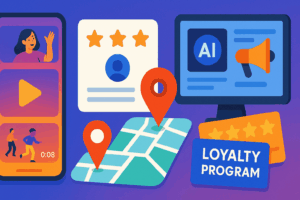
          10 Proven Small Business Marketing Strategies for 2025 visual showing a business owner using digital marketing tools.


          5. Optimize for Voice Search

          Why Voice Search is Growing

          With smart speakers, voice assistants, and AI chat tools booming, voice search is no longer optional. People are asking questions like, “Where’s the nearest vegan restaurant?” instead of typing keywords.

          How to Optimize for Voice Queries


              • Use conversational keywords: “affordable plumber near me” instead of just “plumber Dallas.”

              • Create an FAQ page to answer common questions directly.

              • Ensure your site loads quickly and is mobile-first.


            6. Create High-Value Content Marketing

            Content as a Long-Term Growth Engine

            Content remains king in 2025. Quality content builds authority, improves SEO, and attracts organic traffic.

            Best Practices for Content Marketing


                • Publish SEO-driven blog posts answering customer questions.

                • Repurpose your blog posts into short-form video content across TikTok, Instagram Reels, and YouTube Shorts.

                • Start a podcast or webinar series to engage your audience deeply.

              (Internal link suggestion: connect this section to your article on “how to scale a business fast”).

              📌 Pro Tip: Consistency is key. Posting one high-value blog per week for 12 months can drive exponential organic growth.


              7. Double Down on Short-Form Video

              Why Short-Form Video Dominates Attention

              Video content drives over 80% of online traffic (Forbes). Platforms like TikTok, Reels, and Shorts lead the way in holding audience attention.

              How Small Businesses Can Use Video


                  • Post behind-the-scenes videos to show authenticity.

                  • Use storytelling—why you started, your challenges, your mission.

                  • Share tutorials, product demos, and customer stories.

                📌 Example: A small candle brand grew from 1k to 25k followers in 4 months by posting 15-second videos showing how their candles are made.


                8. Build Strategic Partnerships

                Why Partnerships Help Small Businesses Grow

                Partnerships let you expand reach without heavy costs. By working with complementary businesses, you can tap into new audiences instantly.

                Partnership Ideas for 2025


                    • Bundle complementary services: think yoga studio + juice bar.

                    • Host joint events, webinars, or Instagram Lives.

                    • Exchange guest blogs or newsletter features.

                  📌 Pro Tip: Choose partners with the same target audience but non-competing services.


                  9. Focus on Retention, Not Just Acquisition

                  Why Retention Outweighs Acquisition

                  New customers are expensive. Acquiring a new customer costs 5–7x more than retaining one. Improving retention can boost profit growth by 25–95%.

                  Retention Strategies That Work


                      • Launch loyalty programs (points, discounts, exclusive perks).

                      • Send personalized offers (birthday discounts, tailored product suggestions).

                      • Use email and SMS to stay top of mind.

                    📌 Case Study: A salon introduced a “Refer a Friend” program—customers who referred others received free services. Within 6 months, repeat business doubled.


                    10. Track Data & Iterate Fast

                    Why Data-Driven Marketing Wins

                    Marketing without data in 2025 is like driving at night with no headlights.  Small businesses now have access to analytics tools once reserved for big companies.

                    How to Apply Data Insights


                        • Use Google Analytics 4 to track traffic, conversions, and behavior.

                        • Set up a CRM (HubSpot, Zoho, or Salesforce Essentials).

                        • Run A/B tests on headlines, offers, and CTAs to improve results.

                      📌 Pro Tip: Don’t stall for perfect. Launch, test, improve, and keep going.


                      FAQs About Small Business Marketing in 2025

                      Q1: Which marketing strategy gives the fastest results?

                      Paid ads (Google, Meta, TikTok) often bring the quickest results, but they work best when combined with organic strategies like SEO and email.

                      Q2: What is the cheapest way to market a small business?

                      Content marketing and social media are cost-effective. With consistency, they can outperform expensive campaigns.

                      Q3: Do I need AI tools for small business marketing in 2025?

                      Yes. Even free AI tools like ChatGPT, Jasper, and Canva AI save time by helping with copywriting, content creation, and ad testing.

                      Q4: How do I choose which strategy to start with?

                      Pick 1–2 strategies that fit your strengths. For example, if you’re a local store, start with Local SEO and Reviews. If you’re an e-commerce store, start with Email and Ads.
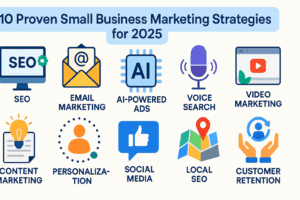
                      Infographic of 10 Proven Small Business Marketing Strategies for 2025 including SEO, AI, email, and video marketing.


                      Conclusion

                      Success in 2025 requires agility, creativity, and consistent execution. By adopting these 10 proven small business marketing strategies for 2025, you can outpace competitors, attract loyal customers, and grow sustainably.

                      Whether it’s optimizing local SEO, embracing AI, or mastering customer retention, the key is to start small, track results, and scale what works best.

                      A strong small business marketing strategy isn’t just about survival—it’s about building long-term success in a fast-changing world.

                      Low-Cost Advertising Ideas for Small Businesses

                      Education has always been a mirror of society, evolving with every major technological shift. The printing press democratized knowledge, the internet broke geographical barriers, and now emerging technologies 2025 are set to change education and learning forever. From AI-powered tutors to immersive VR classrooms, these innovations are not futuristic concepts—they’re tools already shaping how students, teachers, and institutions function.

                      Understanding how emerging technologies 2025 will change education and learning is essential for parents, policymakers, businesses, and students themselves. The coming years will not just alter what we learn, but how we learn, making education more personalized, accessible, and globally connected.


                      Artificial Intelligence in Education

                      Personalized Learning

                      AI can adapt curriculum to individual student needs. Platforms like Khan Academy’s AI tutor and Duolingo’s personalized lessons already demonstrate how machine learning customizes pace, feedback, and content. In 2025, this will become mainstream, helping teachers manage classrooms with diverse abilities.

                      For example, in China, Squirrel AI already provides AI-driven adaptive learning to millions of students. It analyzes student weaknesses and generates customized lessons, ensuring no child is left behind.

                      Administrative Efficiency

                      AI also reduces teacher workload by automating grading, attendance, and even drafting feedback. For example, many U.S. school districts now use AI tools to grade short-answer questions, freeing teachers to focus on deeper engagement.

                      Hospitals in New York have even collaborated with schools to test AI-driven scheduling systems for medical students, showing how automation can reduce burnout for both students and faculty.


                      Virtual Reality (VR) and Augmented Reality (AR) Classrooms

                      Immersive Learning Experiences

                      VR headsets like Meta Quest and AR platforms such as Microsoft HoloLens allow students to experience history, science, and geography firsthand. Imagine “walking” inside the human body during a biology lesson or standing on the Great Wall of China during a history class.

                      At Arizona State University, VR is already being used in astronomy classes where students “fly” through galaxies rather than just looking at images. Engagement scores from these classes are significantly higher compared to traditional formats.

                      Remote Classrooms

                      COVID-19 highlighted the need for effective remote learning. By 2025, VR classrooms will help replicate in-person experiences for students in rural or underserved areas, bridging education gaps.

                      For instance, UNESCO-backed pilot projects in Africa are testing VR classrooms for rural students, giving them access to world-class teachers they could never meet in person.


                      Blockchain for Credentials and Trust

                      Verifiable Academic Records

                      Fake degrees are a global problem. Blockchain guarantees that credentials and transcripts are stored in a safe, unchangeable manner.  The MIT Digital Diploma Initiative is already issuing blockchain-based diplomas. By 2025, this will expand globally.

                      This also reduces paperwork for international students. Instead of waiting weeks for transcripts, blockchain-enabled credentials can be verified instantly by employers or universities.

                      Micro-Credentials and Lifelong Learning

                      As career paths change, micro-credentials (short, skill-based certifications) will be increasingly valued. Blockchain enables secure verification of these, allowing professionals to build “skill passports” recognized worldwide.

                      IBM, for instance, already offers blockchain-verified certificates for competencies like cybersecurity and cloud computing. These are accepted by employers worldwide as credible evidence of expertise.


                      EdTech Platforms and Global Access

                      Democratizing Education

                      Emerging technologies 2025 also address inequality. Platforms like Coursera, edX, and Udemy already offer affordable, sometimes free, courses from top universities. With AI and blockchain integration, these platforms will provide even stronger credibility and personalized learning paths.

                      Case Study: Coursera in Developing Nations

                      In countries like India and Nigeria, Coursera partnerships with local governments are already helping millions gain employable skills. In Nigeria, a World Bank-funded initiative provided free Coursera licenses to job seekers during COVID-19, and by 2025 similar programs are expected to expand.

                      This demonstrates how EdTech platforms can bring Ivy League-quality education to students who previously had no access.


                      Gamification and Engagement

                      Students learn better when engaged. Gamification—integrating challenges, levels, and rewards into education—has proven effective. Platforms like Kahoot! and Quizizz are now classroom staples. With AI, gamification will become even more adaptive, making learning addictive and fun.

                      A case study from Finland shows that gamified math platforms improved test results by 30% compared to traditional methods. Teachers reported students were excited to “level up” instead of dreading homework.


                      Risks and Challenges

                      Digital Divide

                      Not every kid has access to sophisticated tools, gadgets, or the internet. If not addressed, emerging technologies may widen inequality. Governments and NGOs must invest in infrastructure.

                      In India, a UNICEF report highlighted that during COVID-19, 60% of students lacked access to online tools, showing the danger of technology gaps.

                      Teacher Training

                      Teachers need training to integrate AI, VR, and blockchain effectively. Without it, technology risks becoming a gimmick rather than a learning enabler. Finland and Singapore already have national programs to train teachers on EdTech, a model other countries may follow.

                      Privacy Concerns

                      With AI collecting sensitive student data, privacy and ethics must remain top priorities. Regulations like GDPR in Europe and FERPA in the U.S. will influence how EdTech companies operate worldwide.


                      Investor and Business Opportunities

                      By 2025, the worldwide EdTech market is expected to grow to a value of over $400 billion (HolonIQ).  Startups in AI tutoring, VR classrooms, and blockchain credentialing are attracting massive venture capital.

                      In India, Byju’s, an EdTech giant, scaled from a small startup into a $22 billion company by combining gamification, AI, and aggressive online expansion. This shows how investors are betting on EdTech as the future of learning.


                      FAQs on Emerging Technologies 2025 and Education

                      Q1: Will AI replace teachers by 2025?
                      No, AI will not replace teachers. Instead, it will support them by automating tasks and providing personalized insights, allowing teachers to focus on mentorship and creativity.

                      Q2: How will VR affect traditional classrooms?
                      VR won’t replace schools but will enhance them, making subjects more interactive and giving access to experiences that textbooks cannot provide.

                      Q3: Can blockchain degrees be trusted by employers?
                      Yes. Blockchain-based credentials are tamper-proof, making them highly credible. Companies such as Microsoft and IBM are already investigating blockchain verification.

                      Q4: How does this affect developing countries?
                      Emerging technologies 2025 will help democratize education, but governments must ensure digital infrastructure so rural students aren’t left behind.


                      Conclusion: A New Era of Learning

                      How emerging technologies 2025 will change education and learning is more than just an academic question—it’s a glimpse into the future of society itself. AI tutors, VR classrooms, blockchain credentials, and gamified lessons will redefine education as more personalized, accessible, and lifelong.

                      For students, it means learning tailored to their strengths. For teachers, it means relief from repetitive tasks and deeper human connection. For employers, it means better-prepared graduates ready for future jobs.

                      By 2025 and beyond, education will no longer be limited by geography, wealth, or outdated systems. It will be an evolving, technology-driven journey—where the classroom is everywhere, and learning never ends.

                      Scroll to Top