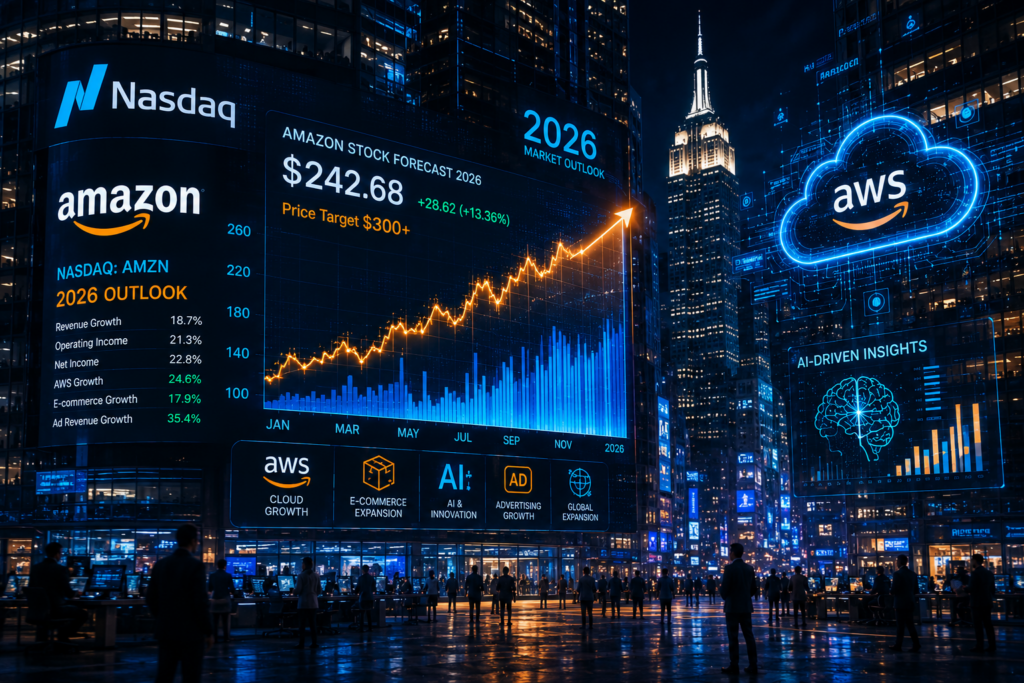
Is Amazon a good investment in 2026? The honest, conditional answer is that it depends on time horizon and valuation discipline: Amazon has evolved into a diversified technology and consumer business spanning e-commerce, AWS cloud infrastructure, and AI-driven enterprise services, not a single-engine retailer, and each of those engines carries a different growth, margin, and risk profile. This article examines Amazon’s core business drivers, current valuation, and principal risks to help investors form their own conditional view rather than relying on a simple yes-or-no headline. Amazon trades on the Nasdaq alongside other large technology companies, and comparisons with other best technology stocks can help place its profile in context.
Quick Answer: Is Amazon a Good Investment in 2026?
- AWS remains Amazon’s clearest profit engine, with revenue growth accelerating to its fastest pace in 18 quarters.
- Advertising has become a genuine high-margin third pillar alongside AWS and retail.
- Valuation is not obviously cheap: forward P/E estimates cluster in the low-to-high 20s depending on source and methodology, and free cash flow is currently pressured by heavy AI-related capital spending.
- The investment case leans more toward long-horizon business-quality investors than short-term or deep-value investors.
- Key risks include AWS competition, the scale of AI capital expenditure, consumer spending sensitivity, and unresolved regulatory scrutiny.
- Verify current price, valuation multiples, and guidance directly before making any decision, since these figures change daily.
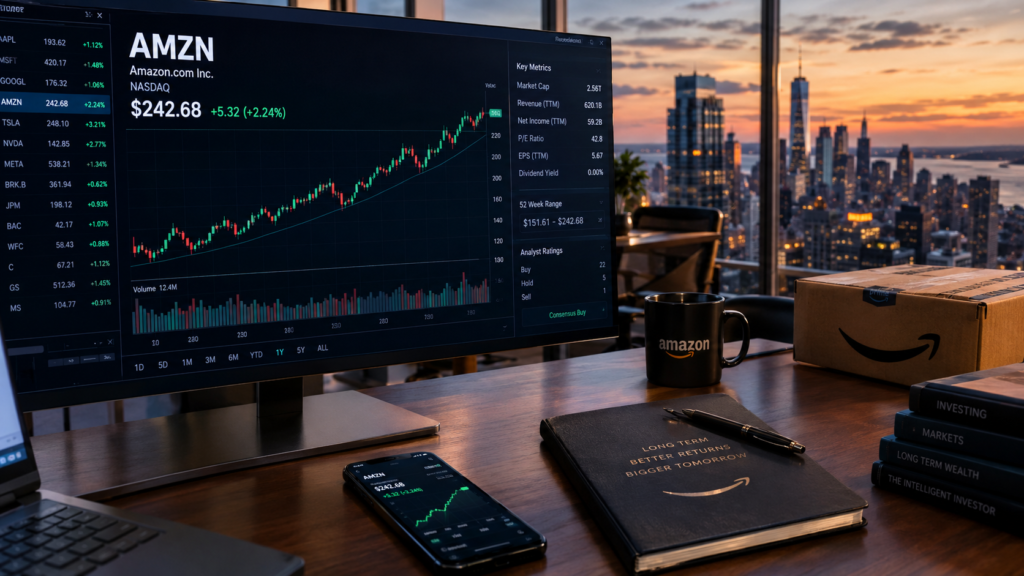
Amazon’s 2026 Investment Thesis
Answering is Amazon a good investment in 2026 requires looking at each business engine on its own terms rather than the consolidated headline alone.
AWS and AI Infrastructure
AWS revenue reached $42.2 billion in the second quarter of 2026, up 37% year-over-year and its fastest growth rate in 18 quarters, according to Amazon’s investor relations disclosures. AWS operating margin stood near 39.4%, and the segment is working through a reported $496 billion infrastructure backlog — demand that is already contracted rather than speculative.
Advertising Growth
Advertising generated $19.8 billion in revenue in the same quarter, up 26% year-over-year. Because ads run directly against first-party shopping data, the segment carries materially higher margins than retail and increasingly influences overall profitability.
Retail Efficiency and Logistics
North America segment sales rose 16% to $116.2 billion and international sales rose 15% to $42.2 billion last quarter. Retail remains the largest share of revenue, with fulfillment automation and logistics efficiency gradually improving margins even though the segment carries lower profitability than AWS or advertising.
Free Cash Flow and Capital Intensity
Amazon has guided to roughly $220 billion in 2026 capital expenditures, mostly for AI data-center capacity. That spending has pressured free cash flow in the near term — one widely cited estimate placed AMZN’s free cash flow yield in negative territory as of early August 2026 — even as consolidated operating income rose 43% year-over-year to $27.5 billion.

AWS, AI Monetization, and Amazon’s Valuation
Why AWS Matters Disproportionately to Operating Profit
AWS earns significantly higher margins than retail, so its growth rate moves Amazon’s consolidated operating income more than a proportionally larger change in e-commerce sales would. That is the core reason AWS growth, more than total revenue growth, is the single most important number in Amazon’s quarterly results.
AI Demand and Monetization Channels
Amazon monetizes AI primarily through AWS infrastructure and custom Trainium and Graviton silicon, alongside its direct investment in Anthropic, which contributed a $53.4 billion pre-tax non-operating gain in Q2 2026 — a figure that should be treated as an investment gain, not operating profit.
Azure and Google Cloud Competition
Competition is intensifying rather than easing. Microsoft’s Azure crossed $100 billion in annual revenue while growing 43% year-over-year in its most recent quarter according to Microsoft’s own results, and Alphabet’s Google Cloud revenue surged 82% to $24.8 billion in Q2 2026 with a $514 billion backlog, per Alphabet’s investor relations disclosures. AWS remains larger in absolute terms, but both competitors are growing cloud revenue faster than AWS on a percentage basis.
Retail and Advertising: The Stability and Margin Layers
Beyond AWS, the retail and advertising businesses are what make is Amazon a good investment in 2026 a more nuanced question than simply betting on cloud growth alone.
Fulfillment Efficiency
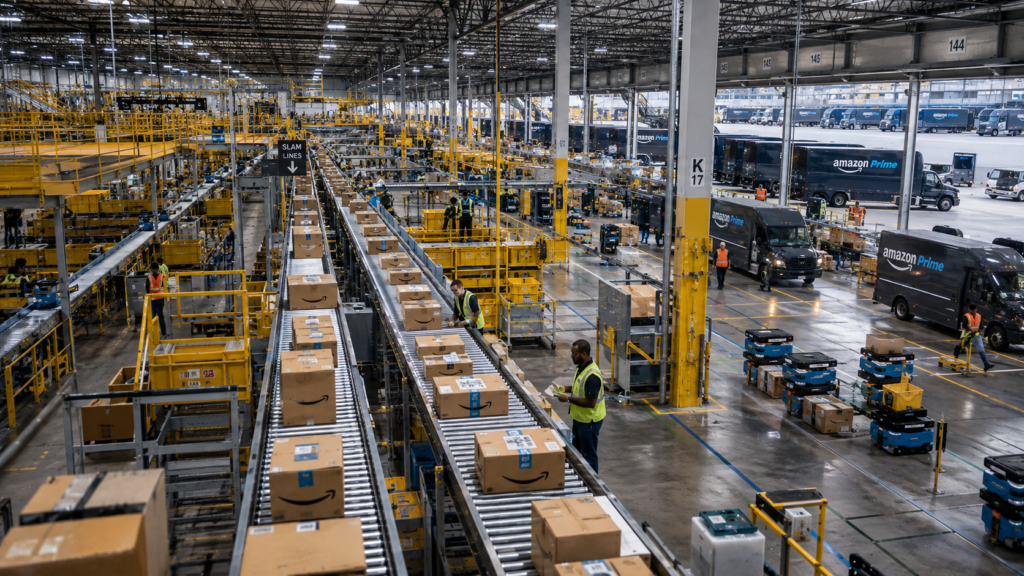
Automation and robotics inside Amazon’s fulfillment network continue reducing the cost of processing each order, a slow but steady margin tailwind for the retail segment.
Advertising Economics
Advertising also reinforces the rest of the business: sellers use it for marketplace visibility, and Prime engagement provides a large, habitual audience for sponsored placements, with margins that help offset lower-margin logistics operations.
How Segment Mix Affects Margins
As AWS and advertising grow faster than retail, their combined share of total operating income keeps rising, which is a central reason overall profitability has been improving faster than consolidated revenue growth alone would suggest.
Amazon Valuation in 2026
Assessing is Amazon a good investment in 2026 still requires weighing valuation against business quality rather than judging either alone.
Metrics That Matter
Third-party data providers show meaningfully different forward P/E estimates for AMZN — roughly 20.7x per GuruFocus (August 15, 2026) versus 28–30x per other trackers — reflecting different methodologies rather than a single settled figure. Free-cash-flow yield has been negative on at least one widely cited measure due to elevated capital spending. Investors should check current figures directly rather than relying on any single cited number, and weigh multiple sources rather than one, since methodology differences of this size can materially change whether a stock looks expensive or reasonably priced.
What Expectations Appear Priced In
A forward multiple in the 20s-to-30s range, alongside a stock that crossed a $3 trillion market capitalization for the first time in early August 2026 following strong Q2 results, suggests the market already expects continued AWS acceleration and successful AI monetization — not merely stable execution.
Bull/Base/Bear Scenario Logic
In a bull scenario, AWS and advertising continue compounding while margins expand as capex moderates. In a base scenario, growth continues but at a decelerating rate as the law of large numbers applies. In a bear scenario, AI capital spending fails to generate proportional returns while cloud competition intensifies, compressing margins and the valuation multiple simultaneously. This framework describes logic, not projected returns, and no specific percentage outcome should be inferred from it.
Key Risks for AMZN Investors
No answer to is Amazon a good investment in 2026 is complete without naming the risks plainly, since strong current results do not eliminate them.
AWS Growth and Competition
Azure and Google Cloud are both growing cloud revenue faster than AWS in percentage terms, which could pressure AWS’s relative position even as its absolute revenue leads the market.
AI Capex and Monetization
Roughly $220 billion in planned 2026 capital expenditure is a substantial bet. If AI-related revenue growth fails to keep pace, free cash flow could remain pressured well beyond the current period.
Consumer and Macro Sensitivity
Retail still represents the largest share of revenue, leaving results sensitive to consumer spending strength, inflation, and broader macroeconomic conditions.
Regulatory Risk
The FTC’s monopoly lawsuit against Amazon, joined by 17 state attorneys general, is currently scheduled for a bench trial in February 2027, with case filings available through SEC EDGAR alongside Amazon’s own risk-factor disclosures. The outcome remains genuinely uncertain and should be treated as an open risk, not a resolved matter.
Valuation Compression
Because Amazon’s stock already reflects substantial growth expectations, any deceleration in AWS or a disappointing AI-monetization update could trigger multiple compression independent of whether the underlying business remains fundamentally healthy.
Amazon vs. Other Mega-Cap Tech Investments
Comparing Amazon against other mega-cap cloud and AI investments helps frame the is Amazon a good investment in 2026 question in relative terms, though this is a comparison framework, not personalized advice.
| Company | Cloud Segment Growth (Latest Quarter, YoY) | Primary Advantage | Primary Risk |
|---|---|---|---|
| Amazon (AWS) | +37% | Largest cloud infrastructure scale, diversified ad/retail base | Heaviest capex relative to segment margin |
| Microsoft (Azure) | +43% | Enterprise software lock-in, OpenAI partnership | AI capex nearly doubled year-over-year |
| Alphabet (Google Cloud) | +82% | Fastest cloud growth, deep AI research base | Search-disruption and antitrust risk |
For a deeper look at Amazon specifically, see our full Amazon Stock Analysis, and for how Amazon’s AI infrastructure position compares with a leading chip supplier, see our Amazon vs Nvidia stock comparison.
Who Amazon May Suit — and Who It May Not
Is Amazon a good investment in 2026 for a given portfolio depends heavily on investor type. Long-horizon investors comfortable holding through volatility, who prioritize business quality and diversified growth engines over near-term catalysts, are generally better suited to Amazon’s profile. Investors seeking deep-value pricing, short-term trading catalysts, or income through dividends are likely to find better fits elsewhere, since Amazon pays no dividend and its valuation already assumes continued strong execution rather than a margin of safety.
Conclusion: Is Amazon a Good Investment in 2026?
Is Amazon a good investment in 2026 depends on weighing genuinely strong business quality — AWS acceleration, growing advertising margins, and improving retail efficiency — against a valuation that already prices in continued execution and a capital-spending plan that is pressuring near-term free cash flow. For long-horizon investors comfortable with that trade-off and its risks, including regulatory uncertainty and intensifying cloud competition, Amazon presents a reasonable, evidence-based case; for others, the price already reflects much of the optimism. This article is informational and does not constitute personalized financial advice.