These ideas aren’t just creative — they’re built to capture attention and spread fast.
Most ads in modern campaigns are ignored within seconds. But some campaigns explode overnight — not because of budget, but because of creativity. These guerrilla marketing ideas are designed to do exactly that.
Whether it’s a pop-up installation, an AR-based experience, or an interactive social challenge, guerrilla advertising has become one of the fastest ways for brands to achieve massive reach with minimal spend.
In this article you’ll learn why guerrilla campaigns dominate today, see seven standout idea types, explore real examples from the USA and UK, and conclude with how to integrate them into your digital strategy. You’ll also see how the core keyword guerrilla advertising appears naturally, helping reinforce context and SEO value.
Why Guerrilla Advertising Ideas Are Dominating 2025
Today, brands are competing for attention in an oversaturated digital world. Traditional ads (TV-spots, banner ads, standard social ads) increasingly struggle to break through. Guerrilla advertising — with its unconventional flair — cuts through that noise. Some of the key drivers behind its rise include:
- The dominance of TikTok, Instagram Reels, and YouTube Shorts for viral reach: short-form, shareable content rewards surprising, bold physical activations.
- The power of user-generated content (UGC): when someone films a pop-up, AR street art or live stunt and shares, the brand benefit multiplies.
- A lower cost-to-impact ratio compared to traditional media buys: guerrilla tactics often leverage existing public spaces, social momentum, or micro-influencers rather than big ad budgets.
- The blending of physical and digital: campaigns that combine physical and digital elements get higher engagement.
For instance, according to one guide on guerrilla growth marketing, such campaigns allow “unconventional, creative, and cost-effective strategies” in an era of ad fatigue. Also, the definition of guerrilla marketing clarifies it is about “unconventional, surprising methods” to create impactful, memorable campaigns.
Because of this, guerrilla marketing is no longer just trendy — it’s a smarter way to capture attention.
7 Guerrilla Marketing Ideas That Actually Go Viral
Here are seven guerrilla marketing ideas that are designed to go viral.
1. AR-Powered Street Art
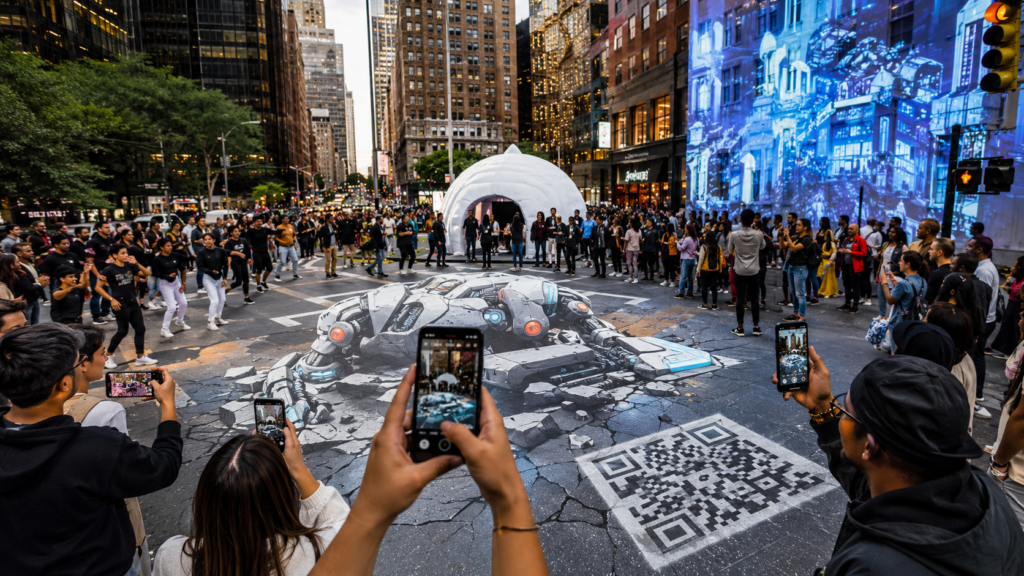
Imagine scanning graffiti on a city wall and watching it come alive through augmented reality. In today’s digital environment, brands will increasingly use AR layers over public art to turn static installations into interactive brand experiences. For example, in the UK or USA a mural might animate when viewed through a phone, offering hidden content, prizes or share-able moments.
It works because it combines physical space, digital surprise, and high shareability.
Why This Works:
- Turns passive viewers into active participants
- Creates a “wow” moment that people want to share
- Blends physical and digital experience seamlessly
But that’s just one approach. Another powerful strategy focuses on turning the audience into participants.
2. Social Media Treasure Hunts
Gamified city-wide hunts, often launched via social media clues, bring digital audiences into the physical world and back. Each clue doubles as branded content — driving UGC and community engagement. A brand in the USA might hide QR codes in public parks, tweeting clues; or in the UK might stage a surprise pop-up where participants unlock an experience by solving a riddle. These hunts can go viral when participants share their progress.
Why This Works:
- Encourages audience participation instead of passive viewing
- Builds excitement through gamification
- Naturally drives user-generated content
3. Pop-Up Emotional Triggers
Temporary booths or street activations designed to spark emotional reactions — from laughter to nostalgia — work incredibly well. Emotion drives virality, as shown in research on storytelling and campaigns. For example, a UK retail brand could pop up a “memory lane” installation where visitors share childhood photos, and the brand’s name is tied to that nostalgia. This works because it creates strong emotional engagement, not just visual appeal.
Why This Works:
- Emotional reactions increase sharing behavior
- Creates memorable brand associations
- Connects with audiences on a personal level
If you want something more visually impactful, this next idea takes it to another level.
4. Interactive Projection Mapping
Large-scale projection art on buildings transforms ordinary cityscapes into brand stories. Imagine a landmark in New York or London suddenly lighting up with visuals tied to a brand experience, with passers-by invited to interact via their phones. It’s visual, shareable, and engineered for viral traction — exactly part of the future of guerrilla advertising.
Why This Works:
- Highly visual content performs well on social media
- Transforms ordinary locations into shareable moments
- Captures attention instantly in crowded environments
5. Public Stunt Collaborations with Influencers
Merging influencer reach with real-world creativity leads to huge potential. For instance, a fitness brand in Los Angeles might stage a live public challenge filmed by micro-influencers, then encourage attendees to film their own attempts and share. This kind of activation captures both physical presence and online momentum — a signature component of viral guerrilla campaigns.
Why This Works:
- Combines real-world impact with online reach
- Leverages influencer trust and audience
- Encourages audience participation and replication
Not all campaigns rely on visuals — some win by connecting with deeper values.
6. Eco-Activism Advertising
Environmental causes resonate deeply with Gen Z and Millennials. Brands that use guerrilla tactics for sustainability awareness — such as biodegradable pop-ups, street art crafted from reclaimed materials, or surprise clean-up events with branded messaging — gain both PR coverage and social credibility. In the UK especially, where activism is culturally strong, this kind of campaign is very timely.
Why This Works:
- Aligns with values of modern audiences (especially Gen Z)
- Builds brand credibility and trust
- Generates organic PR and social discussion
7. Nostalgia-Based Pop Culture Revivals
Retro-inspired flash mobs or analog pop-up stores are making a comeback. They mix old-school charm (think vinyl records, vintage gaming, film culture) with digital virality. For example, a brand might recreate an 80s arcade in a public space in London, invite people to play and share their scores on TikTok. That blend of nostalgia + surprise + shareability is ideal for guerrilla campaigns that go viral.
Why This Works:
- Nostalgia triggers strong emotional engagement
- Familiar experiences increase shareability
- Blends past memories with modern platforms
Real-World Examples from USA & UK
Let’s ground those idea types with real examples:
USA
- Red Bull Stratos: While not new, the principle remains relevant in modern marketing — Red Bull’s famed sky-dive stunt across the stratosphere captured enormous global attention by being extreme and shareable.
- Coca‑Cola “Happiness Machine” (college campus vending machine giving out pizzas, balloons etc) is a classic guerrilla marketing example that emphasises surprise + share-ability.
- Tesla: One article lists Tesla in its top guerrilla growth marketing case studies, noting how the brand mostly avoids traditional ads and instead relies on community/evangelist tactics.
UK
- ZEISS Smartphone Wipes campaign: A UK case study — teams handing out branded pillows and direct-to-desk samples of wipes outside big offices (Sainsbury’s, Apple HQ, etc) as a targeted sampling/experiential activation.
- The UK & USA rise of guerrilla marketing: One article explores how guerrilla tactics surged in both countries thanks to the need for memorable engagement. Face2Face Marketing
- While not strictly UK, the UK market has seen plenty of street art, flash mob and experiential campaigns that align with guerrilla marketing definitions.
These ideas aren’t just theory — brands are already using them in real campaigns.
How to Make Guerrilla Advertising Campaigns Go Viral
Here’s how to make your own campaigns succeed — according to best practices and aligned with current campaigns trends:
- Build a Hook: The first 5 seconds — or even the first glance — should trigger curiosity or emotion. If people stop and stare, they’re more likely to record/share.
- Focus on Relatability: Viral content connects emotionally — laughter, nostalgia, wonder, surprise. If your brand activation triggers a “wow” or “aww” moment, it can spread.
- Design for Shareability: Every visual or tagline should look great in short-form video, social feed or story. Consider how the moment looks when captured on a mobile phone.
- Leverage Micro-Influencers or Ambassadors: These individuals can film and promote the activation authentically. Their audience trusts them more than typical ads.
- Measure Real Impact: Use engagement metrics (shares, mentions, hashtag usage, UGC volume) not just reach. A small engaged audience can beat a large unengaged one.
By aligning your strategy with these principles, your campaign has a much higher chance of going viral.
Examples of Viral Guerrilla Campaigns (2023-2025)
Here’s a brief snapshot of campaigns across timelines, showing the progression toward current marketing landscape -ready tactics:
| Year | Brand | Campaign | Result / Notes |
| 2023 | Burger King | “Moldy Whopper” (viral food-decay ad) | ~8 million organic shares (according to case listing). |
| 2024 | Spotify | “Wrapped Billboards” | ~1.2 billion impressions in some markets (reported). |
| 2025 | Tesla | “AI Street Roam” (concept) | To be fully announced, but reflective of next-gen guerrilla ideas. |
Each of these reflect the core notion of modern campaigns — bold, authentic, engineered for participation and share-ability.
Integrating Guerrilla Advertising with Digital Strategy
To really maximize the effect of guerrilla activations in today, brands must integrate physical creativity with digital amplification — creating hybrid experiences. Here’s how:
- Use QR codes or NFC tags embedded in the public activation that lead to AR experiences or behind-the-scenes content.
- Employ interactive polls or filters on Instagram, TikTok to extend the physical moment into the user’s phone.
- Run live event coverage or short-form video recaps via YouTube Shorts or Reels to extend reach beyond the location.
- Create a hashtag challenge so participants record themselves and share; user-generated content becomes part of the campaign’s spread.
- Ensure your website and internal blog capture the activation story, with links back to your digital channels — a way to measure and continue engagement beyond the one-time event.
By combining physical surprise with digital follow-through, the activation becomes more than a moment — it becomes a content engine. This is central to the future of guerrilla advertising and what makes the idea of unconventional advertising ideas so compelling.
How to Apply These Guerrilla Marketing Ideas
You don’t need a massive budget to execute these ideas — just the right approach.
- Start with a simple but surprising concept
- Focus on emotional impact, not just visuals
- Make your campaign easy to record and share
- Always connect the idea back to your brand message
Even small campaigns can go viral if they create the right reaction.
Conclusion
The next era of guerrilla advertising will belong to brands that dare to blur lines between reality, art, social engagement and technology. Today, the most effective guerrilla marketing ideas will be those that prioritize:
- Emotion over information
- Participation over passive observation
- Hybrid physical-digital experiences over purely online or offline ones
- Shareability, micro-influencer momentum and public spectacle over big-budget media buys
Whether you’re a startup or an enterprise, embracing this creative chaos can make your brand unforgettable — one viral moment at a time. If you focus on guerrilla advertising as a mindset (not just a tactic), you’ll be positioned to generate meaningful reach and engagement when the world sees yet another standard digital ad and swipes past.
Ultimately: don’t just advertise — surprise, delight, engage and let your audience become your amplifiers. By doing so, you tap into what makes modern marketing truly effective — creativity, surprise, and shareability.
Frequently Asked Questions (FAQs)
❓ What is guerrilla advertising?
Guerrilla advertising is a marketing strategy that uses unconventional, creative, and low-cost tactics to capture attention and create memorable brand experiences in public or unexpected spaces.
❓ What are some examples of guerrilla marketing ideas?
Examples include street art campaigns, flash mobs, pop-up experiences, interactive installations, viral social media challenges, and public stunts designed to surprise and engage audiences.
❓ Why do guerrilla marketing campaigns go viral?
Guerrilla campaigns go viral because they trigger strong emotional reactions such as surprise, curiosity, or excitement, making people more likely to record, share, and discuss them online.
❓ Is guerrilla marketing effective for small businesses?
Yes, guerrilla marketing is highly effective for small businesses because it focuses on creativity rather than budget, allowing brands to achieve significant visibility with limited resources.
❓ How can a guerrilla marketing campaign be successful?
A successful campaign needs a strong creative idea, emotional appeal, high shareability, and a clear connection to the brand message. It should also be easy for people to capture and share on social media.
❓ What is the difference between guerrilla marketing and traditional advertising?
Traditional advertising relies on paid media like TV, billboards, or digital ads, while guerrilla marketing uses unconventional and often low-cost methods to create high-impact engagement.
❓ Are guerrilla marketing campaigns risky?
They can be risky if not planned properly, especially in public spaces. Legal permissions, safety considerations, and brand reputation must be carefully managed.
❓ How do brands measure the success of guerrilla advertising?
Success is measured through engagement metrics such as social shares, user-generated content, brand mentions, website traffic, and overall audience interaction.