Investing in IPOs (Initial Public Offerings) is one of the hottest ways to enter financial markets, especially in 2025 when tech companies, biotech startups, and green energy firms are rushing to go public. For beginners, IPOs can look exciting — after all, who wouldn’t want to invest in the “next Google” before it becomes a household name?
But at the same time, many new investors are confused about the actual process. They ask: What is an IPO? How do I buy IPO shares? What risks should I know? This guide answers all those questions and shows you exactly how to invest in IPOs for beginners in 2025 step by step.
What Are IPOs and How Do They Work?
An Initial Public Offering (IPO) is when a private company decides to raise money by selling shares to the public for the very first time. Once the shares are listed, anyone can buy or sell them through stock exchanges.
- For companies → IPOs raise money for expansion, paying debt, or investing in new projects.
- For investors → IPOs offer early entry into businesses that could multiply in value over time.
Example: When Amazon went public in 1997, its IPO price was $18. Today, after stock splits and growth, it’s worth thousands per share. On the other hand, some IPOs flop — like WeWork’s failed IPO attempt in 2019, showing that not every IPO is a guaranteed success.
Key takeaway: IPOs can create wealth, but they’re also risky without proper research.
How to Invest in IPOs for Beginners in 2025 (Step-by-Step Guide)
Here’s a structured beginner-friendly process to follow:
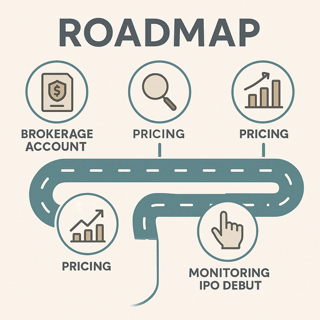
Step 1 – Set Up a Brokerage Account
The very first step is opening a brokerage account that gives access to IPOs. Not every broker allows retail investors into IPOs.
In 2025, platforms like Robinhood, Fidelity, Charles Schwab, TD Ameritrade, and SoFi offer IPO participation to everyday investors. Choose a broker with:
- Low or zero commission fees
- Easy IPO application tools
- Educational resources for beginners
Internal Link Suggestion: Check our guide on choosing the best online brokers
Step 2 – Research the Company Going Public
Every business that plans to go public is required to submit a prospectus (Form S-1) to the SEC. This is your homework material.
Beginners should focus on:
- Growth in revenue → Does the business regularly increase sales?
- Profit margins → Are they making or losing money?
- Competitors → Is it competing with giants like Google or does it have a niche?
- Future potential → Is the industry itself growing in 2025 (AI, green tech, biotech)?
External Resource: SEC EDGAR Database
Step 3 – Understand IPO Pricing and Allotment
IPO pricing works in two ways:
- Fixed Price IPOs → One fixed price for all investors.
- Book-Building IPOs: Investors place bids within a certain range of prices. Demand determines the final price.
Important for beginners: Retail investors often receive fewer shares because institutions (banks, hedge funds, large funds) get priority.
Example: When Snowflake went public in 2020, retail demand was so high that many individuals only got partial allotments.
Step 4 – Place Your IPO Bid
After research, you can log in to your brokerage account and place a bid. You’ll choose:
- Number of shares
- Price (within the range if book-building)
Note: Submitting a bid doesn’t guarantee allotment. If the IPO is oversubscribed, you might get fewer or even zero shares.
Step 5 – Monitor Market Debut and Performance
After listing, the stock may open:
- Higher than the IPO price (premium)
- Lower than the IPO price (discount)
- Flat (same price)
Beginners should:
- Avoid panic-buying if prices skyrocket on day one
- Track performance for weeks or months
- Focus on long-term growth, not daily volatility
Example: Google (2004) IPO started at $85 per share. Today, Alphabet trades thousands of dollars higher. But many IPOs — like Uber in 2019 — fell below their listing price shortly after debut.
Key Risks of Investing in IPOs
Before rushing in, beginners must understand the risks.
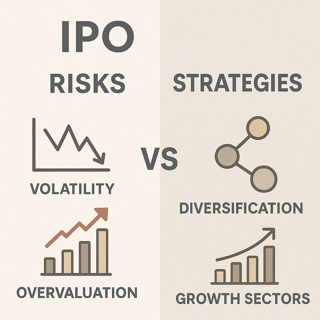
Risk 1 – Overvaluation
Companies sometimes price shares too high to cash in on hype. This can lead to a quick price drop after listing.
Risk 2 – Volatility
IPO stocks are quite erratic during the initial weeks. It is not unusual to see a 20–30% fluctuation in a single day.
Risk 3 – Limited Information
Unlike established firms, IPO companies may not have decades of financial history. Investors rely mostly on the prospectus, which is future oriented.
Risk 4 – Lock-in Periods
Insiders and early investors can’t sell shares immediately. When the lock-in expires (often 90–180 days), insider selling may push prices down.
Example: After Facebook’s IPO in 2012, its stock price dropped nearly 50% before recovering, partly due to insider selling.
Best IPO Investment Strategies for 2025
Here are some beginner-friendly strategies to reduce risk:
- Target high-growth industries → In 2025, AI, clean energy, robotics, and biotech are expected to dominate IPO listings.
- Follow institutional demand → If big banks are buying heavily, it often signals strong fundamentals.
- Diversify your IPO choices. Avoid investing all of your funds in a single IPO. dispersed among several industries.
- Think long-term: Some initial public offerings (IPOs) do poorly after listing but later do better. The key is patience.
External Resource: Bloomberg IPO Calendar
Tips for Beginners to Maximize Success
- Don’t ignore the fine print; always read the prospectus.
- Avoid investing just because of hype or celebrity endorsements.
- Start with small amounts to learn without losing too much.
- Track IPO schedules on Nasdaq, Bloomberg, and Yahoo Finance.
- Consider IPO-focused ETFs if you want exposure without single-stock risk.
Internal Link Suggestion: Explore our beginner’s guide to ETFs
Final Thoughts on How to Invest in IPOs for Beginners in 2025
If you’re wondering how to invest in IPOs for beginners in 2025, the answer is preparation. IPOs can deliver life-changing returns, but they also come with risks of volatility and overvaluation.
The smartest approach for beginners is to:
- Do proper research
- Invest carefully and start small
- Avoid hype-driven decisions
- Stay patient for long-term results
Remember: Amazon, Google, and Tesla were once IPOs too — and patient early investors were rewarded. But at the same time, companies like Pets.com crashed despite massive hype. Your success depends on strategy, not luck.
By following the structured steps in this guide, you’ll be ready to navigate the IPO market confidently in 2025 and beyond.