In today’s digital-first economy, online advertising for small businesses is no longer optional — it’s a necessity. Whether you’re running a local coffee shop, an e-commerce store, or a consultancy, the right advertising strategies can help you compete with larger brands and attract consistent customers.
This guide explores the best approaches, tools, and practices in online advertising for small businesses, with practical steps to help you maximize your budget and ROI.

Why Online Advertising for Small Businesses Matters
Small businesses often face limited budgets, making every marketing dollar count. Online advertising for small businesses allows you to:
- Reach highly targeted audiences.
- Compete with bigger brands using affordable campaigns.
- Track performance in real-time.
- Scale quickly once campaigns are profitable.
Unlike traditional advertising such as print or billboards, digital platforms allow precise targeting and measurable results. For example, you can target people in your neighborhood who are actively searching for your service, instead of paying for a newspaper ad seen by thousands who may never need your business.
With more consumers searching online before purchasing, online advertising for small businesses can directly impact visibility, credibility, and revenue growth. Even a budget of $10 a day can bring meaningful results if campaigns are planned strategically.
Case Study Example
Imagine a small landscaping company in a medium-sized town. By running Google Ads targeting “affordable lawn care near me” with just $15 a day, they consistently reached homeowners searching for seasonal lawn maintenance. Within two months, their ROI tripled compared to printing flyers. This shows how online ads directly tie investment to measurable results.
Key Online Advertising Channels for Small Businesses
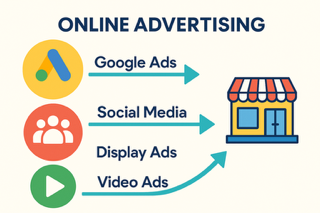
When planning online advertising for small businesses, choosing the right platform is crucial. Each channel has unique advantages depending on your goals and industry.
Google Ads
Google Ads is still one of the best tools for online ads for small businesses. It lets you target keywords that people are actually searching for.
For example, a local bakery can target searches like “best cupcakes near me” and instantly appear in front of ready-to-buy customers. The benefit is intent-based targeting: people are already looking for what you offer.
Success with Google Ads requires:
- Careful keyword research (long-tail keywords reduce cost).
- Competitive but smart bidding.
- Writing compelling ad copy that drives clicks.
- Regular optimization with A/B testing.
Pro Tip: Use “negative keywords” to avoid wasting budget on irrelevant searches. A pet grooming salon doesn’t need clicks from “dog adoption center.”
Social Media Ads
Social media platforms like Facebook, Instagram, TikTok, and LinkedIn also have strong targeting features.
Using social media for small businesses helps build brand awareness and connect with customers.
- A fitness trainer can run short Instagram video ads targeting people in their city interested in health and wellness.
- A B2B consultancy can use LinkedIn ads to connect with decision-makers in specific industries.
The creative element — images, videos, and storytelling — plays a huge role here. Unlike Google Ads, where intent is high, social media ads are more about generating interest and pulling customers into your sales funnel.
Organic + Paid Blend
Small businesses should combine organic content (regular posts, stories, reels) with paid ads. Paid ads help you reach more people, while organic content helps build trust and feels more real.
Display Advertising
Display ads appear as banners across Google’s Display Network or other ad networks. They help build brand visibility at scale.
Online advertising for small businesses through display ads is useful for:
- Retargeting past website visitors.
- Building brand recognition.
- Running affordable awareness campaigns.
For example, someone who visited your clothing store but didn’t buy can be shown a banner ad for the exact product they viewed — keeping your brand fresh in their mind.
Video Ads
Video advertising (e.g., YouTube, TikTok, Instagram Reels) is exploding. People consume billions of hours of video daily, and small businesses can leverage this trend affordably.
You don’t need TV-style productions. A simple, authentic video shot on a smartphone can connect better than a polished ad if it feels real and relatable.
Best Practices for SMB Video Ads
- Keep it short (15–30 seconds).
- Start with a hook in the first 3 seconds.
- Add captions (most people watch on mute).
- End with a clear CTA (“Book Now,” “Visit Us Today”).
Budgeting for Online Advertising for Small Businesses
Many entrepreneurs fear that online ads are too expensive. In reality, online advertising for small businesses can start with as little as $5–$10 per day.
Smart Budgeting Tips
- Set clear goals (leads, sales, website visits).
- Choose the right pricing model: CPC (pay per click) for conversions, CPM (pay per 1,000 impressions) for brand awareness.
- Continuously optimize campaigns using performance data.
Test, Measure, Scale
A practical approach is to test three small campaigns (e.g., $50 each), analyze results, and scale only the winner. For example:
- Campaign A: Google Search Ads → $50 → 10 leads.
- Campaign B: Instagram Ads → $50 → 2 leads.
- Campaign C: YouTube Ads → $50 → 7 leads.
Here, you’d reinvest more heavily in Campaign A since it provides the highest ROI.
Best Practices in Online Advertising for Small Businesses
Focus on Local Targeting
Geo-targeting allows ads to appear only in relevant neighborhoods or cities, saving money while boosting relevance. For a restaurant or salon, this ensures only people nearby see the ad.
Use Retargeting Ads
Retargeting re-engages people who already know your brand. For example, an online store can show ads of the exact product someone added to their cart but didn’t purchase. Retargeting often delivers 2–3x higher ROI than cold ads.
Track and Measure Everything
Using tools like Google Analytics, Facebook Pixel, or HubSpot helps you track conversions, revenue, and customer behavior. Without measurement, money will leak into ineffective campaigns.
Create Compelling Ad Copy
Your ad copy should:
- Highlight clear benefits (“Get Faster Delivery”).
- Include urgency (“Offer Ends Tonight”).
- Use emotional resonance (“Freshly Baked Cupcakes, Just Like Home”).
Strong CTAs like “Book Your Free Consultation Today” or “Order Now for 20% Off” drive immediate action.
Common Mistakes to Avoid in Online Advertising for Small Businesses
- Targeting audiences that are too broad.
- Ignoring mobile optimization (70%+ of ad views are mobile).
- Not testing multiple creatives (images/videos).
- Stopping campaigns too early before optimization.
The Patience Factor
Many small business owners pause ads too quickly. Most platforms require a “learning phase” (7–14 days) before results stabilize. Cutting early can waste money and data.
Future Trends in Online Advertising for Small Businesses (2025 & Beyond)
- AI-driven ad targeting: Hyper-personalized ads based on behavior.
- Voice search advertising: As Alexa/Google Assistant rise, optimizing for “voice intent” is essential.
- Short videos like those on TikTok, Instagram Reels, and YouTube Shorts are still very powerful.
- Privacy-first strategies: Cookieless tracking means small businesses must collect first-party data (emails, SMS lists).
Preparing for the Future
Start building your own data now (email subscribers, loyalty apps). The businesses that own their audience will win in a cookie less world.
Final Thoughts
Online advertising for small businesses is one of the fastest ways to increase visibility, reach customers, and grow revenue in 2025. By starting with small steps, choosing the right platforms, and keeping track of what works, even small businesses can stand up to bigger companies in their industry.
Remember: consistency and optimization are the keys to long-term success. Start small, test aggressively, and refine. Over time, every marketing dollar you spend will give you more value — and your business will grow in a steady, long-term way.